
Lind Dryland Research Station keeps Washington on the cutting edge of wheat
JOEL MARTIN | Hagadone News Network | UPDATED 1 year, 8 months AGO
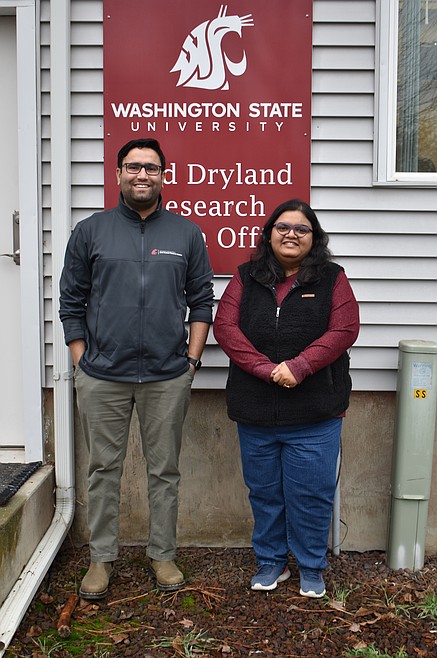
Washington State University Lind Dryland Research Station Director Surendra Singh, left, and soil scientist and Assistant Professor Shikha Singh stand outside the office at the research station. The Singhs came to the station about a year and a half ago.
FILE PHOTO
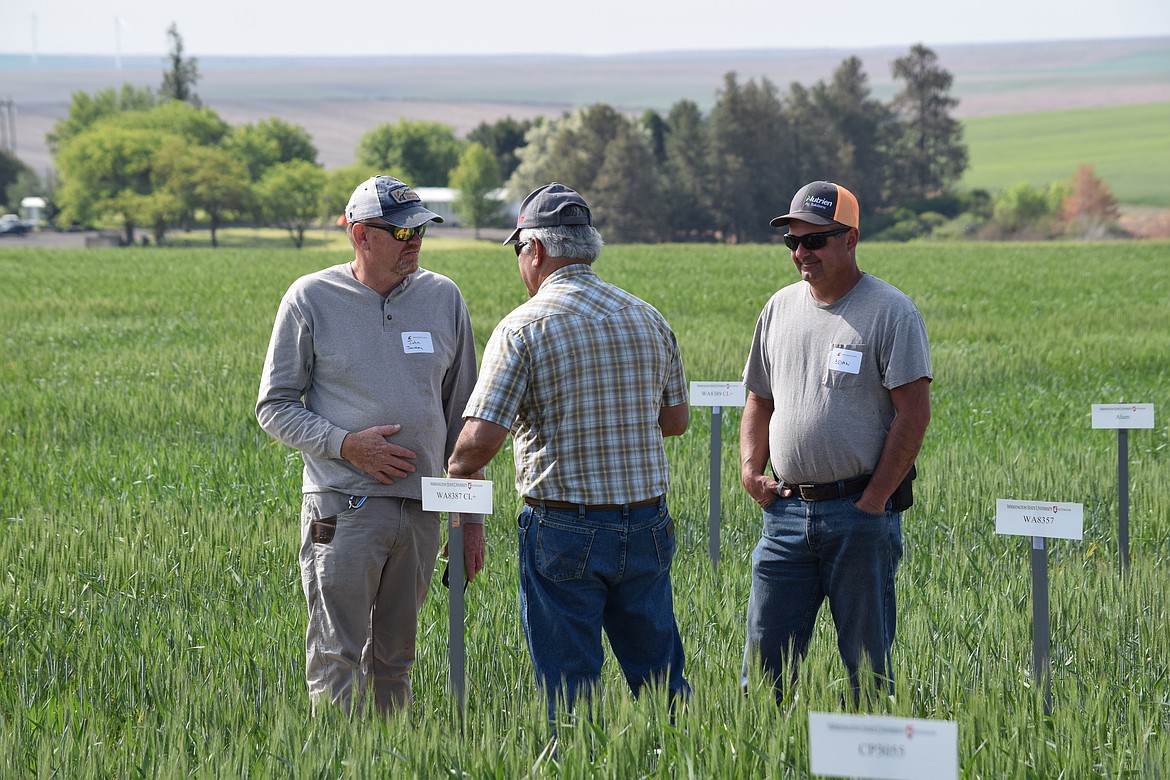
Three attendees discuss wheat farming as they stand in the middle of spring wheat test plots on Field Day at Washington State University’s Dryland Research Station in Lind. The event was attended by around 250 farmers and scientists from across Eastern Washington. (
FILE PHOTO
Joel Martin has been with the Columbia Basin Herald for more than 25 years in a variety of roles and is the most-tenured employee in the building. Martin is a married father of eight and enjoys spending time with his children and his wife, Christina. He is passionate about the paper’s mission of informing the people of the Columbia Basin because he knows it is important to record the history of the communities the publication serves. | February 9, 2025 1:00 AM
LIND — Some of the driest of dry land in the Northwest is to be found in the middle of Adams County, Washington, where a team of scientists is working hard to improve the region’s biggest crop, wheat.
“We have a lot of projects ongoing right now,” said Surendra Singh, director of the Washington State University’s Lind Dryland Research Station. “We have an organic wheat trial in Adams, Oregon … and then we recently got funding to do research on (Conservation Reserve Program) land. We are doing research on, when land goes into the CRP and out of CRP, what changes happen to the crop and plants and soil, what changes growers should expect, and how soil recovers, how long those benefits last, and how the function of microbial microbial function within soil changes and how it will affect the crop yield and grain quality.”
The Lind Dryland Research Station was established in 1915, according to WSU’s website, to promote better farming practices in an area that gets 8-12 inches of rain a year. The Lind Station receives an average of 9.6 inches annually, which makes it the driest of any state or federal dryland ag research facility in the U.S. The station has trials going at Davenport, Ritzville, Walla Walla and Washtucna, and also down into the Pendleton, Oregon area. Even in the relatively small expanse of eastern Washington, Singh said, there’s a lot of variance.
“We are in an area where there are lots of microclimates,” Singh said. “Even if you go 50 miles, things start to change in terms of rainfall, and from here to Ritzville (about 12 miles) we have a couple of inches’ difference.”
The Lind Station has ongoing trials in weed control, particularly Russian thistle, and a study of more than 400 lines of camelina, a relative of canola that’s shown promise in rotating with wheat, according to the WSU website. Singh’s predecessor, Bill Schillinger, began a study in the legacy of biosolids in 2011 that is ongoing as well.
“The last application of biosolids was done in 2016 and until last year, when we took the yield data and soil data, those effects are still present in the soil,” Singh said. “It’s not only when you apply; everything we do, especially in dryland, has long-term impact, whether the tillage or the biosolids, manure, or anything we do, it has a legacy effect. The last application was in 2016 and … we are still seeing those effects in the soil, in the weeds, in the yield biomass of the crop and everything.”
Much of this work will go on display for the public in June, when the Lind Dryland Research Station holds its annual Field Day. Attendees will spend the day learning about the work done at the station and its effects, with presentations from WSU experts.
“We have different spots in the field where each researcher has their trial, and we take everybody on different vehicles and bleachers and they showcase (their project), and then they move to the next spot. Then we have WSU department chairs and the Washington Association of Wheat Growers, the grain commission, and Senator Schoesler give their updates about their work.”
The Field Day also includes lunch and an ice cream social, something the staff particularly looks forward to.
“In the morning we have humungous donuts,” said Shikha Singh, a research assistant professor and soil scientist at the station. “And then we have lunch, barbecued chicken and pork.”
“We get ice cream sandwiches from the WSU Creamery,” Surendra Singh interjected.
“Yeah,” Shakti Singh said. “They have the best huckleberry ice cream.”
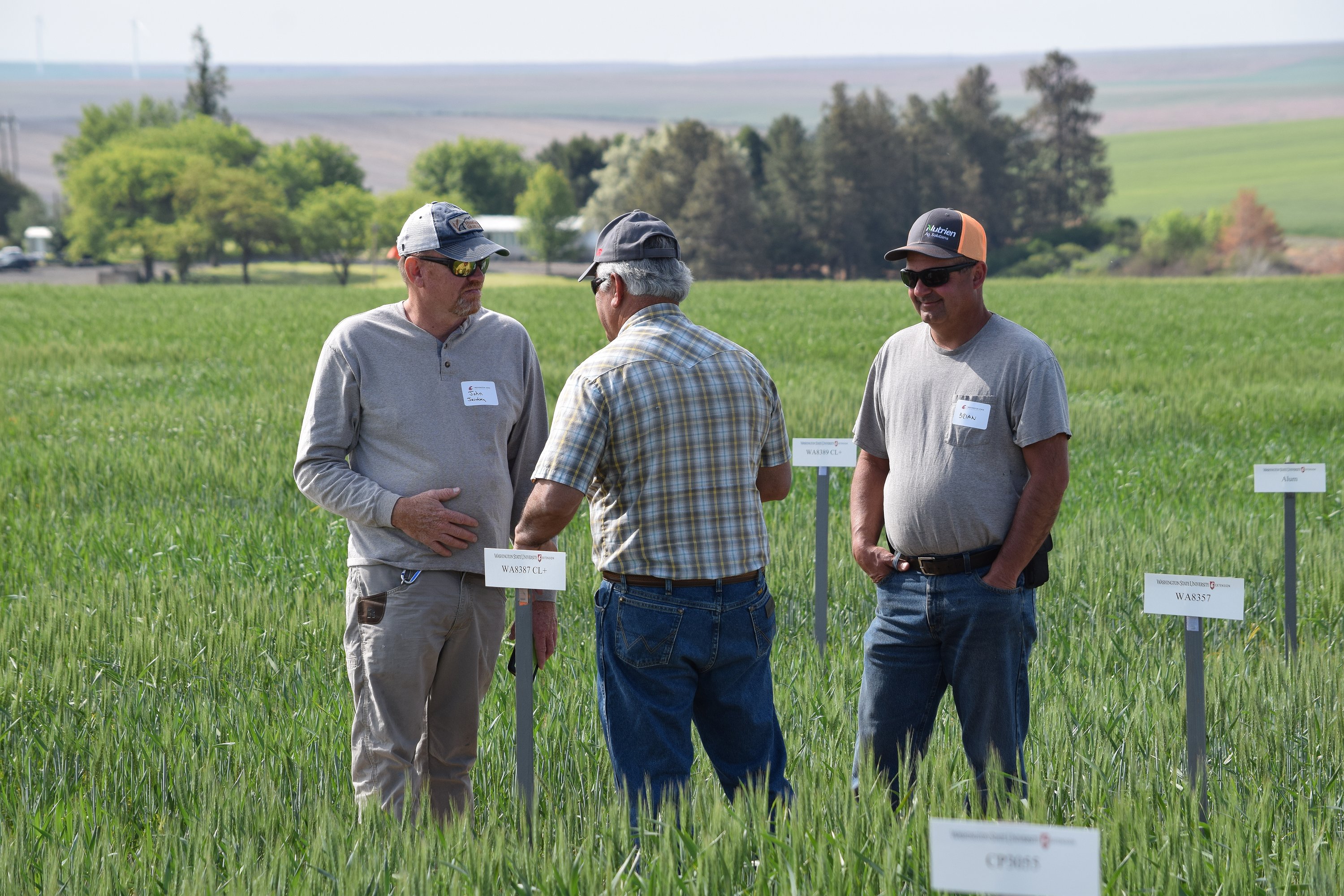 Three attendees discuss wheat farming as they stand in the middle of spring wheat test plots on Field Day at Washington State University’s Dryland Research Station in Lind. The event was attended by around 250 farmers and scientists from across Eastern Washington. (
FILE PHOTO
ARTICLES BY JOEL MARTIN

Endless battle
Noxious Weed Control Board works to keep invasive plants under control
MOSES LAKE — Some of the nastiest plants in Grant County were the topic of a class led by Jay Johnson, a consultant with the Grant County Noxious Weed Control Board, Tuesday. The Noxious Weed Control Board, as its name would suggest, is tasked with keeping weeds under control in Grant County. That’s not a small job; the board’s website lists 129 species of noxious weeds that are found around Grant County. A noxious weed is defined as an invasive, non-native plant that threatens agricultural crops, local ecosystems or fish and wildlife habitat, according to the Noxious Weed Control Board. Washington state law requires that these weeds be identified and their spread kept to a minimum, if not completely eradicated. “We’re one of those agencies a lot of people don’t really understand,” Johnson said. “We’re a county office and … our funding is tax-based assessment. When you get your tax bill and you look down at all the expenses that you pay for, there we are.”

BASIN EVENTS: Oct. 16-24
COLUMBIA BASIN — Whether you feel like shopping, crafting, learning or seeing a show, there’s something happening for you this week in the Basin. Oct. 16 ‘My Family (Mi Familia)’ screening Spanning three generations, “My Family (Mi Familia)” is a heartfelt drama that follows the Sánchez family as they build their lives in East Los Angeles. Through love, hardship, triumph, and sacrifice, the film explores the immigrant experience, the strength of family bonds, and the traditions that connect one generation to the next. Lowrider show and taco truck before the screening. Sponsored by Columbia Basin Allied Arts, EDUBS C/S and the Moses Lake Creative District. $12 per person. Doors open at 6 p.m., film begins at 7 p.m. at the Moses Lake Civic Center Auditorium, 401 S. Balsam St. Tickets and info: www.cba-arts.org.

Moses Lake author encourages women to look beyond church culture norms
MOSES LAKE — A Moses Lake author’s book, “A Christian Woman Striving to Live Her Faith in a Man-Controlled World,” takes aim at the role to which many churches relegate the female half of their congregations. “It’s to encourage women in the faith,” Linda Curran said. “A lot of churches say, ‘Teach Sunday school, do this, do that, but don’t (evangelize.)’" In her book, Curran recounts a time when she moved to a new community and joined a church there. She was surprised to learn that, as a new female member, she had been automatically assigned church cleaning duties. When she questioned it, she wrote, she was met with condescension and her objections were brushed aside. In other churches, she said, women who were capable of teaching were relegated to “women’s ministry.”