
MLSD levy decision tomorrow
NANCE BESTON | Hagadone News Network | UPDATED 1 year, 2 months AGO
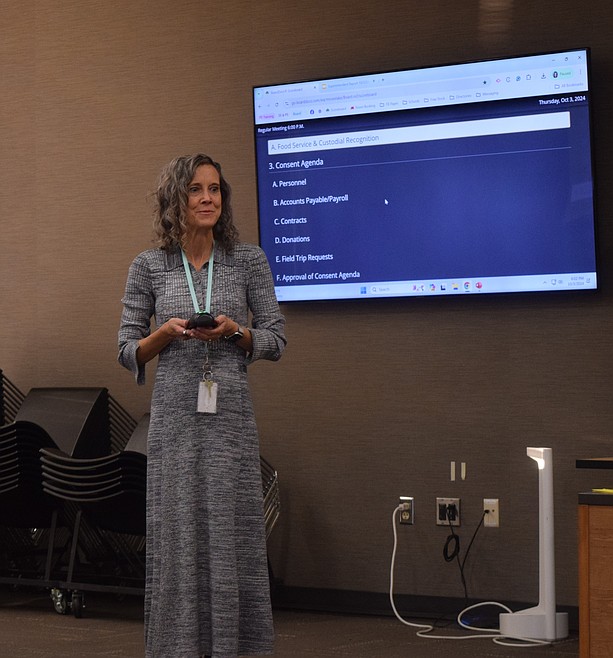
Moses Lake School District Superintendent Carol Lewis discusses the potential impacts on various parts of the district if the proposed Educational Programs and Operations Levy passes or fails Feb. 11.
FILE PHOTO
MOSES LAKE — Voters must cast their votes by 8 p.m. Tuesday evening in the Moses Lake School District’s educational programs and operations levy. Initial results will be available that night, though a final count will take a bit due to Washington’s mail-in voting system.
The levy proposal is for four years.
The results of the levy will have impacts in academic support; athletics and activities; safety, security and health; maintenance and custodial; materials and supplies; and technology. MLSD Superintendent Carol Lewis broke down the potential impacts depending on if the levy passes or fails.
“We've been talking a lot about the levy, and much of our community outreach has been currently about the levy and our finances, but people can expect us to continue to reach out after this,” Lewis said. “We're not doing this just because of the levy. We're doing this because we genuinely want a connection with our community. Right now, having the support of just a little over 50% of our community would pass the levy, but 50% is not a very good score, right? While the immediate goal may be to gain the support and trust of 50% of our community, the goal is to continue to work towards 100%.”
If the levy is passed, the district will not receive any money until early 2026, in the second half of the 2025-26 school year, Lewis said. The estimated tax rate for residents is $1.50 per $1,000 of assessed property value.
If approved, the district anticipates collecting approximately $11.2 million in 2026, with the total amount gradually increasing each subsequent year. Lewis said the estimates are based on property value, and it is assumed property value will go up during the levy’s term. By the fourth year of the levy, collections are projected at $14.2 million.
The district is also anticipating collecting around $23.5 million in Local Effort Assistance in the four-year period. LEA funds are state funds provided to “property-poor” districts with the condition the district passes a levy. A property poor district is one that has less than average taxable property values for its geographic size and population.
Lewis said she is hopeful that district residents recognize the value a good education can provide to the community.
“I just hope that everyone recognizes that schools are such an important part of our community, and Moses Lake has such a rich tradition of excellence with academics and athletics and activities that I want to be able to continue that,” she said.
Academics
Academic support includes paraeducators, teaching staff, elementary specialists including PE and music and secondary course offerings including advanced placement classes and specialized arts.
If the levy passes, there will be an increase in the number of educators, allowing for PE, music, advanced placement and specialized courses to be restored to what they were previous to the double levy failure last spring. There is an anticipated $2 million to be collected during the second half of 2025-26 and around $4.5 million to be collected during the 2026-27 school year for academic support.
“We are really looking at the largest portion of levy and LEA money going toward academics for our kids,” Lewis said. “I mean that's our primary purpose as a public school system and so that would be the largest way in which we would spend that money.”
Lewis said in a separate interview that increasing support for those programs will not necessarily mean staff who were laid off will be rehired. She said prior administrations had allowed overstaffing and she would only hire to meet clear requirements and goals.
However, if the levy fails, there will be reductions of at least $2 million in paraeducators and teachers. There will be at least $600,000 in reductions for specialized course offerings for kindergarten through fifth grades and there will be at least $600,000 in reductions of specialty courses for grades six through 12. Between the three, there will be at least $3.2 million in reductions for academic support.
Lewis said she doesn’t know how many staff the reduction would have to be. She said there will be an increase of over $100 per month for each employee’sbenefits from a legislative change – which will also impact how much the district is paying per employee.
“These are the at leasts,” she said. “We know, ultimately, it's going to be a further reduction just because of inflation,” Lewis said.
Extracurriculars
Athletics and activities were supported by Community Athletics and Activities, a nonprofit formed to support students, for the 2024-25 school year. CAA, according to Lewis, will be supporting the district for two years. Which means if the levy passes, CAA will be able to assist until levy funds come in. It is, however, just a stop-gap.
“The plan with CAA had always been that it was a two-year commitment on their part, and assuming that we pass a levy,” Lewis said. “They have really provided as much as they can to fully support things. Our coaches and advisors have done things for free this year to get us through. And so CAA is assuming that we'll have a levy going to the next school year, which we're only going to have half of a collection, and so that they would continue to support and to try to supplement as much as possible during that half year that we wouldn't be collecting, but that we would also have a contribution next year.”
Coaches have accepted salaries of $1 per season, due to various contracts and regulations, and advisors have worked free of charge to support various arts and academic clubs, Lewis said.
CAA’s leadership has said the work the group is doing is not sustainable long-term.
If the levy passes, full support of athletics and activities will happen by the 2026-27 school year. During the 2025-26 school year, partial support will be provided. There is an anticipated $1.4 million to be collected during the second half of 2025-26 and around $2.8 million to be collected during the 2026-27 school year for activities and athletics, provided the levy is approved.
If the levy fails, there will be reductions of around $400,000 which will reduce the ability to use facilities and less administrative support for athletics and activities.
“If the levy fails, we'll have to take a really hard look at a pay-to-play situation,” Lewis said. “But that is less than ideal for a whole lot of reasons, and it's really costly for families. Not only would the families who are paying for their own children, they also would have to supplement for low-income kids who want to participate. That's the foundation of public school – it's an equal footing for all kids and so it would be very costly for individuals to do that. We will look at that and consider that, but it is far less than ideal.”
Safety
During last spring’s budget cuts, the district was able to keep all its safety and security staff; however, Lewis said if the levy fails again, there will be cuts to either security guards or school resource officers, or both.
“There's a lot of factors that cause this to shift a little bit, but we know we could not keep both of those options available for our students and we really value both. We value our security guards as our employees. We significantly rely on our school resource officers for all kinds of things for positive outreach, as well as for help when we have crisis situations. I'm hopeful that we don't come to a place where we must eliminate those things, because keeping kids safe is our paramount duty while they're with us,” she said.
If the levy fails there will be at least a $400,000 cut in safety, security and health.
However, if the levy passes, there is an anticipated $500,000 to be collected during the second half of the 2025-26 school year and around $750,000 to be collected during the 2026-27 school year for safety, security and health.
“Well, I think it provides a point of connection for kids, because when you go into our schools and you see our security staff, our SRO staff interact with kids,” Lewis said. “I mean, they're smiling, they're joking, they're engaging and making connections. It also provides that layer of just getting security right for our kids to know that they have those people in our schools that are watching out for their safety as they go about their day.”
Maintenance
The levy will impact access to custodial care, maintenance of buildings and grounds and use of spaces such as gyms and fields.
If the levy passes, there will be increased custodial staff and maintenance. There is an anticipated $750,000 to be collected during the second half of 2025-26 and around $1.5 million to be collected during the 2026-27 school year for maintenance and custodial.
If the levy fails, however, there will be a decrease of around $500,000 and reduced usage of gyms and fields.
“There would be facility maintenance costs that we could cut or eliminate such as lawn watering and just the general ability to keep up our facilities in such a way that they're available to everyone, including the public, to use will diminish,” Lewis said. “I anticipate that we will have reduced or eliminated the ability to have outside groups come in and use our facilities if we end up in that situation.”
Supplies
Currently, MLSD is on a very tight budget for materials and supplies which include textbooks and other educational supplies. If the levy fails, there will be further reductions of at least $500,000.
“I haven't requested any materials and supplies for myself,” Lewis said. “If I need some file folders, I just take myself to Walmart to buy them. I know that everybody's doing that, so I'm not unique in that way. We want our staff to be able to have the things that they need to do their jobs, and our kids the stuff that they need to be able to learn.”
If the levy passes, there is an anticipated $1 million to be collected during the second half of 2025-26 and around $1.5 million to be collected during the 2026-27 school year for materials and supplies.
Tech
Lewis said MLSD was unable to purchase new Chromebooks at the end of the 2023-24 school year because of the spending freeze. That resulted in students not being able to each have their own computer this past school year.
If the levy were to fail, there would be further reductions to technology of at least $100,000.
“Probably further reductions just in our ability to replace equipment,” Lewis said. “We have things that teachers use in their classrooms, and we have Chromebooks that kids get to use in their classrooms. As we know technology, it doesn't have a long life, and so we need to be able to replace that to maintain the current levels. I think that those reductions would just come from our inability to replace things as they break.”
However, if the levy does pass, there is an anticipated $250,000 to be collected during the second half of 2025-26 and around $750,000 to be collected during the 2026-27 school year for technology.
Make sure it counts
For those voting in the levy election, remember to get your ballot postmarked at the Post Office on or before Feb. 11 to ensure your vote is counted. Alternately, you can drop your ballot off at the Moses Lake Civic Center ballot drop box location by 8 p.m. Tuesday.
ARTICLES BY NANCE BESTON
1 arrested after Highway 17 stop; detectives recover fentanyl, firearms
MOSES LAKE — The Moses Lake Street Crimes Unit conducted a traffic stop on Highway 17 near Randolph Road and executed a search warrant Friday morning as part of an ongoing narcotics investigation.
4th-year drought declaration in WA, subtle effects in the Columbia Basin
EPHRATA — Washington’s fourth straight year of drought is expected to hit some regions hard, but in Grant and Adams counties, the impacts will look different – quieter, less visible and centered underground. Statewide, the Department of Ecology issued an emergency drought declaration after a warm winter left Washington with about half its usual snowpack, raising concerns about low summer streamflows, stressed fish populations and heightened wildfire risk. Seven of the past 10 years have included drought somewhere in the state. “If you look at our mountains, the challenge we are facing is clear,” Gov. Bob Ferguson said during a press conference Wednesday. “We’re taking emergency action to protect fish, farmers and communities across Washington.”
Sleep Diagnostic Center to close after doctor’s sentencing
MOSES LAKE — The Central Washington Sleep Diagnostic Center announced it will be closing its doors effective April 30. This includes locations in Moses Lake, Spokane Valley, Brewster and Wenatchee. The announcement follows the March 25 guilty plea from Dr. Eric Edward Haeger, 57, in United States District Court to adulterating and misbranding medical devices with the intent to defraud or mislead, according to a statement from the U.S. Attorney’s Office. “The adulterations by Dr Haeger show a dangerous disregard for the safety of his patients,” Washington Attorney General Nick Brown said in a statement. “This is a win for patient safety, for protecting public dollars from fraud, and for ensuring citizens of Washington get necessary healthcare. This case exemplifies the great work our team is doing in collaboration with our federal partners to fight fraud and protect Washingtonians.”