
Editor takes purposeful polar plunge
KRISTI NIEMEYER | Hagadone News Network | UPDATED 1 year, 1 month AGO
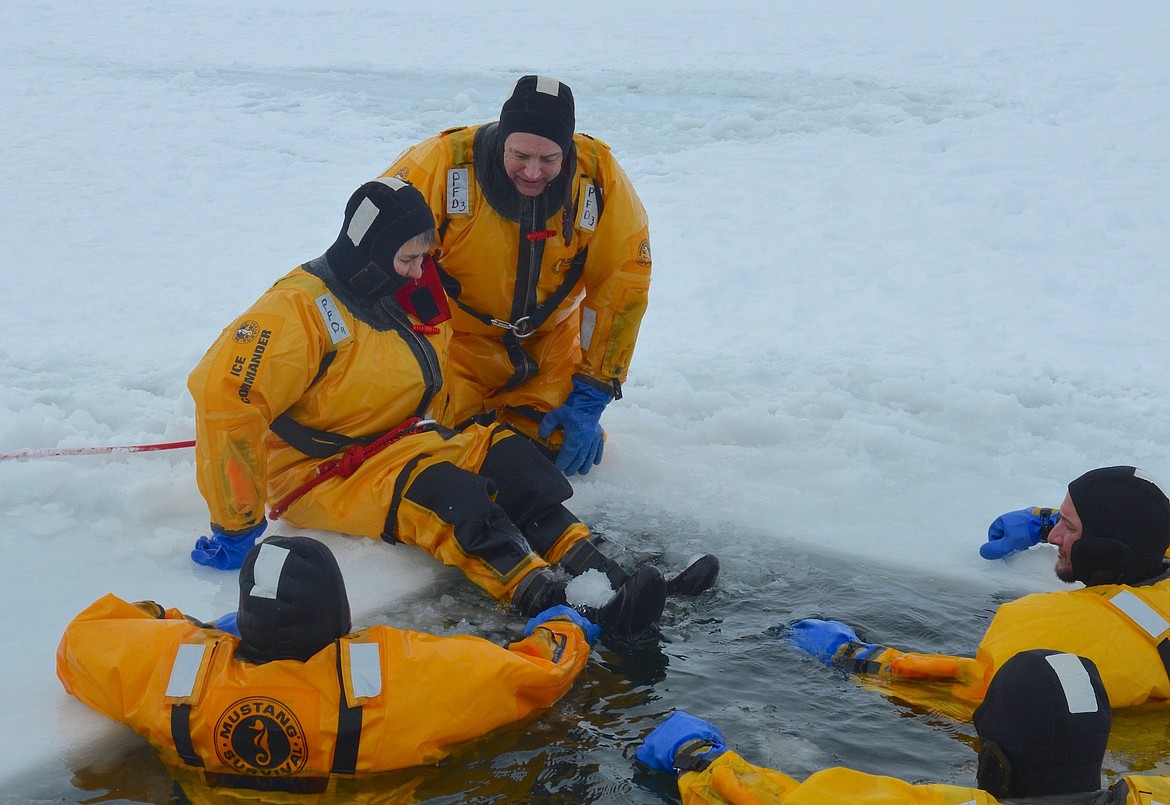
Polson firefighter Stacy Violett helps the Leader editor take an icy dunk in Flathead Lake Saturday during a training exercise in ice rescue. (Adam Reed photo)
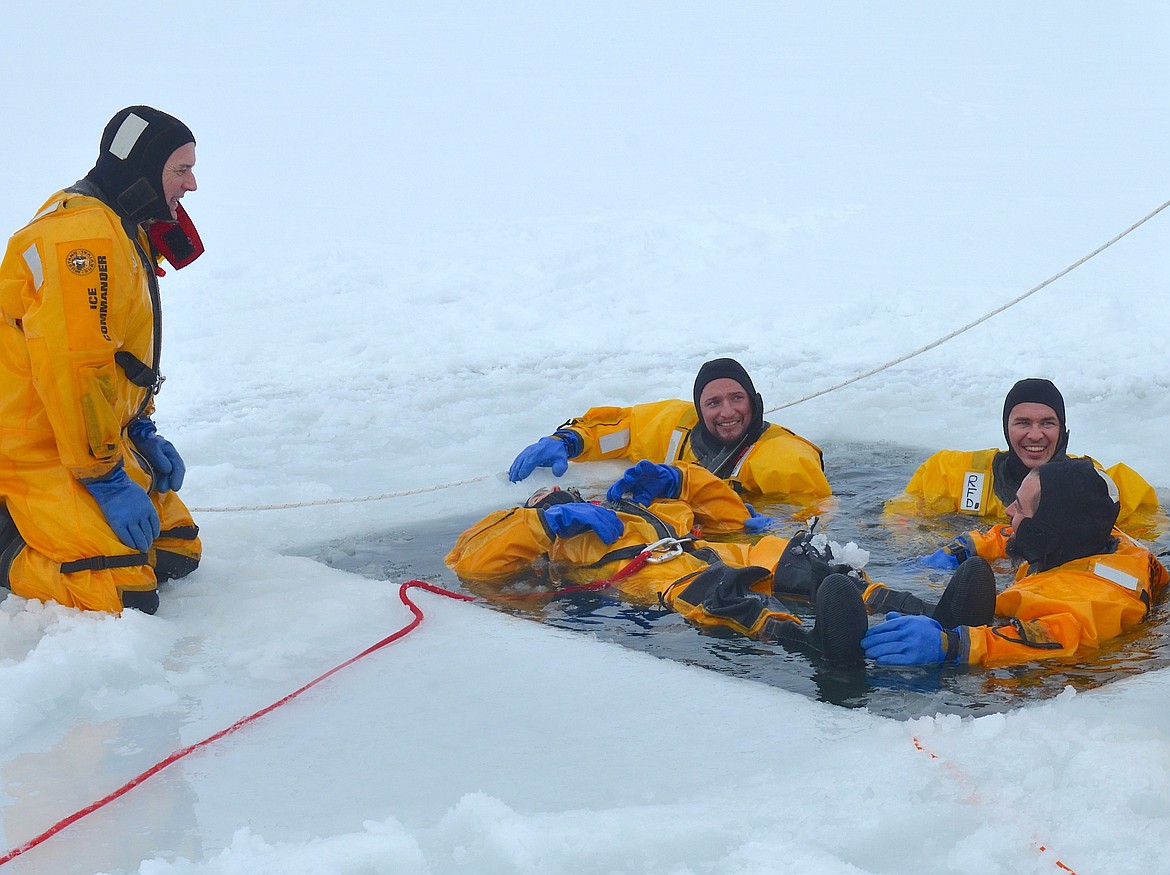
The editor, blissfully bobbing and safely harnessed during Saturday's ice-rescue training on Flathead Lake. (Adam Reed photo)
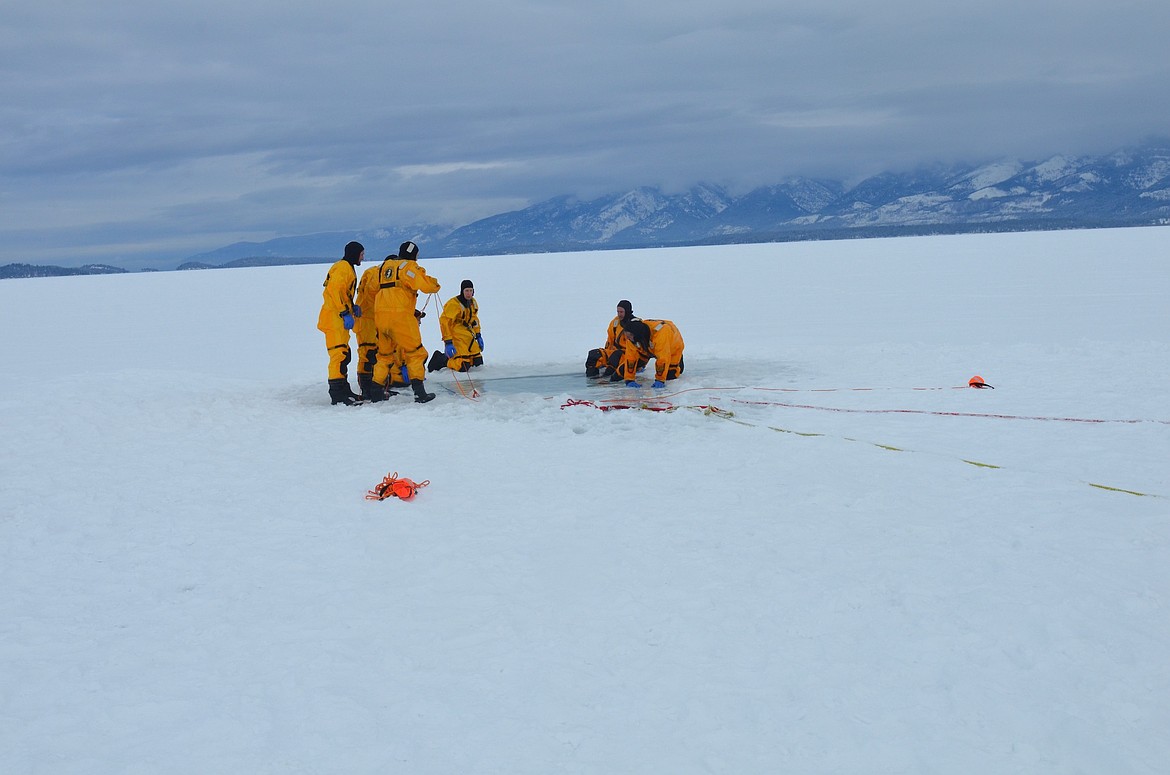
A group of volunteers huddles around a puddle of open water during an ice-rescue training Saturday on Flathead Lake.
Kristi Niemeyer is editor of the Lake County Leader. She learned her newspaper licks at the Mission Valley News and honed them at the helm of the Ronan Pioneer and, eventually, as co-editor of the Leader until 1993. She later launched and published Lively Times, a statewide arts and entertainment monthly (she still publishes the digital version), and produced and edited State of the Arts for the Montana Arts Council and Heart to Heart for St. Luke Community Healthcare. Reach her at [email protected] or 406-883-4343. | February 19, 2025 11:00 PM
I intentionally fell in Flathead Lake Saturday. Fortunately, I was in good company: four men, attired like me in bright yellow waterproof suits, were all trained to rescue.
As I bobbed blissfully on my back, barely feeling the frigid water sloshing around me, they recalled last year’s ice-rescue training, conducted on unstable ice, with blowing snow and 40 mph wind.
“Icicles were growing off our beards,” said one of my companions. In comparison, he added, “This is a fantastic day for training.”
Earl Davis seemed gleeful about the outing. “I’m all about sketchy water,” he said. “I love swimming in February.”
The annual training, which involved about 30 volunteers from Lake County Search and Rescue and Polson City, Polson Rural and Chief Cliff fire departments, was conducted at the boat launch near KwaTaqNuk Resort. They had also attended a two-hour class last Tuesday before venturing onto the ice.
Saturday, they measured the ice thickness with a drill before using chainsaws to carve out rectangular pools. The resulting ice blocks were tugged off to the side, to be slid back over the holes after the exercise to make sure no one accidently tumbled in, necessitating a real rescue.
Lieutenant Adam Reed with Polson City Fire was my guide. He estimated the ice at six to seven inches thick.
“Most people don’t fall through nice ice like this,” he said. “They fall through bad ice.”
Safety lines were strewn across the surface and tied off on shore or to augers screwed into the ice. Victims – like myself – and rescuers pulled on one-size-fits-all waterproof suits, replete with booties, gloves and a hood. Before sliding into the ice hole, air is squeezed out of the suit (like letting air out of a raft or innertube) by loosening a valve. Otherwise, I would have bobbed around like a giant yellow balloon.
As it was, I felt like a penguin waddling across the ice, and a beached whale when I was tugged out and slid across the slick surface.
Had I been in real trouble, clinging to the edge of a crumbling piece of ice, a rescuer would have come up behind me, circled my waist with a safety line and helped stabilize and hoist me as a crew pulled me to safety.
According to Reed, the best thing to do if you fall through ice is to try to get your arms on the ice shelf or edge, reduce movement to avoid breaking more ice, and try to roll out if possible.
If a friend or family member falls in, call for help immediately. Then, try to keep them (and yourself) calm.
“Try not to become a second victim by running out to try and save them,” he advised. “It’s going to be cold, but an average person dressed for cold weather will have 30 minutes or more before hypothermia starts.”
An ice depth of a least four inches is considered safe for most people, and depth can be measured with an auger or drill. Clear ice is typically stronger than cloudy ice, which often contains air bubbles.
Lake County Search and Rescue put their training to work Sunday night when they were summoned to the Flathead River near Irvine Flats, where a fisherman had reportedly fallen into the cold water. The team was “prepared to navigate terrain and the cold waters” with side by sides, sleds, and cold-water rescue suits, according to a Facebook post.
Fortunately, “The fisherman was located in a timely manner and hiked out to meet the sleds that were waiting for him.”
According to the post, “We were thankful for the necessary ice-rescue training just the day before.” The Lake County Sheriff’s Office and Polson Rural Fire Department also contributed to the rescue efforts.
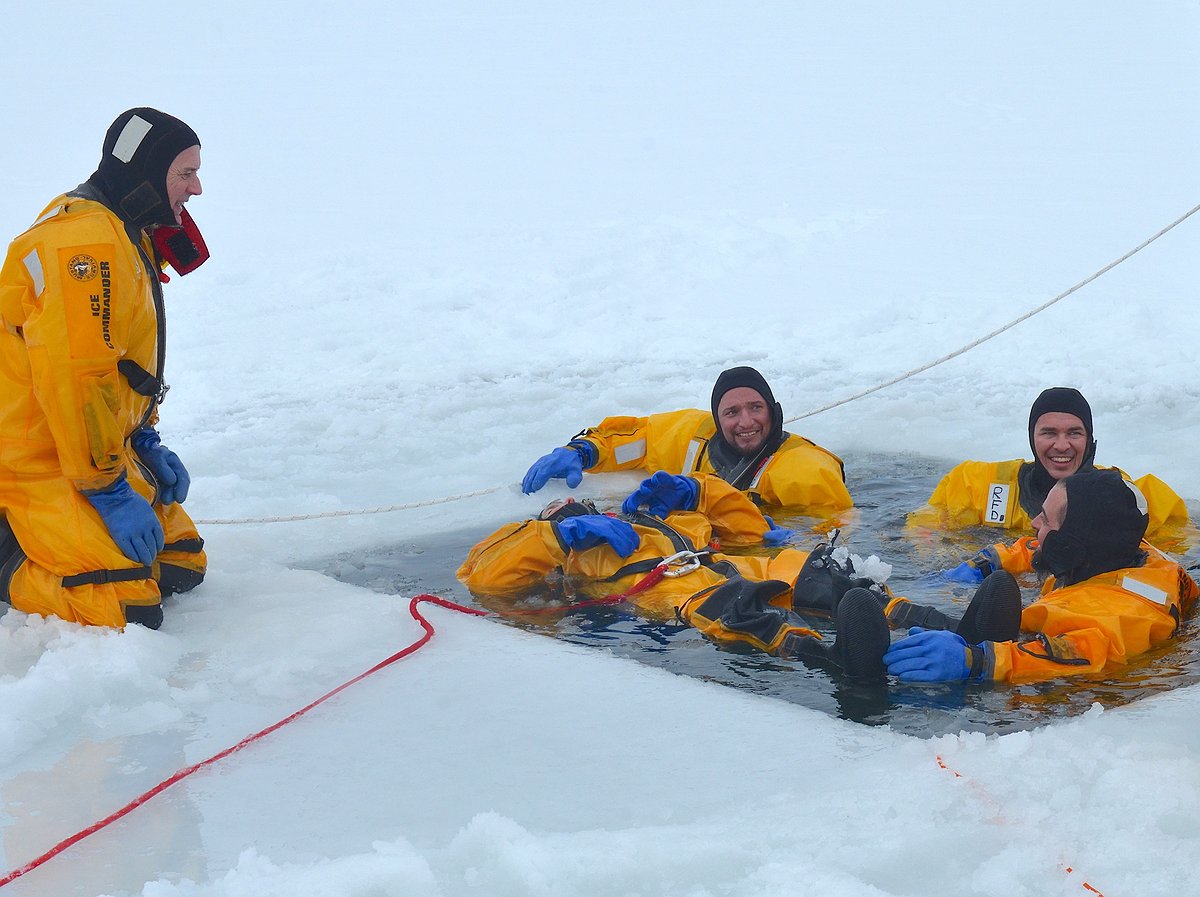 The editor, blissfully bobbing and safely harnessed during Saturday's ice-rescue training on Flathead Lake. (Adam Reed photo)
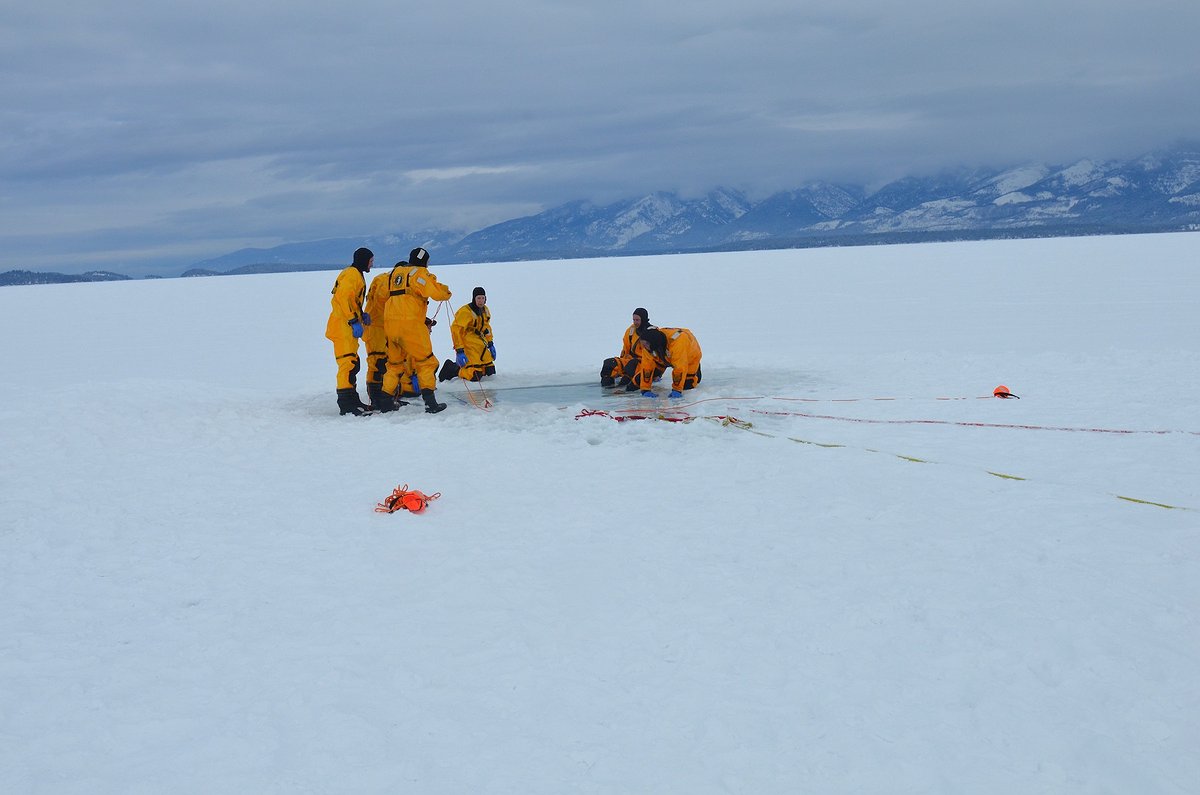 A group of volunteers huddles around a puddle of open water during an ice-rescue training Saturday on Flathead Lake.
ARTICLES BY KRISTI NIEMEYER

Scholarship helps mother of two reach for college degree
For Taurie Matt, higher education offers a path to building a better life for her family. A recent scholarship from the Gianforte Family Foundation is helping her stay in school without drawing down her family’s resources.

Jig Jam: Cherry Valley students learn about music from The McDades
The McDades, a Canadian quintet that claimed the 2007 JUNO Award for Best Roots/Traditional Album, weren’t at all daunted by their audience of Cherry Valley students last Thursday.

Former Polson man files complaint against library alleging ADA violation
Former Polson resident Michael Ross has lodged a civil complaint in U.S. District Court in Missoula, accusing the North Lake County Library and its director, Abbi Dooley, of violating the Americans with Disabilities Act.