
FIRST RESPONDER FOCUS: Josh Bronn
JOEL MARTIN | Hagadone News Network | UPDATED 1 year, 7 months AGO
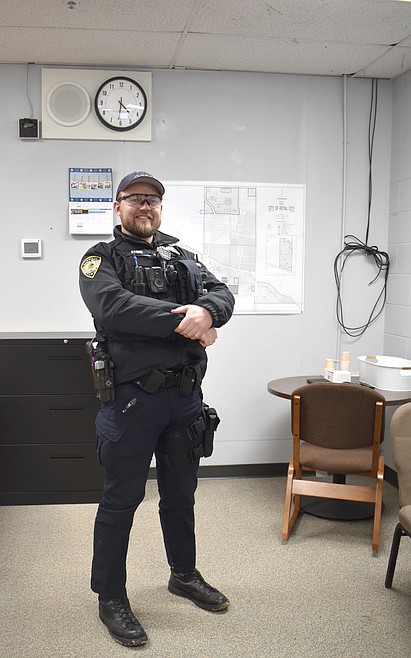
Royal City Police Officer Josh Bronn stands in his office at Royal High School. As the district’s school resource officer, Bronn maintains safety, but more importantly he enables students to have a relationship with the police that’s based on trust rather than fear.
JOEL MARTIN/COLUMBIA BASIN HERALD
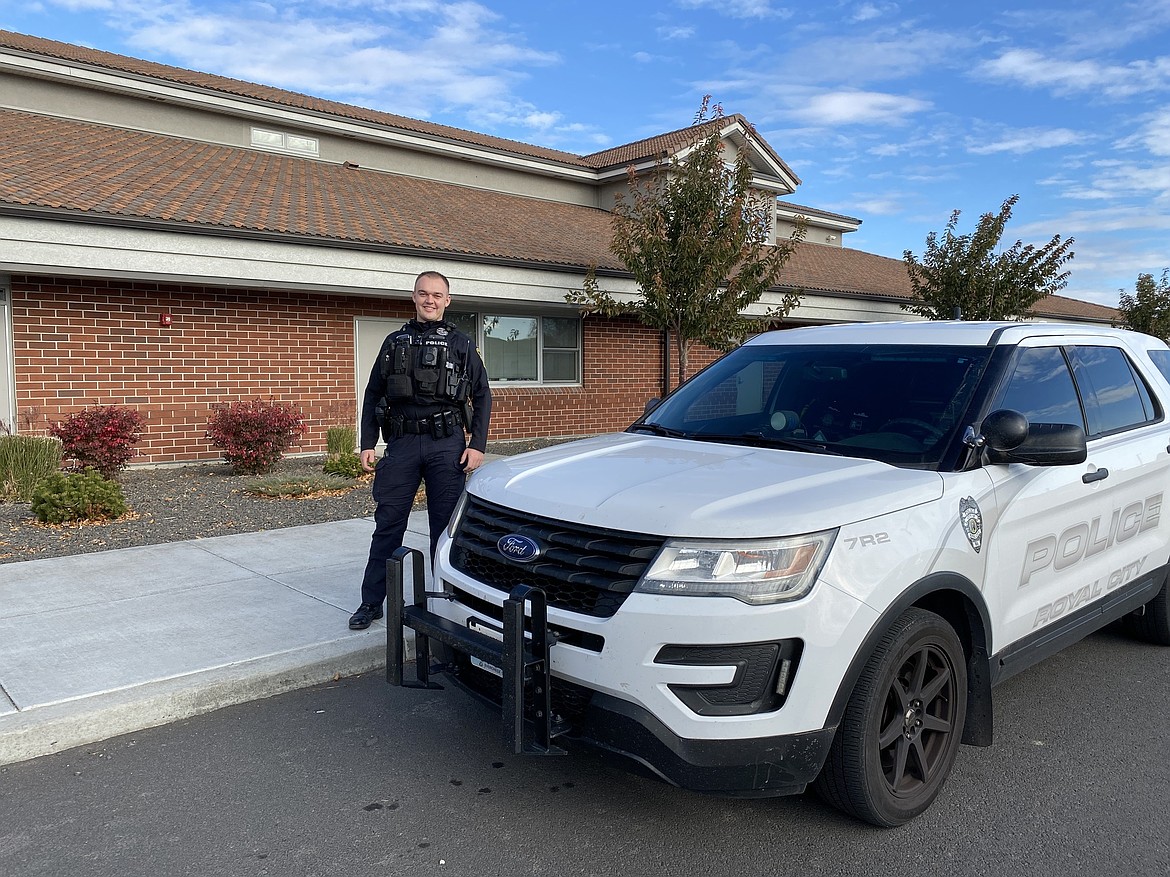
Royal School District School Resource Officer Josh Bronn stops for a photo in 2022 when he first started patrolling the district. Since then, Bronn has helped students avoid gang involvement and helped student redirect behaviors toward success.
Joel Martin has been with the Columbia Basin Herald for more than 25 years in a variety of roles and is the most-tenured employee in the building. Martin is a married father of eight and enjoys spending time with his children and his wife, Christina. He is passionate about the paper’s mission of informing the people of the Columbia Basin because he knows it is important to record the history of the communities the publication serves. | February 25, 2025 1:15 AM
ROYAL CITY — One thing most people can agree on is that schools shouldn’t be dangerous places, especially in a small town. But they can be, especially with undesirable elements in schools.
“In typical school fights, you’d have a couple of kids fighting, and then everyone’s gathered around and they’re cheering them on,” said Royal City Police Officer Josh Bronn, who’s the school resource officer for the Royal School District. “But in these fights, the kids were wearing their gang attire. They dropped their backpacks and everyone else would leave. They scattered like ‘We don’t want to be involved in this.’”
That was in the fall of 2024, Bronn said. A lot of the students causing problems were expelled, and some of those have returned and are among the district’s success stories. About 80% of crime in Royal City is gang-related, he said, much more than in many other areas of the state.
“I was really impressed with the school district,” Bronn said “They were backed up by the school board and by the community, who really took the gang fighting, the fistfights and things like that, seriously. And they did their discipline and removed those kids from the school.”
Royal City itself is pretty small, with a population under 2,000 and a four-person police force.
The Royal School District, however, covers nearly 400 square miles from Beverly almost to Othello. There are roughly 1,700 full-time students, according to the district’s website. The gang problems don’t originate in Royal City, but the town’s location in relation to Othello and the Tri-Cities makes it vulnerable, according to local officials.
“This is what made Royal City big,” said RHS Assistant Principal Randy Miller, holding up a cell phone. “Royal City is not a little dot on the map. All the world’s problems come in this cell phone and all these kids have one. It totally opens up the isolation.”
“I dealt with a 15-year-old kid who told me his whole story because he was afraid and he wanted to get out of his gang, the South Side Locos, which is a Sureño gang,” Bronn said. “He was living here in Royal City, and he was going to be picked up by a Sureño gang leader to go do a shooting in Tri-Cities. So, the region is very connected.”
Bronn was able to help the boy get out, he said. Afterward, the student and his family moved to another part of the country for safety.
At 30, Bronn doesn’t look a whole lot older than the students he sees every day. He grew up on Orcas Island, a green, rainy spot in the middle of Puget Sound that’s about as unlike Royal City as it’s possible to be in Washington. He started his police career with San Juan County, but that didn’t work out, he said, so he took his police academy certification and went online in search of a small community that needed an officer. He’d never been to Royal City before when he applied, he said.
“The first time I went on a ride along with the chief was the middle of summer and it was like 111 degrees. I was like ‘Where am I? It’s like Mars.’ But I love it here. I’ve put down roots, bought a house. I love the community here.”
He had learned a little Spanish in school, he said, but most of what he knows he learned on the job, in a school district where 44% of the students are learning English and many of their parents don’t speak any.
A school resource officer in Washington is kind of a hybrid. They’re full-fledged police officers, able to make arrests and investigate crimes, but they’re separate from the school’s internal disciplinary process. The position was defined under a Washington law passed in 2019 to improve school safety and requires SROs to have special training in working with youth and community policing. When school’s not in session, Bronn switches off with another officer on the night shift, he said.
“My first year, I arrested probably a dozen (students) for distributing cannabis, for assaults,” Bronn said. “There was a hit-and-run incident in the parking lot, but this year it's been a lot more mellow.”
“There have been numerous times where kids have sat in (my office) where they've had (a hostile attitude toward police), but they go through the process with me, and at the end they look at Josh and go, ‘I'm sure glad you're here,’” Miller said. “They don't say it, but I can see it.”
Bronn has a small, tucked-away office at Royal High School, but he spends a lot of his time just being among students, stopping problems before they develop. Having a police officer visible in the schools when nobody is getting into trouble goes a long way, Miller said.
“Every school district in this day and age needs a resource officer,” he said. “There's a lot of stuff that filters into the high schools nowadays that hasn't happened in the past, and (it helps) having a friendly face that the kids know. Ninety percent of it is just presence.”
“It's a lot of proactive influence, like building relationships with the kids,” said RHS Principal Courtney McCoy. “They go to him when they need assistance and help, and if we need any kind of assistance for things that are more major, if there's a rumor or something we have a severe safety concern about, we investigate and Officer Bronn’s there immediately. He's very relational with both staff and students.”
Even after only a few years, Bronn said, he’s beginning to see his efforts pay off with students who have graduated and stayed in the area.
“We've had some success stories, for sure,” he said. “There's kids who were hanging around gangs when they were in middle school, and then they've since turned a corner and have found better friends, and that’s good.”
 Royal School District School Resource Officer Josh Bronn stops for a photo in 2022 when he first started patrolling the district. Since then, Bronn has helped students avoid gang involvement and helped student redirect behaviors toward success.
ARTICLES BY JOEL MARTIN

Endless battle
Noxious Weed Control Board works to keep invasive plants under control
MOSES LAKE — Some of the nastiest plants in Grant County were the topic of a class led by Jay Johnson, a consultant with the Grant County Noxious Weed Control Board, Tuesday. The Noxious Weed Control Board, as its name would suggest, is tasked with keeping weeds under control in Grant County. That’s not a small job; the board’s website lists 129 species of noxious weeds that are found around Grant County. A noxious weed is defined as an invasive, non-native plant that threatens agricultural crops, local ecosystems or fish and wildlife habitat, according to the Noxious Weed Control Board. Washington state law requires that these weeds be identified and their spread kept to a minimum, if not completely eradicated. “We’re one of those agencies a lot of people don’t really understand,” Johnson said. “We’re a county office and … our funding is tax-based assessment. When you get your tax bill and you look down at all the expenses that you pay for, there we are.”

BASIN EVENTS: Oct. 16-24
COLUMBIA BASIN — Whether you feel like shopping, crafting, learning or seeing a show, there’s something happening for you this week in the Basin. Oct. 16 ‘My Family (Mi Familia)’ screening Spanning three generations, “My Family (Mi Familia)” is a heartfelt drama that follows the Sánchez family as they build their lives in East Los Angeles. Through love, hardship, triumph, and sacrifice, the film explores the immigrant experience, the strength of family bonds, and the traditions that connect one generation to the next. Lowrider show and taco truck before the screening. Sponsored by Columbia Basin Allied Arts, EDUBS C/S and the Moses Lake Creative District. $12 per person. Doors open at 6 p.m., film begins at 7 p.m. at the Moses Lake Civic Center Auditorium, 401 S. Balsam St. Tickets and info: www.cba-arts.org.

Moses Lake author encourages women to look beyond church culture norms
MOSES LAKE — A Moses Lake author’s book, “A Christian Woman Striving to Live Her Faith in a Man-Controlled World,” takes aim at the role to which many churches relegate the female half of their congregations. “It’s to encourage women in the faith,” Linda Curran said. “A lot of churches say, ‘Teach Sunday school, do this, do that, but don’t (evangelize.)’" In her book, Curran recounts a time when she moved to a new community and joined a church there. She was surprised to learn that, as a new female member, she had been automatically assigned church cleaning duties. When she questioned it, she wrote, she was met with condescension and her objections were brushed aside. In other churches, she said, women who were capable of teaching were relegated to “women’s ministry.”