
Bill headed to WA Legislature would allow private family cemeteries
JOEL MARTIN | Hagadone News Network | UPDATED 1 year, 9 months AGO
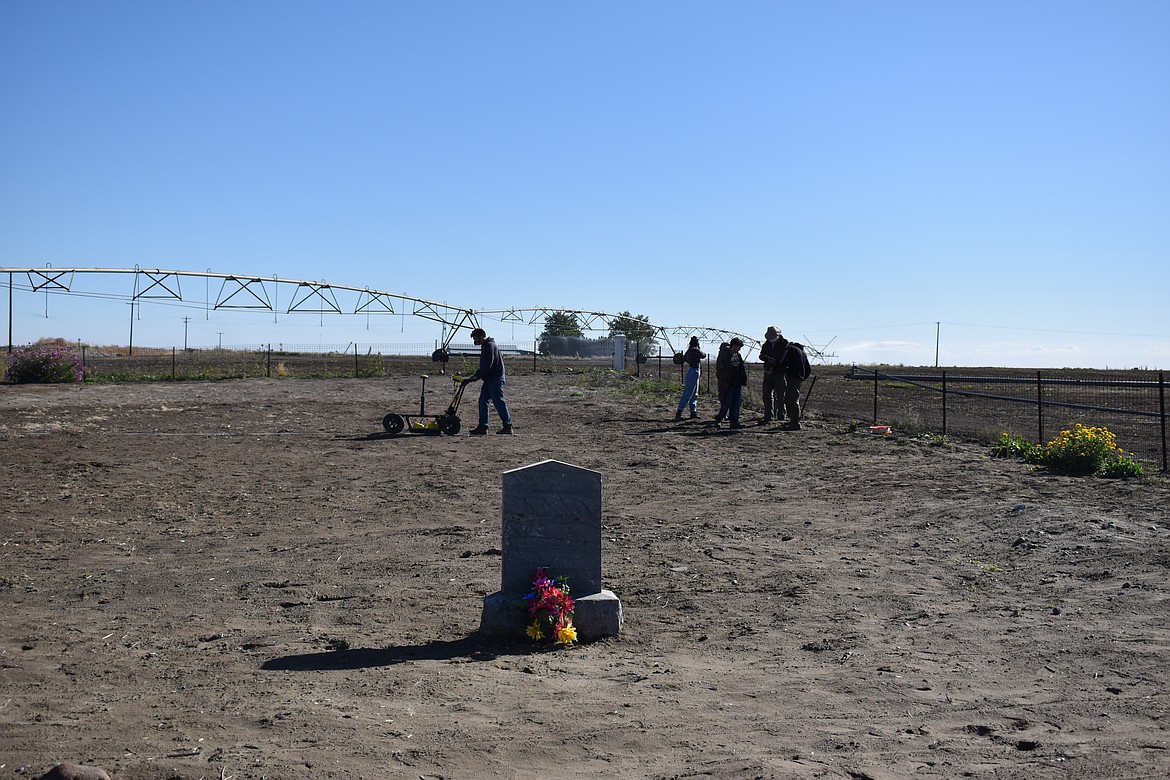
Volunteers search for graves at the Hill Family Cemetery in Mae Valley in 2021. Since 1987, Washington law has prohibited the creation of private family cemeteries, but a bill prefiled in the Legislature is poised to change that.
FILE PHOTO
State Rep. Jim Walsh, R-Aberdeen, has pre-filed a bill to allow families to bury their loved ones on their own land.
Joel Martin has been with the Columbia Basin Herald for more than 25 years in a variety of roles and is the most-tenured employee in the building. Martin is a married father of eight and enjoys spending time with his children and his wife, Christina. He is passionate about the paper’s mission of informing the people of the Columbia Basin because he knows it is important to record the history of the communities the publication serves. | January 2, 2025 2:35 AM
OLYMPIA — Washington could allow family burial plots on private property, according to a statement from the office of Rep. Jim Walsh, R-Aberdeen, who pre-filed the bill Dec. 13.
House Bill 1065 would amend state law to allow burials on private land if other conditions are met, according to the statement. Walsh wrote that the legislation addresses ambiguity in state law, protects property rights, and honors cultural traditions.
"This remains a small but important property rights issue in our state that needs to be addressed in law. Washington families should be able to bury loved ones who've passed away on privately owned land," Walsh wrote in the statement. "It's a tradition with deep cultural roots in this part of the world. Current state law is not clear on the practice – and many Washington families are carrying on their personal and cultural traditions, uncertain of the legality of what they're doing."
Under RCW 68.20.010, it is illegal in Washington to bury human remains anywhere other than a legally-designated cemetery or a building built exclusively for religious purposes, and that cemetery must be owned by a corporation. This means, according to the Washington State Department of Licensing, that a Washington landowner who wished to bury their loved ones on their land would be required first to register as a nonprofit, apply for a business license and register the property as a cemetery with the county. HB 1065 would amend the law to allow an individual landowner the same rights as a corporation, according to the bill’s text.
Washington is the only state in which existing law is so rigid; California and Arkansas also generally prohibit private burials but allow for a special permit. Washington’s law regulating cemeteries went into effect in 1987, but did not address family plots established on private property before that date, nor did it directly address individuals who wished to maintain a family plot.
"These changes help clear up this uncertainty," Walsh wrote. "It requires that families follow local land-use guidelines about wetlands, title filings, and other matters. It limits the practice to family members and doesn't allow any sort of commercial use. But it states clearly that, if families follow those rules, they can bury a loved one's remains on land they own."
HB 1065 clarifies that families wishing to continue traditional burial practices must follow local land-use guidelines, including wetlands and title filings, according to Walsh’s statement. It specifies that the option only applies to direct family members and disallows any commercial use. The plot would have to be at least 25 feet from the parcel boundary and 50 feet from an existing easement or right-of-way. City and county governments still would have jurisdiction under HB 1065 to regulate or prohibit private burial grounds.
In addition to its past bipartisan legislative support, HB 1065 has garnered backing from several groups, including Native American tribes, property rights organizations, and those invested in preserving Washington's rich cultural heritage, according to Walsh’s statement.
"I am honored to have broad support for this worthy reform – from our state's Native American tribes, property-rights groups, and Washingtonians interested in our state's history and traditions," Walsh wrote. "I hope this version of the bill can complete its journey into law."
The text of HB 1065 and updates to its status can be found at https://bit.ly/WAHB1065.
 State Rep. Jim Walsh, R-Aberdeen, has pre-filed a bill to allow families to bury their loved ones on their own land.
ARTICLES BY JOEL MARTIN

Endless battle
Noxious Weed Control Board works to keep invasive plants under control
MOSES LAKE — Some of the nastiest plants in Grant County were the topic of a class led by Jay Johnson, a consultant with the Grant County Noxious Weed Control Board, Tuesday. The Noxious Weed Control Board, as its name would suggest, is tasked with keeping weeds under control in Grant County. That’s not a small job; the board’s website lists 129 species of noxious weeds that are found around Grant County. A noxious weed is defined as an invasive, non-native plant that threatens agricultural crops, local ecosystems or fish and wildlife habitat, according to the Noxious Weed Control Board. Washington state law requires that these weeds be identified and their spread kept to a minimum, if not completely eradicated. “We’re one of those agencies a lot of people don’t really understand,” Johnson said. “We’re a county office and … our funding is tax-based assessment. When you get your tax bill and you look down at all the expenses that you pay for, there we are.”

BASIN EVENTS: Oct. 16-24
COLUMBIA BASIN — Whether you feel like shopping, crafting, learning or seeing a show, there’s something happening for you this week in the Basin. Oct. 16 ‘My Family (Mi Familia)’ screening Spanning three generations, “My Family (Mi Familia)” is a heartfelt drama that follows the Sánchez family as they build their lives in East Los Angeles. Through love, hardship, triumph, and sacrifice, the film explores the immigrant experience, the strength of family bonds, and the traditions that connect one generation to the next. Lowrider show and taco truck before the screening. Sponsored by Columbia Basin Allied Arts, EDUBS C/S and the Moses Lake Creative District. $12 per person. Doors open at 6 p.m., film begins at 7 p.m. at the Moses Lake Civic Center Auditorium, 401 S. Balsam St. Tickets and info: www.cba-arts.org.

Moses Lake author encourages women to look beyond church culture norms
MOSES LAKE — A Moses Lake author’s book, “A Christian Woman Striving to Live Her Faith in a Man-Controlled World,” takes aim at the role to which many churches relegate the female half of their congregations. “It’s to encourage women in the faith,” Linda Curran said. “A lot of churches say, ‘Teach Sunday school, do this, do that, but don’t (evangelize.)’" In her book, Curran recounts a time when she moved to a new community and joined a church there. She was surprised to learn that, as a new female member, she had been automatically assigned church cleaning duties. When she questioned it, she wrote, she was met with condescension and her objections were brushed aside. In other churches, she said, women who were capable of teaching were relegated to “women’s ministry.”