
Curiosity keeps centenarian young
JOEL MARTIN | Hagadone News Network | UPDATED 1 year, 9 months AGO
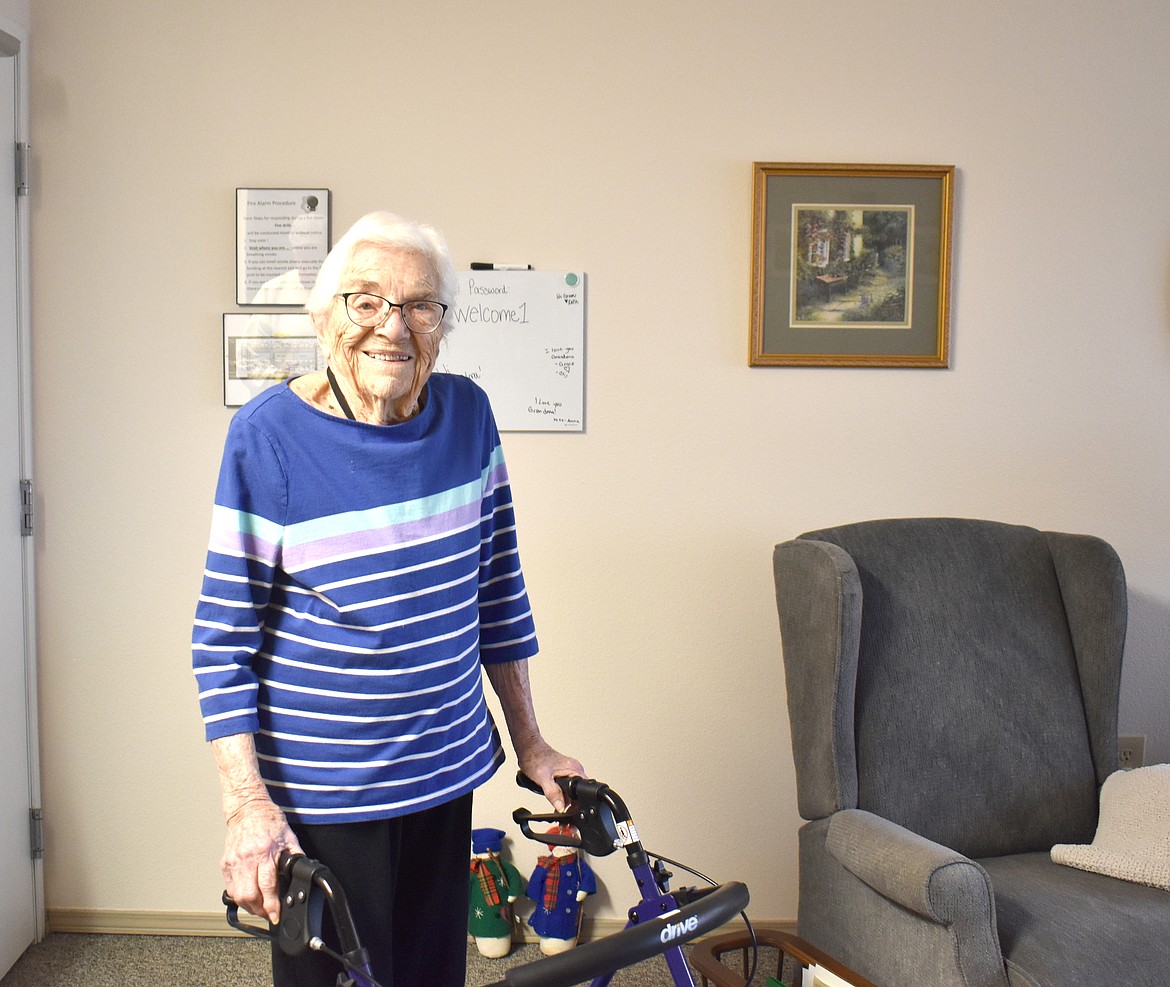
Betty Davis, who recently moved from Coulee Dam to Moses Lake, turned 100 years old on Jan. 2.
JOEL MARTIN/COLUMBIA BASIN HERALD
Joel Martin has been with the Columbia Basin Herald for more than 25 years in a variety of roles and is the most-tenured employee in the building. Martin is a married father of eight and enjoys spending time with his children and his wife, Christina. He is passionate about the paper’s mission of informing the people of the Columbia Basin because he knows it is important to record the history of the communities the publication serves. | January 8, 2025 3:00 AM
MOSES LAKE — It could be that the secret to living a long time is just not to get old.
“I golfed until I was 95,” said Betty Davis, who celebrated her 100th birthday Jan. 2 at Monroe House. “I found out what I like to do, and at 75 I took golfing lessons and I never looked back … I would hop on a bicycle and ride if they would let me.”
“She was still bowling well into her 80s,” said Betty’s son, Jim Davis. “She was still riding her bicycle until her doctor told her not to after she broke her arm, and (she was) about 80 then.”
Starting out
Betty was born Betty Spellman, the sixth of seven children, in Isabel, South Dakota, where, she said, it was so flat you could see the lights of the next town. Her parents had homesteaded outside of town, but when Betty was three years of age the Dust Bowl drove them from their farm and they moved to town. Betty’s father, a trained carpenter, had to take whatever jobs he could, which in the Depression weren’t exactly plentiful.
“My dad had worked for the White Owl Oil Company, and he drove a truck home one day. That was it,” she said. “They closed the company, and he drove his truck home, I don't know why, and they came and got the truck. That was the end of the White Owl Company.”
Like many families at that time, the Spellmans headed west in 1936, when Betty was 11. Betty’s parents had friends who had settled in Hayden Lake, Idaho, and they stopped off there briefly before settling in Coeur d’Alene. North Idaho was a far cry from the endless plains of South Dakota, she said, which she learned when she started seventh grade.
“I remember seeing the first snowfall,” she said. “The classroom was one of those that's a basement, but the windows were there, and you could see out the windows. And I was mesmerized by all the snow that was coming straight down. I'd never seen snow fall straight. In South Dakota, it was (blown) this way or this way or this way, but it never fell straight. And I was just mesmerized.”
Betty’s father worked for a couple of years for the Works Progress Administration, one of President Roosevelt’s New Deal programs, and then, when Betty was 14, he passed away, leaving Betty’s mom to raise her and her sister.
“My mother had Aid to Dependent Children,” Betty said. “She had us girls, and I think it probably amounted to about 14 cents a day. You might have had enough to buy a tablet for school.”
War and love
One day when Betty was 16, she was out walking with some friends when it began to rain, she said. A group of boys from Spokane was driving past and drove the girls three or four blocks to Betty’s house. The boys came back the next week and took the group of young ladies to Natatorium Park in Spokane.
“I was sitting in the back, and I saw this guy, he was the driver,” Betty said. “And I said to my friend before we left, ‘That’s the guy I’m going to marry.’”
The young man’s name was Ted Davis, and his father owned an excavation company in Spokane, Betty said. Any plans for marriage had to be put on hold, however, when America entered World War II and everybody’s life was upended. Ted went into the army while Betty graduated high school and entered the working world.
She worked at Van’s Creamery for a while, she said, but felt she should be doing something for the war effort. So she went to work for the Office of Price Administration, the agency in charge of rationing.
“I gave people permission to buy their tires and gas,” Betty said. “Then I went to work for the naval supply people. I loved that job … It was very secretive, no matter what you did. My fingerprints are in Washington, D.C.”
That job ended after the war, Betty said, by which time she and Ted were married. He’d learned a machinist’s trade in the army, she said, and found an open position at Grand Coulee Dam. So Ted and Betty packed up and moved west.
“I didn’t want to live there,” Betty said. “I thought, Coulee Dam? That was like moving to Isabel, South Dakota. We moved there in 1958 and about three days later, I had made up my mind that I would live here forever.”
Staying curious
And until last year, she did. Betty worked for the school district for 25 years as the secretary at Wright Elementary School. She and Ted purchased a house in Coulee Dam and raised four children there.
“It was (like) ‘Leave it to Beaver,’” Jim said. “We’d leave in the morning and come home at night, the screen door slammed, just regular small-town stuff. They were really involved with everything we did: PTA, bowling league, Cub Scouts, all that stuff.”
Betty retired in 1995, and Ted passed away in 1999. Betty, never one to remain idle, kept finding new enthusiasms to pursue.
“She started new hobbies when she was in her 80s and early 90s,” Jim said. “She’d (say) ‘I think I’ll take this up’ and ‘I’m going to start doing this.’ I think that’s what’s kept her going, a natural curiosity.”
A bad fall sent her to the hospital last year, Betty said, and her children brought her and her furniture to Monroe House, where she has a window that looks out over the playfield at Garden Heights Elementary School.
“Ten of my grandchildren have gone to school there, and my daughter-in-law taught there,” she said. “I can look out and watch the kids at recess … At night they play soccer on that field, and I watch the soccer games. I just really feel that this is my home.”
“She has a relationship with her (grandchildren and great-grandchildren),” Jim said. “They connect on Facebook; they email back and forth. A lot of people her age and a lot younger, they withdraw from all of that, because it's just too complicated. I'm telling you, it's pretty cool.”
Betty’s birthday qualified her to join an exclusive club at Monroe House, she said; there are two other centenarians living there as well. As long as she can keep finding things out, she said, she’ll be fine.
“I’m curious,” she said. “I look out (the window) and I want to know what that tree is, and I want to know what those birds are. I have to stick around and find out what’s happening.”
ARTICLES BY JOEL MARTIN
Endless battle
Noxious Weed Control Board works to keep invasive plants under control
MOSES LAKE — Some of the nastiest plants in Grant County were the topic of a class led by Jay Johnson, a consultant with the Grant County Noxious Weed Control Board, Tuesday. The Noxious Weed Control Board, as its name would suggest, is tasked with keeping weeds under control in Grant County. That’s not a small job; the board’s website lists 129 species of noxious weeds that are found around Grant County. A noxious weed is defined as an invasive, non-native plant that threatens agricultural crops, local ecosystems or fish and wildlife habitat, according to the Noxious Weed Control Board. Washington state law requires that these weeds be identified and their spread kept to a minimum, if not completely eradicated. “We’re one of those agencies a lot of people don’t really understand,” Johnson said. “We’re a county office and … our funding is tax-based assessment. When you get your tax bill and you look down at all the expenses that you pay for, there we are.”

BASIN EVENTS: Oct. 16-24
COLUMBIA BASIN — Whether you feel like shopping, crafting, learning or seeing a show, there’s something happening for you this week in the Basin. Oct. 16 ‘My Family (Mi Familia)’ screening Spanning three generations, “My Family (Mi Familia)” is a heartfelt drama that follows the Sánchez family as they build their lives in East Los Angeles. Through love, hardship, triumph, and sacrifice, the film explores the immigrant experience, the strength of family bonds, and the traditions that connect one generation to the next. Lowrider show and taco truck before the screening. Sponsored by Columbia Basin Allied Arts, EDUBS C/S and the Moses Lake Creative District. $12 per person. Doors open at 6 p.m., film begins at 7 p.m. at the Moses Lake Civic Center Auditorium, 401 S. Balsam St. Tickets and info: www.cba-arts.org.
Moses Lake author encourages women to look beyond church culture norms
MOSES LAKE — A Moses Lake author’s book, “A Christian Woman Striving to Live Her Faith in a Man-Controlled World,” takes aim at the role to which many churches relegate the female half of their congregations. “It’s to encourage women in the faith,” Linda Curran said. “A lot of churches say, ‘Teach Sunday school, do this, do that, but don’t (evangelize.)’" In her book, Curran recounts a time when she moved to a new community and joined a church there. She was surprised to learn that, as a new female member, she had been automatically assigned church cleaning duties. When she questioned it, she wrote, she was met with condescension and her objections were brushed aside. In other churches, she said, women who were capable of teaching were relegated to “women’s ministry.”