
Superintendents discuss reading, math skills locally, statewide
NANCE BESTON | Hagadone News Network | UPDATED 1 year, 5 months AGO
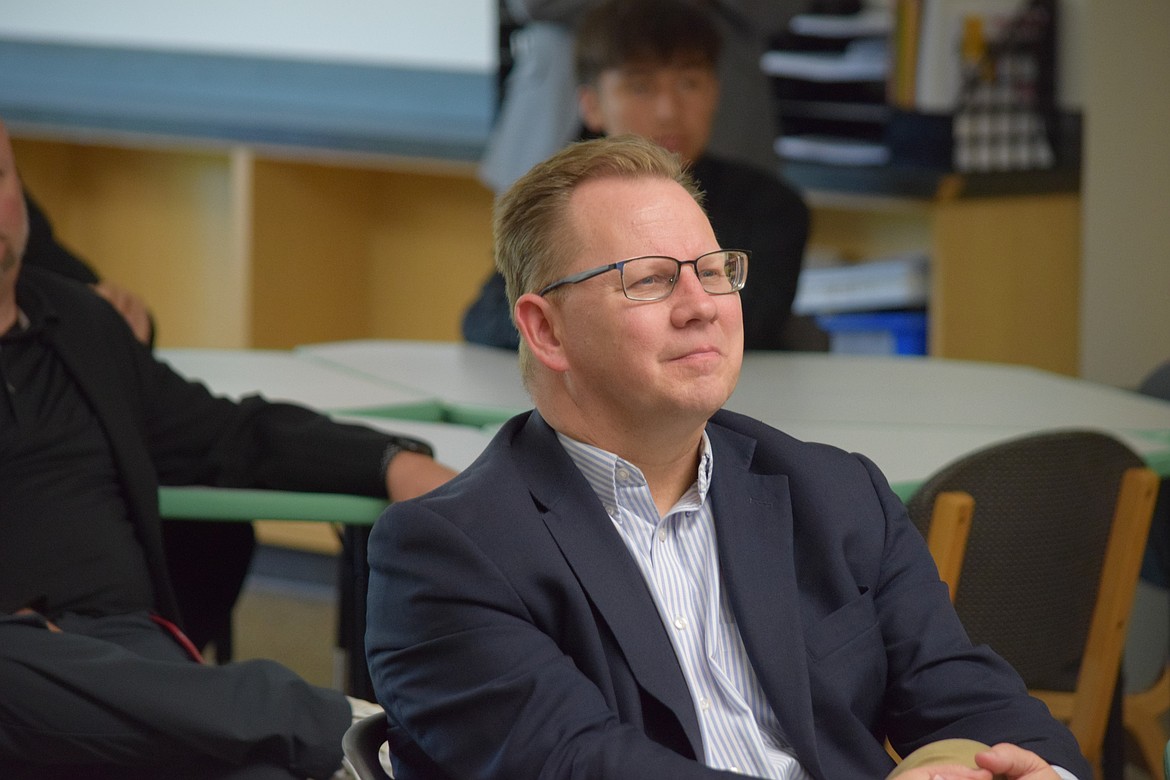
Superintendent of Public Instruction Chris Reykdal listens to an introductory presentation on the Wahluke School District in the Wahluke High School Library in 2024. On Thursday, Reykdal released a statement in regard to the National Assessment of Educational Progress testing trends in Washington. The state saw positive results from fourth-graders in both reading and math and from eighth-graders in reading; however, there was a decline in math for eighth-graders. Wahluke School District Superintendent Andy Harlow said WSD experienced the opposite result, with students excelling in math over r…
FILE PHOTO
OLYMPIA – The National Center for Education Statistics released the 2024 results of the National Assessment of Educational Progress Thursday, revealing that Washington’s fourth grade students continue to outperform many peers nationally in reading and math, while eighth graders experienced a decline, particularly in math.
The NAEP assessment, known as the "nation's report card," evaluates student achievement in reading and math for fourth and eighth graders nationwide, allowing for state comparisons and long-term trend analysis.
The latest results indicate that five states exceeded Washington in fourth-grade reading, four states in fourth-grade math, and four states in eighth-grade reading. However, in eighth-grade math, 14 states outperformed Washington, marking a significant decline for middle school students in the state.
“I am proud that our students continue to outperform many of their peers across the nation,” State Superintendent Chris Reykdal said in a press release. “This assessment is the only reliable tool we have to compare our progress with the country, and there are very few states that outperform Washington’s students. However, the overall results for the nation and Washington are not good enough.”
Moses Lake Superintendent Carol Lewis said that although MLSD did not participate in NAEP, to her knowledge, they have also seen an improvement in general with test scores.
“NAEP is interesting because not all school districts get tested. They do a random sampling of groups from across the country, and so I don't think that any Moses Lake District schools were even asked to participate last year,” Lewis said. “I guess in relation to the overall scores that we see in Moses Lake, we do see across our school district lower scores historically in math than we have in reading, and the state does as well.”
Wahluke School District Superintendent Andy Harlow said he has also noticed a positive trend in testing of the district’s students. Harlow said the district tested students in August then again in December. The WSD school board analyzed the data of the summative assessments and there was a positive increase in both.
“As we're starting to get these summative assessments, we are starting to see small signs of the gap starting to close,” Harlow said. “Now it's still there, and we know kids of poverty out at Wahluke. There is a 97% Hispanic population, and we have 94% free and reduced lunch and there are profound studies of how challenging it is. We have all these challenges, but it's the first-time post post-COVID that we've looked at (testing) and we thought, ‘Holy smokes, we actually made some growth.’”
Superintendent Reykdal emphasized the importance of addressing the challenges in eighth-grade math.
“Over the last several rounds of the NAEP administration, we have seen our students make progress in math from fourth to eighth grade compared to other states. This year, however, we see the opposite: Our fourth-graders made gains in math, while our eighth-graders lost ground,” Reykdal said.
Lewis noticed a similar trend within MLSD as compared to statewide results, with students testing better in reading than in math.
“I would say that Moses Lake School District is falling in line with what the NAEP is finding,” Lewis said.
Despite U.S. students performing well in reading on international exams, Reykdal noted that they lag in math. He underscored the necessity for Washington to improve its performance in arithmetic to sustain its economic excellence in sectors like software and engineering.
However, Harlow said he saw something different at Wahluke, with students excelling in math-based tests and falling behind with reading-based tests.
“We are finding that math is where we're getting our bump,” Harlow said. “Some early hypothesis from our principals is we struggle here with language. You can see that with reading scores taking a dip. It is easier for some of our multilingual students to grasp math concepts versus reading.”
For the rest of the state, Reykdal outlined an initial plan he said would fully fund basic education. He also advocated for enhanced regional professional development, increased investments in the Learning Assistance Program, and allocating more instructional time for math in elementary schools.
“This testing cycle shows us that we have some targeted, intentional work ahead of us so we can continue to be a top performer in both reading and math,” Reykdal said in the statement.
Looking to the future, Harlow said he would like to see more formative testing to analyze students' progress instead of summative testing. Formative testing happens during a course or when knowledge is forming, and summative assessments are held at the end of courses or as a summary of the knowledge.
“There's good testing. I just wish we would not be so summative,” Harlow said. “It'd be a little more focused on the formative stuff, and then people could still get their data right, because there should be some accountability for these scores.”
Lewis said an important thing to remember about testing such as NAEP is it is more of an evaluation of how the system performs as a whole.
“In general, these big, overarching assessments (are) really nice to have as a broad measure and as a yearly indicator of how the system is doing as a whole,” Lewis said. “But school districts and schools and classrooms also have many other assessments that they use to home in on what every student needs. I always like to think about those big state and national assessments as a way to see how our system is doing, rather than how this individual kid or this individual teacher is doing because we have other measures that tell us that.”
ARTICLES BY NANCE BESTON
Grant County Sheriff candidates discuss transparency, trust
EPHRATA — As Grant County voters prepare to submit their primary ballots, three candidates are vying for the position as Grant County Sheriff including incumbent Joey Kriete and challengers Josh Sainsbury and Darrick Gregg are competing in the upcoming primary election. To help readers compare the candidates' priorities, qualifications and plans for the office, each was asked the same question and given an equal opportunity to respond.
Grant County Commissioner candidates deliberate fiscal responsibility, budgeting
EPHRATA — Four Republicans are seeking election to Grant County Commissioner Position 3 in the upcoming primary: Shannon Durfee, Kelly Raap, Seth Weeks and Janice Flynn. To give voters a clear comparison of the candidates' positions and priorities, each was asked the same set of questions and provided the same deadline to respond. Durfee, Raap and Flynn submitted responses by the deadline; Weeks did not respond.

Sheriff candidates discuss staffing, retention
EPHRATA — As Grant County voters prepare to select their next sheriff, incumbent Joey Kriete and challengers Josh Sainsbury and Darrick Gregg are competing in the upcoming primary election. To help readers compare the candidates' priorities, qualifications and plans for the office, each was asked the same question and given an equal opportunity to respond. This installment focuses on one of the most pressing challenges facing law enforcement agencies: recruiting, retaining and supporting qualified staff within the Grant County Sheriff's Office.