
Othello dentist delivers home-grown greatness
JOEL MARTIN | Hagadone News Network | UPDATED 1 year, 3 months AGO
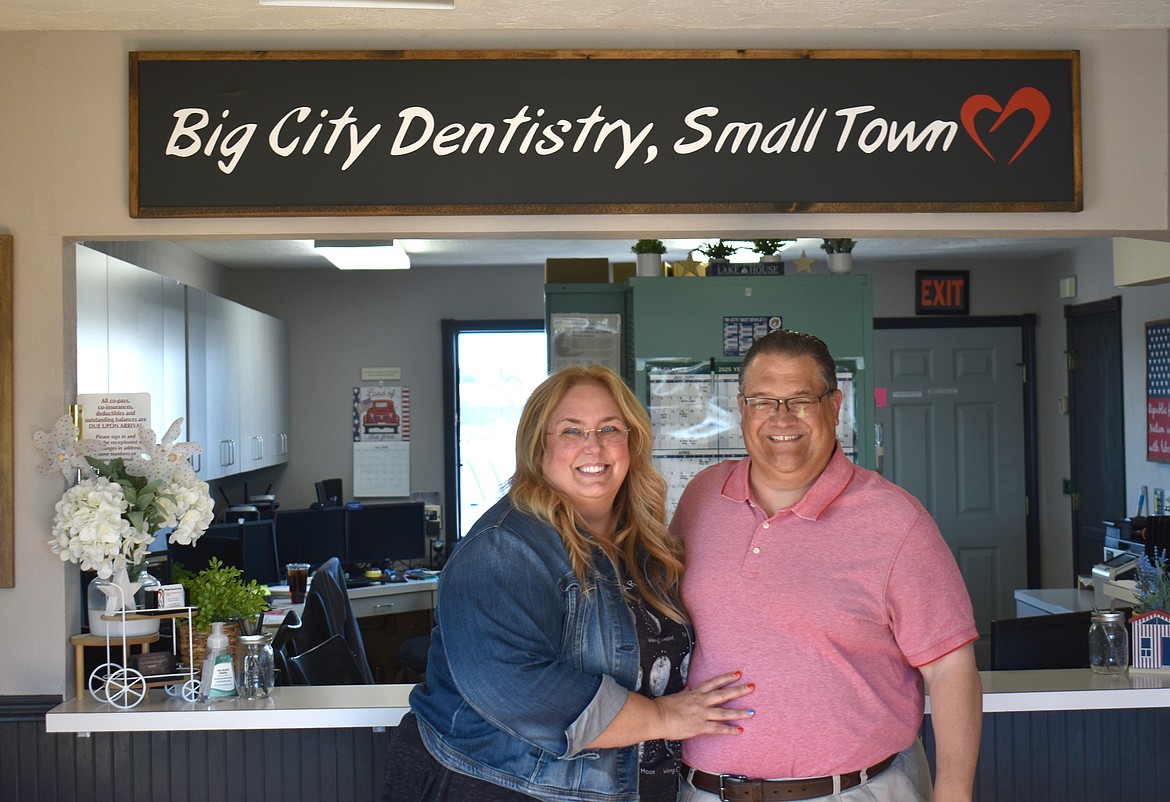
Dr. Chris Dorow, right, and his wife Genna Dorow in the waiting room of Othello Dental Arts. Dorow is a second-generation dentist, having inherited the practice from his father, and the only private dentist left in the area.
JOEL MARTIN/COLUMBIA BASIN HERALD
Joel Martin has been with the Columbia Basin Herald for more than 25 years in a variety of roles and is the most-tenured employee in the building. Martin is a married father of eight and enjoys spending time with his children and his wife, Christina. He is passionate about the paper’s mission of informing the people of the Columbia Basin because he knows it is important to record the history of the communities the publication serves. | July 11, 2025 1:00 AM
“(With) every patient who comes in, I have a puzzle that I get to put together, and I use my science background and my experience to do that. As cool as that is, after I figure out how to fix it, I get to show off what I really (love), which is being an artist. All day long, I do little tiny sculptures that, frankly, can rival some of the great statues of the Renaissance. At least one time this week, somebody's going to cry in this office because I did something they never thought I could do for them.”
— Dr. Chris Dorow, Othello Dental Arts
OTHELLO — It’s been said that some people are born to greatness, some achieve greatness and some have greatness thrust upon them. And then some do great things on a small scale.
“For whatever reason, I always seem to gravitate into leadership,” said Dr. Chris Dorow, owner of Othello Dental Arts and president of the Washington State Dental Association. “When I graduated from dental school in 1995, I was the student body president for the dental school. I went immediately from there into volunteering for the Washington State Dental Association. My first committee was the Communications Committee, and then they moved me to Membership Services … I was there for 16 years, and I (was asked) to be on the board of directors an insane amount of times.”
When he was elected last year for a one-year term, he was the first president ever unanimously elected, he said. As president, he’s worked hard to change the culture of the WSDA, which represents about 4,000 dentists in the state, but has trouble with leadership that was unable to work together.
“The culture was out of whack,” he said. “It was personal. Most people on the board of directors at that time had served one term. You could serve two, but nobody served two. They didn’t relate well to each other.”
Dorow and a few other board members set out to change that, he said, making it more health care-centric and less about the organization itself.
“We’ve reversed the tendency of young dentists not joining the association,” he said. “We made it so right now, they’re joining in droves. We’re having our biggest increase that we’ve had in 10 years in membership.”
Pursuing the art
Dorow is a second-generation dentist, having taken over the practice his father founded in 1971, he said. He hadn’t originally planned to be a dentist; instead, he took a full-ride music scholarship to Central Washington University. However, he soon found that success in music came as much from luck as from ability. He also considered becoming a TV weatherman. But having dyslexia had gotten him in the habit of working hard to learn, he said, and he wanted something to show for it.
“When you go to school … you want to invest your time and get a return on that investment,” he said. “If you’re not doing it that way, you’re going to fail, and fail miserably … I was a pretty good student, so I was getting a lot of A’s. But what fit, what made the most sense? Where was the best application to get a return on that investment, and something that I hopefully will enjoy for the rest of my life? And it came down to medical school and dental school.”
He didn’t even tell his parents he was considering dental school until he was accepted at the University of Washington, he said.
Besides being a good return on his investment, dentistry is both an art and a science, and a way of giving back to the community.
“(With) every patient who comes in, I have a puzzle that I get to put together, and I use my science background and my experience to do that,” he said. “And then, as cool as that is, after I figure out how to fix it, I get to show off what I really (love), which is being an artist. All day long, I do little tiny sculptures that, frankly, can rival some of the great statues of the Renaissance. At least one time this week, somebody’s going to cry in this office because I did something they never thought I could do for them.”
Being one of the very few dentists in a rural area means treating a wide variety of people, some of whom have no other opportunity for dental care, Dorow said.
“The coolest thing about being a health care provider is you get to see everybody, especially in a small community like this,” he said. “I don’t have a niche office. I treat everybody and when it rains, the orchards get shut down, and you better open up the schedule so that people who can only get in here a couple of times a year can get in here and get taken care of. Man, you want to talk about an appreciative group? There’s a reason why I do that, because I love those people. They’re the best.”
Giving back
While he was at Central, Chris Dorow had an encounter even more life-changing than dentistry.
“We met in freshman year,” said Genna Dorow. “We were in the same dorm, and we started dating about halfway through the year.”
The Dorows were married after Chris’ graduation from UW and recently celebrated their 30th anniversary. They have two grown children, both of whom are planning to attend dental school, they said.
However, Chris Dorow said, the field is changing.
“The viability of dental practices has really dropped, especially in rural communities,” he said. “When I came (back) to Othello 30 years ago, there were eight private dental clinics within a 12-mile radius. We had four in Othello, we had one in Royal City, two in Connell and one in Warden. Today, in a nearly 20-mile radius, I’m the last one and that is common.”
The problem isn’t so much the dwindling population of small towns as the logistics of running a dental practice and the difficulty of getting dentists and trained staff to settle in a rural area, Dorow said.
“I’m on year five of looking for an associate to come in and help me, and I’ve decided it’s just not going to happen,” he said. “Same thing with a hygienist unless they’re from here. With the dentists, even if you home-grow them, it’s still not for sure that they’ll come back here if they don’t marry (someone) from the same area.”
The Dorows give back to the community in other ways, they said. Genna serves on the city council, and Chris is chairman of the city planning commission. Chris participated in a program for at-risk youth for about 20 years, he said.
“All those kids had one trait in common,” he said. “They didn’t have a lot of hope, but they were really hard workers, and they could get things going. I would hire them to do jobs, and I’d watch them and be in awe of the effort and work they did … It turned out that 80% of my kids in that program ended up being the first generation to ever go to college or go into some sort of extra training or some sort of school, and God, have they knocked it out of the park.”
There’s a reason he returned to his hometown to practice, Dorow said.
“A lot of dentists are like, ‘Why the heck are you in Othello? You could be (somewhere else) and be a lot more successful,’” he said. “Well, I’m happy, and I’m more than successful with what I’m doing. I came to be a dentist, but I stayed for the people.”
ARTICLES BY JOEL MARTIN

Endless battle
Noxious Weed Control Board works to keep invasive plants under control
MOSES LAKE — Some of the nastiest plants in Grant County were the topic of a class led by Jay Johnson, a consultant with the Grant County Noxious Weed Control Board, Tuesday. The Noxious Weed Control Board, as its name would suggest, is tasked with keeping weeds under control in Grant County. That’s not a small job; the board’s website lists 129 species of noxious weeds that are found around Grant County. A noxious weed is defined as an invasive, non-native plant that threatens agricultural crops, local ecosystems or fish and wildlife habitat, according to the Noxious Weed Control Board. Washington state law requires that these weeds be identified and their spread kept to a minimum, if not completely eradicated. “We’re one of those agencies a lot of people don’t really understand,” Johnson said. “We’re a county office and … our funding is tax-based assessment. When you get your tax bill and you look down at all the expenses that you pay for, there we are.”

BASIN EVENTS: Oct. 16-24
COLUMBIA BASIN — Whether you feel like shopping, crafting, learning or seeing a show, there’s something happening for you this week in the Basin. Oct. 16 ‘My Family (Mi Familia)’ screening Spanning three generations, “My Family (Mi Familia)” is a heartfelt drama that follows the Sánchez family as they build their lives in East Los Angeles. Through love, hardship, triumph, and sacrifice, the film explores the immigrant experience, the strength of family bonds, and the traditions that connect one generation to the next. Lowrider show and taco truck before the screening. Sponsored by Columbia Basin Allied Arts, EDUBS C/S and the Moses Lake Creative District. $12 per person. Doors open at 6 p.m., film begins at 7 p.m. at the Moses Lake Civic Center Auditorium, 401 S. Balsam St. Tickets and info: www.cba-arts.org.

Moses Lake author encourages women to look beyond church culture norms
MOSES LAKE — A Moses Lake author’s book, “A Christian Woman Striving to Live Her Faith in a Man-Controlled World,” takes aim at the role to which many churches relegate the female half of their congregations. “It’s to encourage women in the faith,” Linda Curran said. “A lot of churches say, ‘Teach Sunday school, do this, do that, but don’t (evangelize.)’" In her book, Curran recounts a time when she moved to a new community and joined a church there. She was surprised to learn that, as a new female member, she had been automatically assigned church cleaning duties. When she questioned it, she wrote, she was met with condescension and her objections were brushed aside. In other churches, she said, women who were capable of teaching were relegated to “women’s ministry.”