
THE FRONT ROW with JASON ELLIOTT: A big arm, but bigger heart .... Former Prairie American Legion teammates and coaches remember Bobby Jenks, who recently passed away from cancer
Coeur d'Alene Press | UPDATED 1 year, 1 month AGO
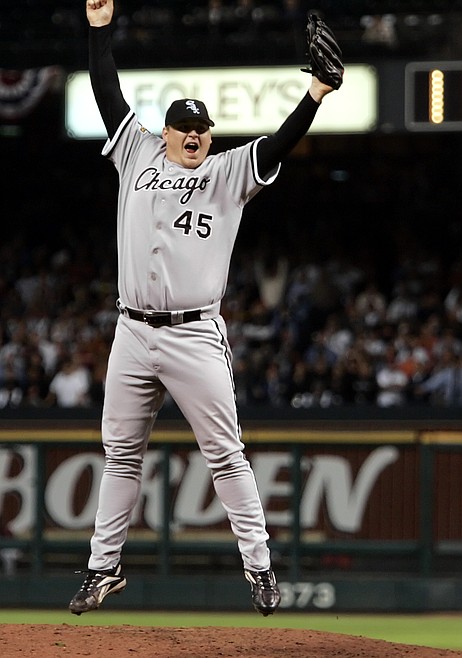
ERIC GAY/Associated Press Chicago White Sox closer Bobby Jenks leaps into the air in celebration after the White Sox beat the Houston Astros 1-0 to win the World Series on Oct. 26, 2005, in Houston. Jenks, who pitched for Lakeland High and the Prairie American Legion baseball program, died from stomach cancer in Portugal on July 4.
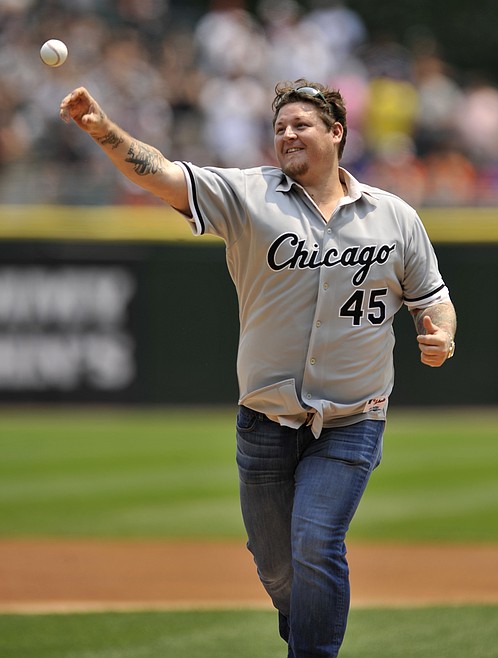
PAUL BEATY/Associated Press Former Chicago White Sox pitcher Bobby Jenks throws out the ceremonial first pitch before a game between the Chicago White Sox and the Baltimore Orioles on July 4, 2015, in Chicago.
Baseball players in this part of the state know that sometimes, it snows right before the season.
But Bobby Jenks never let a long winter stop him.
“There was a year in Rathdrum where it snowed and we had to shovel off the field to get ready to play,” former Lakeland star and current Post Falls baseball coach Kurt Reese said. “We’re still out there shoveling the field off and as soon as we got the mound cleared off, Bobby was up on the mound throwing a bullpen. We’re still trying to clear off an area and he’s throwing off the mound while we’re all laughing at him. He said he had to get ready for the season.”
FORMER LAKELAND High and Prairie American Legion pitcher Bobby Jenks, a two-time All-Star closer who helped the Chicago White Sox win the 2005 World Series, died on July 4 in Sintra, Portugal, where he had been battling adenocarcinoma, a former of stomach cancer, the White Sox announced.
In the 2005 World Series, Jenks saved four games in six appearances during the postseason. He was an All-Star in each of the next two seasons while saving 41 games in 2006 and 40 in 2007. During the 2007 season, he retired 41 consecutive batters, matching a record for a reliever.
“When he was pitching, if there was a runner on first, I had to be wide awake,” former Lakeland High first baseman and current assistant coach Taylor Skidmore said. “Because if he was throwing over there, it was going to be a rocket. When we were kids, the teachers loved him and there wasn’t a mean bone in his body. But he was a light-hearted prankster. Between the lines, he was as competitive as you can get.”
Jenks, who attended school in Spirit Lake, played at Lakeland as a sophomore in 1998 (the only year he was academically eligible) and for the Prairie Cardinal American Legion baseball program in the summer from 1996 to '98. He attended Timberlake High in 1998-99, then enrolled at Inglemoor High in Kenmore, Wash., the following year to better prepare for the draft, graduating in 2000.
“He was the most competitive, best person I’ve played with,” Skidmore said. “He was unbelievable.”
Darren Taylor coached Jenks on the Prairie American Legion baseball team from 1996 to '98.
“We used to put a speed gun up and he was right at 93 (miles an hour),” Taylor said. “By the time he hit the majors, he was throwing 100 and we knew that was going to be the progression. It was really fun to watch him grow and come into form.”
At that time, Jenks traveled in an old El Camino from the family home on Loop Road in Spirit Lake to Coeur d’Alene, according to Taylor, who had to pick him up for practices and games as a result.
“When he’d pull up in that thing, it was something else,” Taylor said. “But one time, it was broke down, so I had to drive all the way to Spirit Lake to pick him up. I walked to the house and couldn’t see any wires going to it. When I walked in, there was a few kids sleeping on the floor and I was stepping over all these kids to get to Bobby. When I finally woke him up, he was in his baseball stuff and we got in the car and went to practice. He loved his family and told me he couldn’t wait to start a family. He just liked being around a bunch of people.”
Skidmore recalled first seeing Jenks, who grew up in Spirit Lake, at a tryout for the Prairie team at North Idaho College in 1996.
“Back in those days, we didn’t have social media and a lot of us didn’t drive,” Skidmore said. “We were all Rathdrum kids and in walked this tall, lengthy kid in a pair of jeans, no hat and an old glove. Nobody had an idea of who he was. But when he stepped on the mound, he just started throwing lightning. Every time he got on the mound, it was something to watch.”
“He had this old bowling bag that had his stuff in it,” Taylor said. “His shoulders were about 50-feet wide. The first time I played catch with him, I knew he was pretty special. We had Darin Blood and Ryan Kempton (both of which went on to pitch in the minor leagues), but I’d never seen anything like that before. He was unbelievable.”
Reese played with Jenks at Lakeland in 1998.
“The biggest thing with him was his raw talent,” Reese said. “He was still early in his career, but was throwing 86 to 87 miles an hour when he was playing as a freshman and sophomore. He really took some jumps after I graduated. Just his power and natural strength were something to behold. He could just pitch.”
Jenks ranks 75th on the major league all-time saves list with 173.
IT WAS that presence on the mound that Al Bevacqua, who graduated from Lakeland High and went on to play at North Idaho College and Division I Mercyhurst in Erie, Pa., relied on at times.
“He was just an unbelievable kid,” Bevacqua said. “That kid was blessed with a thunderbolt of a right arm. But his heart was just as big. It’s super sad to know he’s not around anymore.”
To get up to speed on pitching, Bevacqua spent some summers tracking pitches from Jenks in the batter's box to get his timing.
“There were no swings and I’d sit in the batter’s box and just track his pitches,” Bevacqua said. “He was 16 or 17 years old, and I’m playing college ball. And those pitches were moving. It would either raise or dive. I remember telling Darren Taylor he’s going to be special. It was really nice to have that caliber of player in the area, for as short as he was here.”
Skidmore recalled a game for Prairie against the Spokane Cannons in a wood bat tournament at Gonzaga University.
“I’m pretty sure he had 20 strikeouts in seven innings,” Skidmore said. “He had an incredible breaking ball and was just untouchable. In those summer months, we sure had a lot of fun playing baseball. The thing with Bobby is he didn’t want to come out of the game because he was such a competitor. There were multiple games where he threw over 100 pitches, and he just kept going. He was a lion, and it was pretty cool to see.”
Skidmore also praised Jenks’ connection with D.J. Eberlin, who was the team’s catcher.
“D.J. was an incredible catcher and watching him and Bobby together was amazing,” Skidmore said. “We had so many amazing players. He had an incredible heart and he was just a competitor and excellent teammate. All of that stuff that the former White Sox players have been saying really resonates. All of that fame didn’t change him at all. He just worked hard and was a really cool guy.”
Jenks was drafted by the Anaheim Angels in the fifth round of the 2000 MLB Amateur Draft, the 140th selection. After being designated for assignment in 2004, Jenks was claimed off waivers by the Chicago White Sox in 2004. In 2010, Boston signed Jenks to two-year deal. After struggling with injuries throughout 2011, he was released in 2012.
After spending 2023 as the pitching coaching with the Princeton WhistlePigs, he was named manager of the Windy City ThunderBolts on Oct. 26, 2023. He led the ThunderBolts to a 40-56 record in 2024 and was set to return this season before taking a medical leave of absence on Feb. 15.
From 2006-10, Jenks ranked among the AL relief leaders in saves (third, 167), appearances (sixth, 297), save percentage (sixth, 87.4), strikeouts (seventh, 284), and innings pitched (seventh, 302.1). He recorded back-to-back 40-save seasons in 2006-07 at age 26, becoming at that time the second-youngest pitcher in major league history to accomplish the feat.
“One of the things I’ll always remember about him is his smile,” said Reese, who played with Jenks at Lakeland in 1998. “Being in the dugout, you could tell that was his happy place. On the field, he was as happy as could be. I just remember hanging out with him during the games, and he didn’t worry about a lot of other stuff. But he just played the game hard. He wasn’t concerned with a lot of other stuff.”
The White Sox are wearing a No. 45 patch in honor of Jenks for the remainder of the season.
“He had it tough back in the day,” Skidmore said. “He really wanted to be someone the community could be proud of. We kind of lost touch for a while, but communicated after the World Series win. It had been quite a few years and I followed what he did in coaching. All of the stories I’ve heard from former White Sox, none of them surprised me. Bobby had the biggest heart. He had a lot of struggles, but he was an incredible human being.”
Jason Elliott is a sports writer for The Press. He can be reached by telephone at 208-664-8176, Ext. 1206 or via email at [email protected]. Follow him on X (formerly Twitter) @JECdAPress.
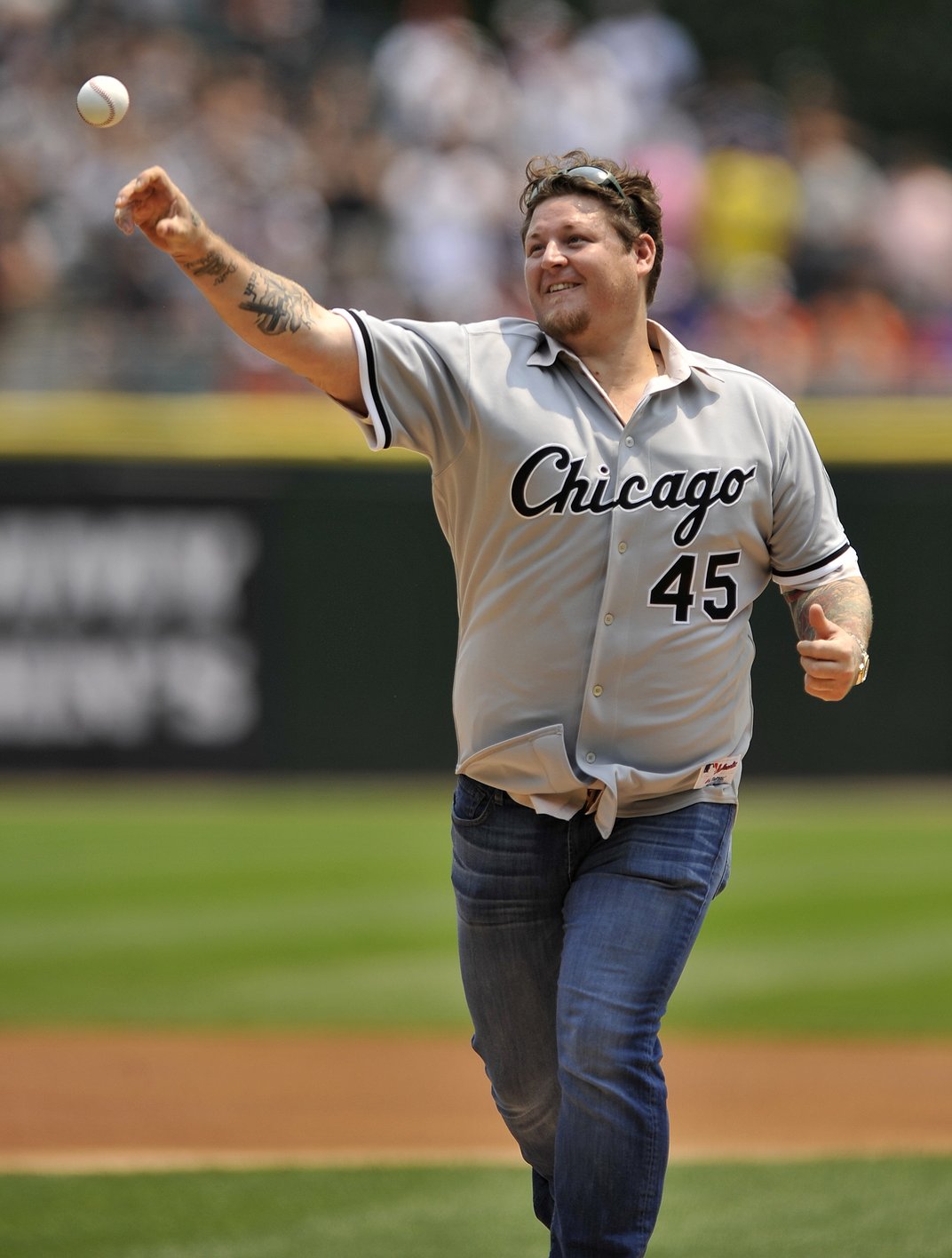 PAUL BEATY/Associated Press Former Chicago White Sox pitcher Bobby Jenks throws out the ceremonial first pitch before a game between the Chicago White Sox and the Baltimore Orioles on July 4, 2015, in Chicago.