
Joe Toney: Managing cities in turbulent times
NICK SMOOT/Contributing Writer | Coeur d'Alene Press | UPDATED 9 months AGO
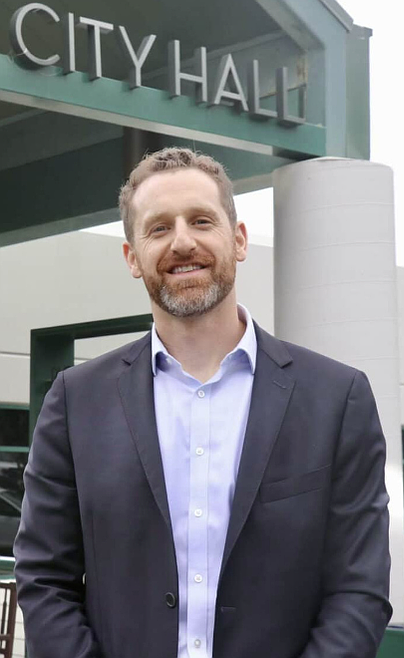
Joe Toney in front of Malibu City Hall.
Courtesy photo
When wildfires swept across Malibu in January 2025, Joe Toney wasn’t watching from a distance. As the city’s acting manager, he was the one making calls at midnight, managing evacuations, coordinating emergency teams and leading a city through chaos.
But before Malibu, Joe was a Coeur d’Alene kid, shaped by Little League, tight-knit neighborhoods and the kind of hands-on learning that mirrors the best of early-stage startups.
“It was Little League, I think,” Toney said in a recent interview on the American Dream Factory podcast. “Fourth or fifth grade. I think we’ve known each other for 30-plus years at this point.”
We met on the ballfield here in Coeur d’Alene — back when teamwork meant passing the bat, not pitching venture capitalists. And while Joe didn’t launch a tech startup like we cover in most of these articles, his story mirrors that of a founder navigating a volatile market.
“Running a city today is like steering a ship through a hurricane while everyone on board argues about the map,” he said. Cities run on code, legacy infrastructure and a very public group of users with competing feature requests.
Crisis Management at Civic Scale
Toney has spent nearly 20 years building experience in city government, working in places like Long Beach, Santa Barbara County and Simi Valley before stepping into leadership in Malibu. His resume would look at home in a startup pitch deck: complex environments, tight timelines, public pressure and systems design.
When the fires hit Malibu, he found himself responding to a situation that changed by the hour — without clear data, without a functional comms stack and with lives on the line.
“There was a moment when I was on the phone with the sheriff’s department at midnight and shared with them that it appears ‘Nothing’s stopping this,’” Toney recalled. “We were attempting to prepare to evacuate the rest of the city without power or the ability to communicate to residents. It was a tough moment.”
In startup terms, that’s product-market chaos: limited bandwidth, no buy-in and a hard launch at scale.
What saved the city was a natural fire break left behind by a previous fire — what would be similar to “technical debt” is actually what might have saved the rest of Malibu.
A CDA Operating System
What makes Joe’s story resonate — especially for startup founders — is how much he credits Coeur d’Alene’s culture for shaping his approach to leadership.
“Back in Coeur d’Alene, your neighbors mattered. You showed up. That culture of showing up — that stayed with me,” he said.
He compared civic rules and processes to the kind of legacy software a new CTO inherits.
“Our communities and our agencies are built by the people,” Tony said. “All the rules that have been put in place have been put in by community members over the years. And so those are your bumper rails.”
You don’t just “disrupt” a city. You build within it.
And like many startup founders, Joe learned that ambition, left unchecked, can become a liability.
“One of my major saboteurs — the things that sabotage you — is ambition,” he said. “Sometimes you keep climbing because you think you want to be the number one… but maybe that’s not really where you belong.”
Civic Engagement as Product-Market Fit
Today, Joe is taking time with family and considering his next step. But he left our conversation with a message that speaks to both policymakers and product builders:
“The civic engagement has died out,” he said. “The resident, the citizen, ultimately does have the control. It’s just how much do you want to be engaged?”
If a startup is only as strong as its user feedback loop, a city is only as resilient as its citizen participation. And in Joe’s view, cities like Coeur d’Alene may have the clearest path forward, because they still remember how to show up, work together and solve problems without needing to scale.
• • •
Nick Smoot is a Coeur d’Alene native, entrepreneur and founder of build_; an economic and civic innovation platform designed to help communities reconnect through shared purpose and local problem-solving. He is also the host of the American Dream Factory podcast, where he interviews builders, leaders and change-makers reimagining the future of work, cities and belonging.
He has redeveloped over 300,000 sq ft of real estate for innovation campuses, introduced federal economic policy and helped cities across the U.S. rethink how to engage residents through technology, gatherings and goal-setting.