
Regional library consortium will dissolve
KAYE THORNBRUGH | Hagadone News Network | UPDATED 5 months AGO
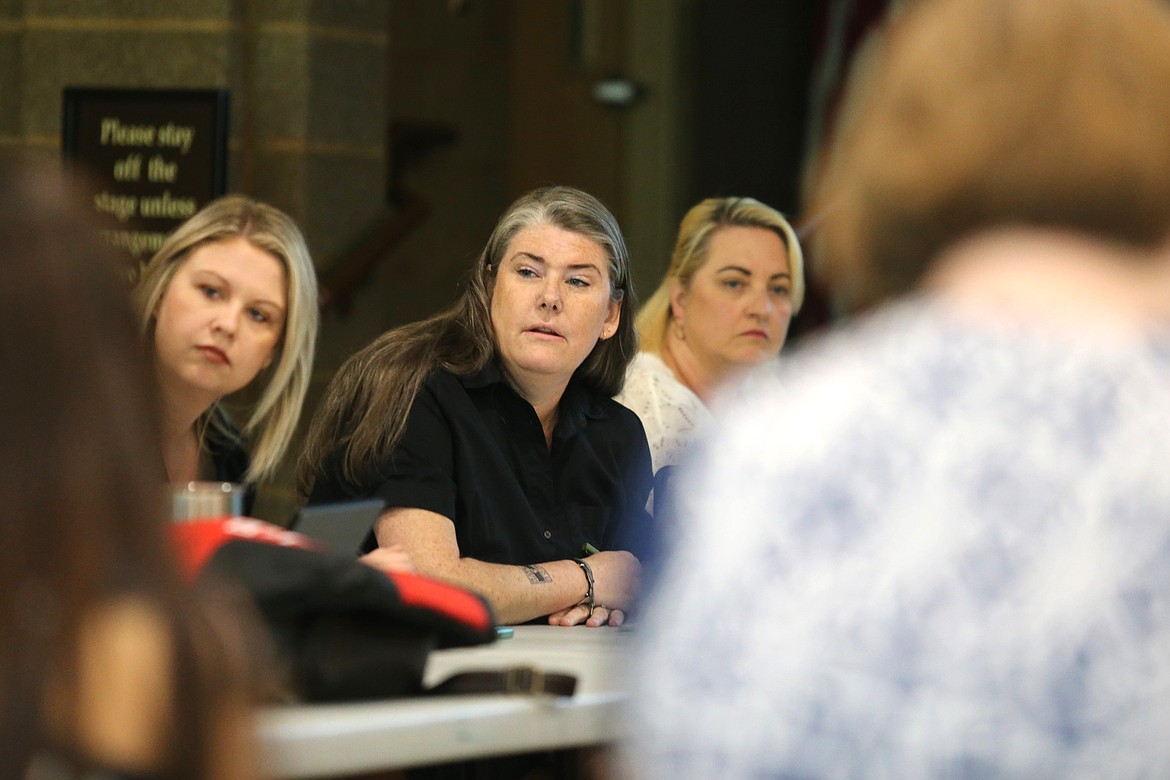
Meagan Mize, director of the West Bonner Library District, center, convened with other regional library directors Wednesday to vote on the dissolution of the Cooperative Information Network.
KAYE THORNBRUGH/Press
Kaye Thornbrugh is a second-generation Kootenai County resident who has been with the Coeur d’Alene Press for six years. She primarily covers Kootenai County’s government, as well as law enforcement, the legal system and North Idaho College. | July 17, 2025 1:09 AM
COEUR d’ALENE — The regional library consortium that allowed libraries in North Idaho and Eastern Washington to share their collections will dissolve in September, ending more than 40 years of partnership.
The majority of the Cooperative Information Network voted in favor of dissolution during Wednesday’s meeting at the Coeur d’Alene Public Library. The vote was the culmination of months of unsuccessful efforts to reorganize the consortium under a new name and a new joint powers agreement.
“I’m sad that it came to this because it does mean, at least for now, some reduced services for Coeur d’Alene library patrons and the surrounding community,” said Jim Windisch, chair of the Coeur d’Alene Public Library board of trustees.
Representatives of libraries from Benewah County, Coeur d’Alene, Kellogg, Liberty Lake, Mullan, Osburn, Pend Oreille County, Plummer, Priest Lake, St. Maries, Wallace and West Bonner voted in favor of dissolving the consortium. The Clarkia Free Library District in Shoshone County voted against dissolution.
The Community Library Network abstained from the vote.
CLN Trustees Tom Hanley and Rachelle Ottosen declined to comment on the dissolution, as did CLN Director Martin Walters.
During a past CLN board meeting, some trustees appeared troubled that CLN cardholders who are minors can check out books from non-CLN libraries within the consortium.
“We’re saying that somebody could take a CLN card to Liberty Lake and they would honor it?” Trustee Tim Plass asked in one meeting. “That seems really bizarre to me that Liberty Lake, Wash., would honor a CLN card.”
That won’t be the case after Sept. 30.
From Aug. 1 onward, patrons won’t be able to place holds on material from libraries outside the taxing district where they reside. Patrons won’t be able to renew checked-out material from libraries outside their taxing district as of Aug. 15.
After Sept. 30, library patrons won’t be able to check out material from libraries outside their taxing district. This means, for example, that CLN patrons who reside in Athol, Harrison, Hayden, Pinehurst, Post Falls, Rathdrum and Spirit Lake will no longer be able to use their CLN library cards to borrow books from the Coeur d’Alene Public Library and vice versa.
The dissolution will likely impact library patrons who use OverDrive, a digital distributor of ebooks, audiobooks and other digital material, though the details are yet to be ironed out.
“This is a treasure, really, this collection,” said Meagan Mize, director of the West Bonner Library District. “I would hate to see it go away.”
The consortium’s existing OverDrive collection may be split between the CLN and the Coeur d’Alene Public Library, with other libraries making agreements for access to the divided collection.
The Coeur d’Alene Public Library provides nonresident cards to patrons from outside the CIN geographic area who complete an application form, show photo ID and proof of address and pay an annual $30 fee. As the dissolution date approaches, the city may reassess the nonresident card policy.
“I just don’t know how (the policy) will apply with the increase in use it will see after CLN members aren’t able to use the Coeur d’Alene library as freely as they have,” Windisch said.
The Community Library Network provides nonresident cards to patrons outside the service area for a $25 annual fee.
It’s unclear what changes to library services CLN patrons will immediately experience after the consortium dissolves, beyond losing the ability to check out materials from other libraries.
“I guess we’ll find out,” Ottosen said.
Naomi Strom of the Library Alliance of North Idaho, a grassroots movement that supports local libraries and raises community awareness about library issues, said the vote to dissolve the Cooperative Information Network was “unfortunate but necessary.” She said the move is the direct result of the “irresponsible actions” of the CLN trustees, as well as the CLN director and assistant director.
“It was their controversial policies and staff decisions that have opened up our libraries to potential lawsuits,” Strom said. “The main reason for the dissolution of the (library consortium) is to protect the region’s other libraries from what is happening at CLN.”
Under the existing joint powers agreement, the consortium’s governing body is made up of the library directors of member libraries or their proxies, each with one vote. “All decisions of the governing body will be determined by a simple majority,” according to the agreement.
That agreement created obstacles when it became clear that some member libraries had different visions for how the consortium should operate, Windisch said.
Several member libraries have pointed specifically to the Community Library Network’s updated policies for minor library cardholders as the impetus for the dissolution. Some library directors said they believe abiding by CLN’s more restrictive policies would put other libraries in the consortium at risk of litigation.
“That is what created the fire under this situation,” Mize said.
In January, CLN trustees voted to restrict the nearly 9,000 library cards belonging to minor patrons from placing holds on materials from other libraries within the consortium and barred them from accessing material deemed “harmful to minors,” regardless of the wishes of their parents or guardians.
Christopher Brannon, IT coordinator for the Coeur d’Alene Public Library, told board members in June that CLN’s updated policies affect the consortium as a whole because member libraries share a system for patrons to place holds on materials.
“It came to a point where the consortium either needed to make some structural changes to the bylaws and joint powers agreement or it wasn’t going to keep working,” Windisch said.
Attempts to update the joint powers agreement and reorganize the consortium as Inland Northwest Libraries went nowhere, Mize said.
“We were met with constant pushback,” she said.
Meanwhile, CLN trustees hinted at possible litigation involving the consortium, though the basis of any legal action was unclear.
Wednesday’s decision was made with heavy hearts, Mize said, but she remains optimistic about the future of the region’s libraries after the consortium dissolves.
“I want folks to know that librarians are full of grit and determination when it comes to being of service to our patrons,” she said.
ARTICLES BY KAYE THORNBRUGH

Idaho town hall battery trial ends in mixed verdict
Trouette convicted on some battery charges, acquitted on others
Trouette convicted on some battery charges, acquitted on others
Town hall battery trial ends in mixed verdict
Trouette convicted on some battery charges, acquitted on others
Trouette convicted on some battery charges, acquitted on others

TOWN HALL VERDICT: Trouette convicted of some battery charges, acquitted on others
A Kootenai County jury delivered a mixed verdict late Thursday afternoon in the case of Paul Trouette, a security company owner accused of battering several people during a chaotic legislative town hall at Coeur d'Alene High School.