Validation denied, but access may be granted
JOSH McDONALD | Hagadone News Network | UPDATED 1 year, 1 month AGO
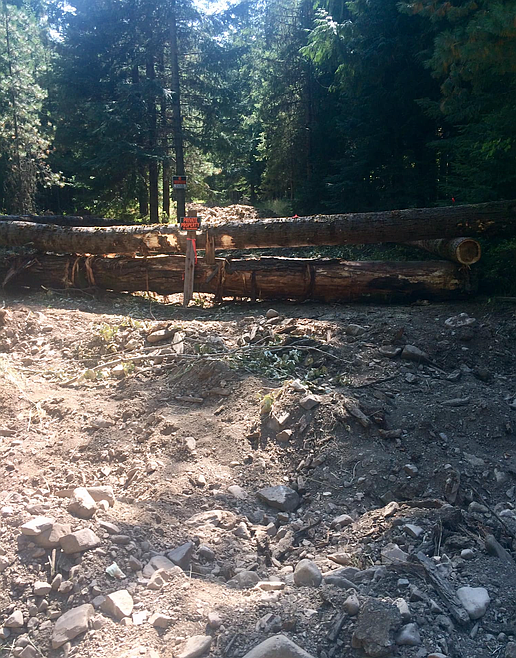
This photo, from 2020, shows the original blockade that resident Joe Avery placed across West Fork Pine Creek Road. The blockade resulted in five years of legal battles, including a petition for Shoshone County to validate the road. Recently, the Idaho Supreme Court upheld the county's decision to deny road validation, but also ruled that the road constitutes a public right-of-way.
Courtesy photo
WALLACE — A recent decision from the Idaho Supreme Court may have raised more questions than it answered in one of Shoshone County’s most contentious legal disputes.
In April, the court heard oral arguments from Shoshone County Prosecutor Benjamin Allen and attorney David Claiborne during a special Law Day session at the University of Idaho’s Menard Law Building. The case centered on the appeal of a decision involving West Fork Pine Creek Road.
The dispute began in 2020, when Pine Creek property owner Joe Avery blocked access to a section of the road long used to reach a popular recreation area on Bureau of Land Management land.
While alternative routes exist, they are either significantly longer or subject to seasonal closures and private easements. After prolonged debate over jurisdiction, Paul Loutzenhiser, represented by Claiborne and Sawtooth Law Offices, filed a petition for road validation in 2022.
Road validation is the formal process of confirming the existence of a road that rightfully belongs to the public.
In an opinion authored by Justice Colleen Zahn, the Idaho Supreme Court affirmed the decisions of both the Shoshone County Board of Commissioners and the District Court, denying validation of the disputed section.
While the ruling appeared to conclude a five-year public dispute, it also perpetuated legal ambiguity stemming from the court’s 2023 decision in Hill v. Blaine County. That landmark case established that a county could deny a validation petition, but if a public road previously existed, the public might still retain access rights.
Petitioners were required to demonstrate both historical use and public interest. Claiborne argued the county had disregarded historical evidence of the road’s longstanding public use. According to records he submitted, the road was established and recorded by the BOCC in 1909, with no subsequent record of vacation or abandonment.
Although this evidence was previously dismissed by the BOCC and lower courts, Justice Zahn acknowledged its validity. However, that alone was not enough to overturn the rulings.
“While we conclude that the Board erred in determining that the 1909 meeting minutes did not establish a public road, we find no error in the Board’s determination that validation of the road was not in the public interest,” Zahn wrote. “As a result, we affirm the district court’s decision affirming the Board’s denial of the petition for validation.”
The road’s historical status is now settled. But because that fact was central to the denial of validation, the question of public interest may be reopened.
During the original hearing, commissioners argued that validation would impose a significant financial burden, requiring the county to survey, upgrade and maintain a road it had not previously recognized as public.
During oral arguments, Justice Gregory Moeller noted a lack of specificity in the county’s public interest analysis. Allen responded, as he had during the district court appeal, that under Idaho’s road validation rules, a BOCC is not required to provide detailed findings, and the burden of proof lies with petitioners.
Despite this, the ruling provides partial clarity: Shoshone County is relieved of jurisdictional responsibility over the disputed section. At the same time, the court’s recognition of the road’s historical establishment, without clarifying who controls its use, could pave the way for a vacation petition or renewed validation effort, now that one of the two required elements has been affirmed.
In the meantime, the Supreme Court’s ruling suggests the road should remain open to the public. In a letter to Allen and the county, Claiborne expressed the petitioners’ desire for continued public access.
“As relates to West Fork Pine Creek Road, though Shoshone County has not accepted jurisdiction of the road, it is still a recognized public road by the Court,” Claiborne wrote. “The decision is clear on this point. The county is not claiming jurisdiction over the road by reason of its denial of validation. But, according to the reasoning in Hill, even though no jurisdiction has been established over the road, that does not mean that it cannot be used by the public. Based on the Court holding that the 1909 Board meeting established the road as a public highway, it is lawful for the public to immediately use this road.”
Claiborne also requested assurances that the county would enforce Idaho laws against blocking a public right-of-way if access were again restricted.
Loutzenhiser acknowledged frustration that the validation was denied but emphasized that the Supreme Court answered the core question he sought to resolve.
“The Supreme Court answered that question without any doubt,” Loutzenhiser said. “I have sent a letter to BLM explaining that with Supreme Court’s ruling qualifies it as a road and that we expect them to stop trying to illegally close it.”
He added that his motivation extended beyond off-road enthusiasts.
“This is a historic access for all recreationalists, including fishing, hunting and huckleberry pickers. With the opportunity for grants, this should never cost the county anything and only bring revenue.”
The initial ruling came from a previous board of commissioners, none of whom remain in office. They declined to comment on the Supreme Court’s decision. Joe Avery also did not respond to requests for comment.
The current board declined to comment as well but held an executive session earlier this month to discuss the ruling and Claiborne’s letter. According to Allen, who couldn't provide much information due to the meeting's privileged status, the board decided to provide copies of the letter to Avery and other nearby property owners.
ARTICLES BY JOSH MCDONALD
Wet weather could help contain Dudley Fire
Wet weather could help contain Dudley Fire