
IDL begins expanded spongy moth trapping effort
JACK FREEMAN | Hagadone News Network | UPDATED 8 months, 2 weeks AGO
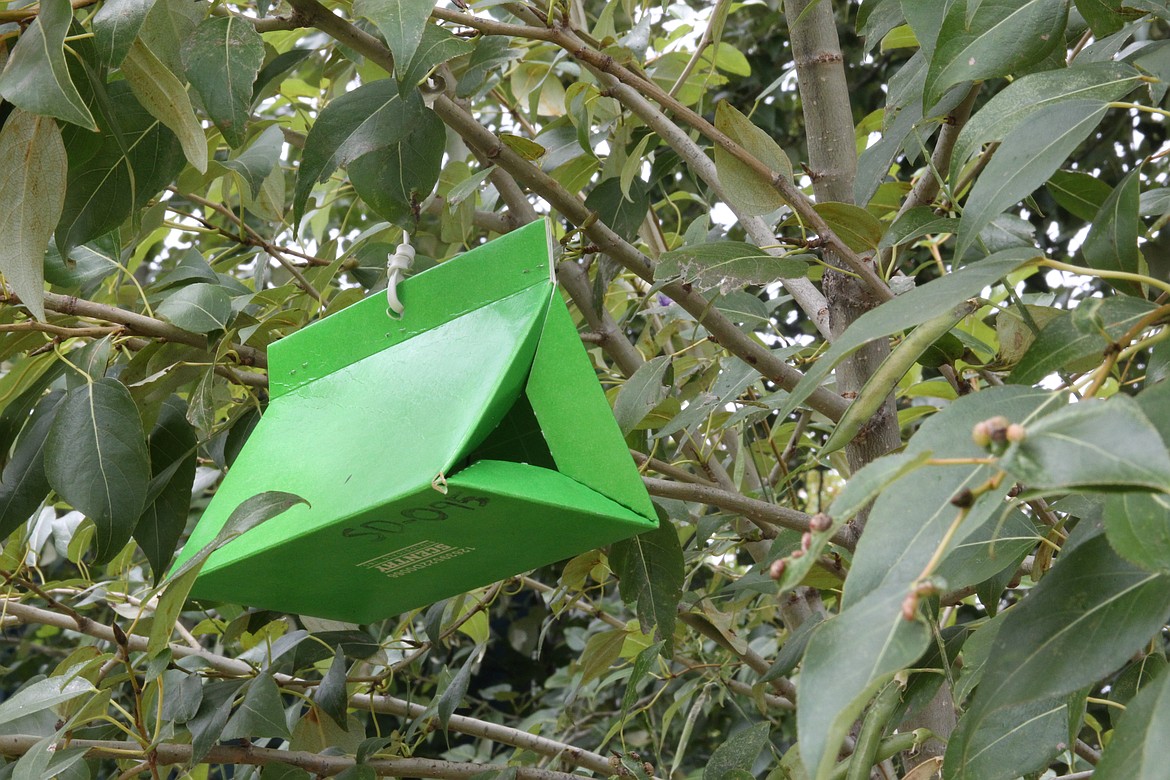
A trap placed by the Idaho Department of Lands sits off the side of the road in Sandpoint.
Photo by Jack Freeman
SANDPOINT — The Idaho Department of Lands has placed around 130 traps in the trees of the Sandpoint area, in the hopes of ascertaining the level of threat posed by some very hungry caterpillars.
The traps are a part of the expanded effort on behalf of the department to capture an invasive species, called the spongy moth. Last year, a single European spongy moth was found in Sandpoint for the first time in 30 years at the intersection of Oak Street and Division Avenue.
“At this point, with what we know today, there is not a cause for alarm,” Erik Bush, Sandpoint’s urban forester, said. “It’s basically the system working ... fingers crossed, we find out it’s just a one-off.”
The spongy moth is most dangerous in its caterpillar phase, when it mainly eats leaves of trees, especially oak trees. While one caterpillar doesn’t pose a threat, a large group of spongy moth caterpillars has the ability to completely defoliate trees, leaving them weak or killing them.
“It can feed on a pretty broad range of broadleaf trees,” Erika Eidson, who runs the IDL’s spongy moth trapping program, said. “Since it’s an invasive insect, there’s not a whole lot of natural control, so when we have outbreaks, it can be pretty extensive.”
The spongy moth does not have a foothold in Idaho, but does in the eastern United States, where it causes millions of dollars in damages to trees every year, according to the IDL.
Bush said that the risk posed by the spongy moth varies by population and that the city and IDL will have a much better idea of the situation once the trapping is complete. The worst-case scenario for this year’s traps would be dozens or hundreds of spongy moths being captured, an initial sign of an infestation, Bush said.
If that were to occur, Sandpoint would see an even larger increase in traps the following year, according to Eidson. If an established pattern of infestation is found after that, the IDL would move for eradication efforts.
“Usually when we catch just one or two, no further treatment is needed,” Eidson said. “If we had caught like 100 spongy moths, then I would be a lot more concerned about heading in the direction treatment.”
In the 51 years of the spongy moth trapping program, there have only been five instances of treatment for invasive moth. The last time an area was treated for the insect was in 2005, when a specimen of the more unknown and dangerous Asian spongy moth was captured the year prior in Kootenai County.
Sandpoint experienced a breakout of spongy moths in the late 1980s, where the peak population reached 334 moths being captured in one year. However, the population was eliminated from the area by 1991, according to the IDL.
“It is one of those things that comes through periodically,” Bush said. “But if you catch it early, which is the whole point of the monitoring program that IDL does, you can usually get a handle on it.”
Female spongy moth cannot fly, which limits their ability to spread naturally, so it relies on having infected materials transported into unaffected areas. Spongy moths usually attach their egg masses to smooth outdoor surfaces like patio furniture, firewood, or tree bark.
The IDL lays traps for spongy moths every year, and the initial process runs from July through August. Once the traps are collected, every capture goes through DNA testing and Eidson will alert Sandpoint officials if more are found.
The traps are built with sticky walls and a pheromone lure inside to lure in male spongy moth. The IDL is asking that the bright green traps be left alone and undistributed.
“Just leave the traps alone,” Eidson said. “Our goal is truly just to get the best data so that we can make sure that we do not have an invasive insect problem.”
ARTICLES BY JACK FREEMAN

Outgoing POP executive director wins statewide award
That effort combined with the construction of nearly 20 miles of new trail and a new trail management plan has earned her the 2026 Professional Award for Parks, Trails, or Conservation from the Idaho Recreation and Parks Association.

APRIL NIBJ: Nonprofits help people follow their life’s compass
Kanning’s story isn’t unique, ask any worker at one of the 500 nonprofits in Bonner County are you’ll likely hear the same reason for working: it feels right.

Ponderay to begin Black Rock clean-up project
With the approval of a memorandum of agreement with Sandpoint on Wednesday evening, the city of Ponderay is now able to begin its Black Rock clean-up project next week.