
RICO suit alleges widespread use of falsified information
CHLOE COCHRAN | Hagadone News Network | UPDATED 8 months, 1 week AGO
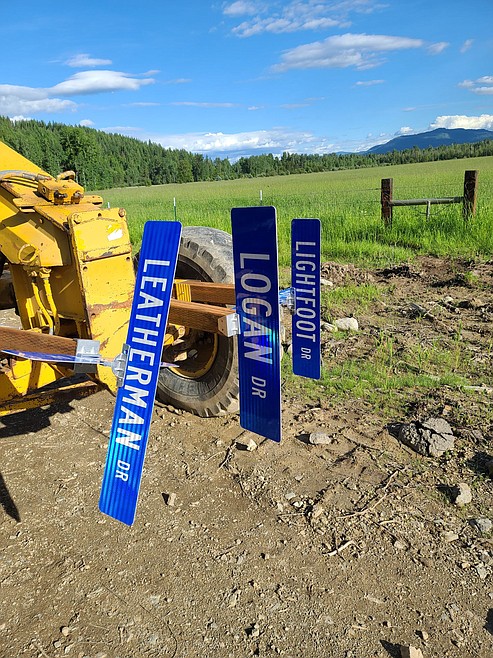
A Sandpoint area homeowner contends septic conditions in his development are not what they should be, saying he is concerned about the drinking safety and flooding of the area's wetlands.
(Courtesy photo)
PONDERAY — Several Bonner County residents are demanding a jury trial to address their claims that false information and faulty labor created by a minor land division has led to trouble since they purchased homes in the Ponderay subdivision.
David and Linda Wittwer, The Wittwer Family Trust, Daniel and Sharla Doyle, Daniel L. Doyle and Sharla K. Doyle Trust, Michael and Grace Williams and Lee Wilson filed a RICO lawsuit July 18, containing that the Mountain Homestead development was allegedly established under falsified information and faulty labor through the use of the minor land division process — a land division process that is currently under a moratorium.
A RICO lawsuit, also known as a “racketeer influenced and corrupt organization act,” allows government to punish individuals associated with criminal activities such as racketeering. In this suit, the plaintiffs allege that defendants — a mix of governmental entities and private companies — conspired together to sell divided property to the plaintiffs through misrepresented information.
Over 50 independents and agencies were named in the suit, allegedly conspiring together through “negligent” and “fraudulent” behavior to receive monetary compensation through the plaintiffs’ purchase of residences in the development.
Among the defendants named were J&J Development LLC, Jason Marble, Glahe & Associates, Tyson Glahe, Joshua Pilch, Milton Ollerton, Jeff Connolly, Steven Bradshaw, Daniel McDonald, Bonner County and Panhandle Health District. Others named were real estate agents who sold the homes, Panhandle Health District workers and other individuals alleged to have suppressed evidence of developmental errors and loopholes that led to significant problems faced by the plaintiffs.
It was noted in court documents that Marble served as a commissioner for the Bonner County Zoning Commission and Pilch as a commissioner for the County’s Planning Commission during the time the subdivision under question was divided. Both are co-owners of J&J Development. Additionally, Ollerton served as the county’s planning director.
A complaint and demand for jury trial document indicates that the Mountain Homestead development started as 41.6 acres, purchased by J&J Development in December 2018 with the intent of dividing the property into multiple residential lots.
In early 2019, Tyson Glahe and Glahe & Associates represented J&J in submitting two MLD applications, seeking the ability to divide the property into eight total lots. Documents indicate that J&J had divided the property into two separate lots of about 20 acres. However, the MLD application was filed for a single, 41.6-acre lot. Plaintiffs allege the faulty application as the first false claim by a party involved with the property.
The MLD application specified that each lot would follow the requirements of Rural 5 zones, being at least five acres in size. A plat in the application equally showed a proposed lot size as 5.1-plus acres. However, it’s alleged in the lawsuit that Glahe created two plats for the MLD application, with only one meeting the five-acre requirement and the others showing 4.83-acre lot sizes. Court documents note that Glahe only submitted the plat showing five-acre lots to the Bonner County Planning Department for approval.
It was noted that markers were placed on the original property to indicate the five-acre parcels but were allegedly buried and replaced with markers showing 4.83-acre lots. Documents indicate that the original markers can still be seen on the properties.
It wasn’t until the approval of the MLD application that J&J and Glahe submitted an exemption request to reduce the lot sizes to 4.83 acres. Upon approval of the new lot sizes, an “illegal” lot was created with the leftover acreage, which accounted for 2.15 acres.
The other 20-acre parcel, after the approval of four 4.83 acre lots, saw an additional “illegal” lot of one acre.
J&J allegedly indicated to the plaintiffs that the extra land would be partially used as a right-of-way to access their applicable properties, known as “Logan Drive.”
County commissioners at the time approved the file, allegedly “rubber-stamping” the request for an eight-lot land division that resulted in 10 lots, the plaintiffs contend in the lawsuit.
Plaintiffs argue that all of the issues coming from the improper land division could have been resolved through the county commissioner’s proper assessment of the proposed development.
Court documents further indicate that the construction of Logan Drive was done without meeting proper Idaho Transportation Department or Bonner County private road standards. After obtaining an estimated $400,000 quote to build the road, J&J opted to build the road themselves.
Plaintiffs contend the road was not built in the correct place, sitting partially on another third-party homeowner’s driveway.
ITD noted that the road was never approved, and that it would likely need safety improvements. The road additionally was built to not meet proper road width requirements and was built over utility lines.
Additionally, documents note that plaintiffs in the case remain uncertain about their legal rights to the road, as J&J sold it to defendant Ruth Barbey without the development’s property owner’s consent or knowledge.
J&J allegedly retained ownership of the 2.15-acre lot in Mountain Homestead and the one-acre lot that is considered the eastern portion of Logan Drive, for which he later sold the properties to Barbey who allegedly had intentions to create a 17-parcel lot using Logan Drive as an access point to the parcels.
While Barbey didn’t originally have access to all of Logan Drive, J&J allegedly inaccurately utilized a scrivener’s affidavit that allowed Barbey to expand her rights to the road.
A scrivener's affidavit is a document used to address minor mistakes such as typographical mistakes in a legal document. It is not intended to alter substantive rights or intentions of the involved parties.
Documents allege that J&J, Glahe, and agents of TitleOne title and escrow company and Barbey “conspired to defraud Mountain Homestead owners with the execution of the fraudulent scrivener’s affidavit and improper transfer of Logan Drive to Barbey” without the homeowner’s consent or knowledge.
Additionally, in further court documents, the plaintiffs claim that J&J executed easement agreements for a shared well and sewer system. A shared sewer system was approved for usage among the eight properties where the property was only fit to support a single home sewer system. Documents show that one well serves four properties in each of the divided 20-acre sections.
Plaintiffs contend that the well is located on one of the homeowner’s property, where the other homeowners cannot access the well without obtaining permission from that homeowner.
Mountain Homestead is located on a floodplain, leading to floods correlated to damaging houses and causing health concerns to property owners. The plaintiffs allege the flooding is partially due to the central septic system’s installation, which was done by Pilch, a licensed septic system installer for Panhandle Health District.
Plans of the drain field and central septic system were allegedly submitted to PHD and approved in December 2019. However, in August 2020, PHD noted that the drain field and septic system had not been constructed according to the plans submitted.
Other issues allegedly persisted due to what the plaintiffs contend was the incorrect installation of the system, including the septic tanks being installed lower than required for the high groundwater area. Pilch was allegedly seen multiple times on the homeowner’s property “attempting to obtain permits for some of the tanks by pretending to raise the tanks to proper depths” by “moving earth around some of the nonconforming tanks to make it appear that he has raised them.”
Due to how the tanks were installed, plaintiffs allege that it has resulted in “significant flooding, sometimes multiple feet of sewage water standing on a homeowner’s land.”
According to court documents, the overflow has contaminated the plaintiff’s well water, as “reflected in third-party tests, showing coliform bacteria, E. Coli, arsenic, nitrates and other harmful materials.”
Several plaintiffs claim that serious illnesses and skin conditions have resulted from the contaminated water.
Complaint documents highlight further issues of alleged neglect, following fabricated documents and faulty work. Plaintiffs urged that the defendants of the case allegedly intentionally misrepresented conditions of the property and information that was relied on heavily throughout the homeowner’s purchasing process.
Should the requested jury rule in the plaintiffs’ favor, the defendants will be required to, among other restitution, award an unspecified amount of damages, pay to connect the homes to sewer and water and fix property issues allegedly relating to negligence and fraudulent actions.
The case will be heard in Boise at the U.S. District Court by Judge Amanda Brailsford at an undetermined date.
ARTICLES BY CHLOE COCHRAN

Armstrong addresses Careywood closure, wildfire deployment concerns
Misinformation and criticism surrounding local fire services were the subject of Tuesday’s “community chat” as Bonner County Commissioner Asia Williams hosted Northside Fire Chief Jeff Armstrong at the event.

Guzzi enters county clerk race
Long-time public servant JoAnne Guzzi has announced her candidacy for Bonner County Clerk.

Williams addresses jail roof, path forward
During a recent Tuesday business meeting, Commissioner Asia Williams provided clarity on long-standing discussions surrounding repairs to the Bonner County jail’s leaking roof.