
Royal Dairy models self-sufficient farming
JOEL MARTIN | Hagadone News Network | UPDATED 1 year, 4 months AGO
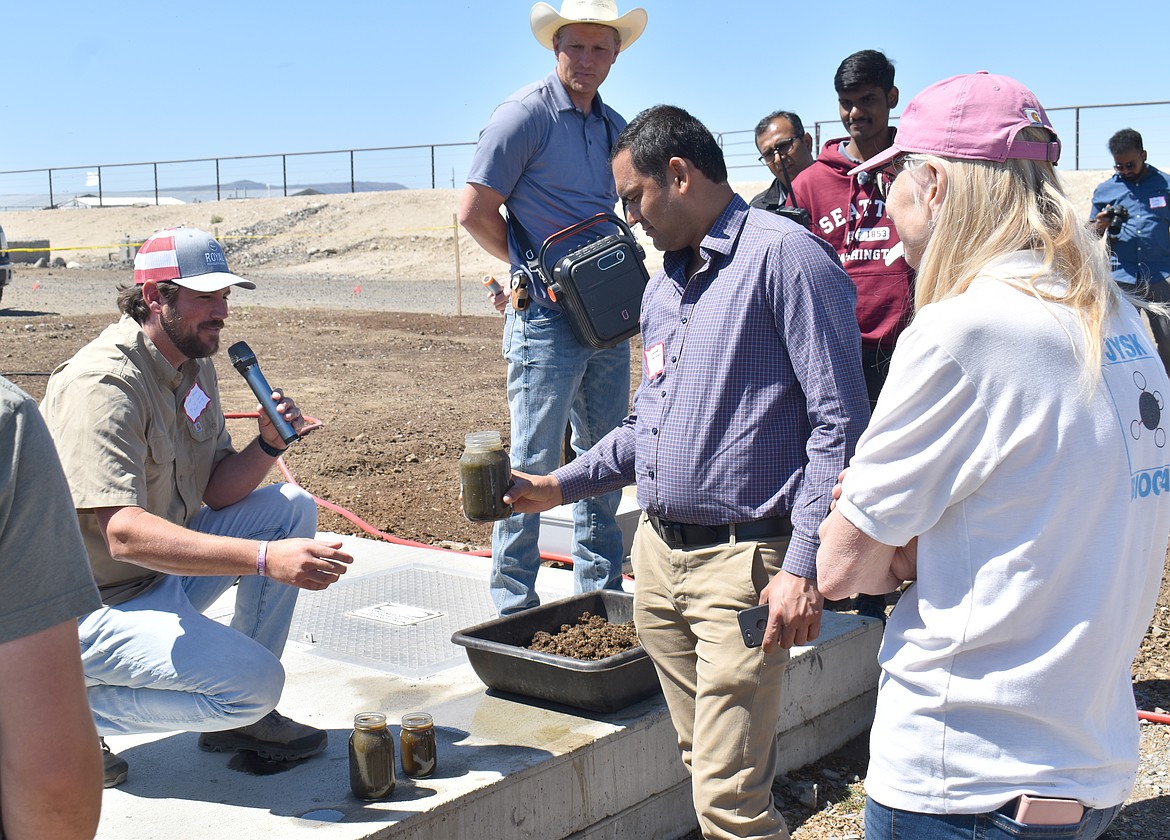
Royal Dairy Vice President of Regenerative Agriculture Michael Hebdon shows Washington State University researcher Muhammad Usman Khan the difference in liquid waste before and after it’s been processed through the dairy’s five-acre worm farm.
JOEL MARTIN/COLUMBIA BASIN HERALD
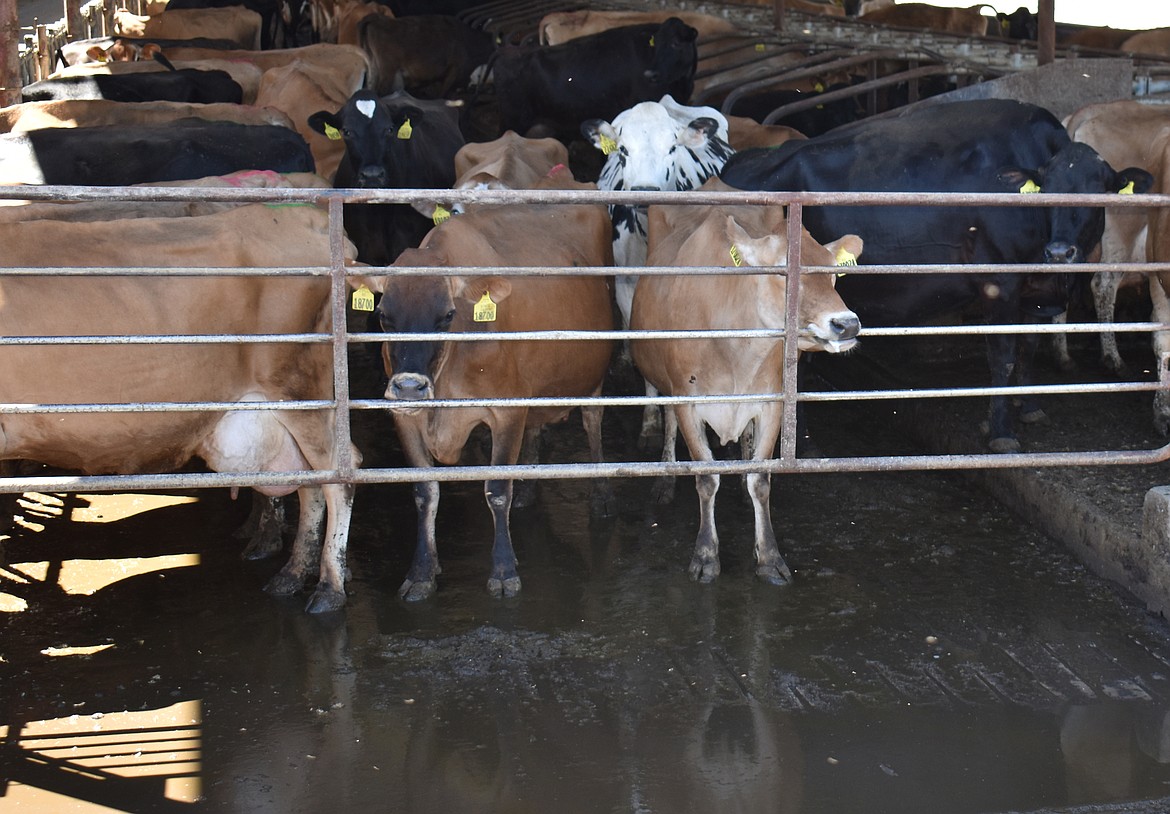
Cows at Royal Dairy watch curiously as the tour passes by at WSU’s Climate-Smart Dairy Farming: Research & Demonstration Field Day Friday.
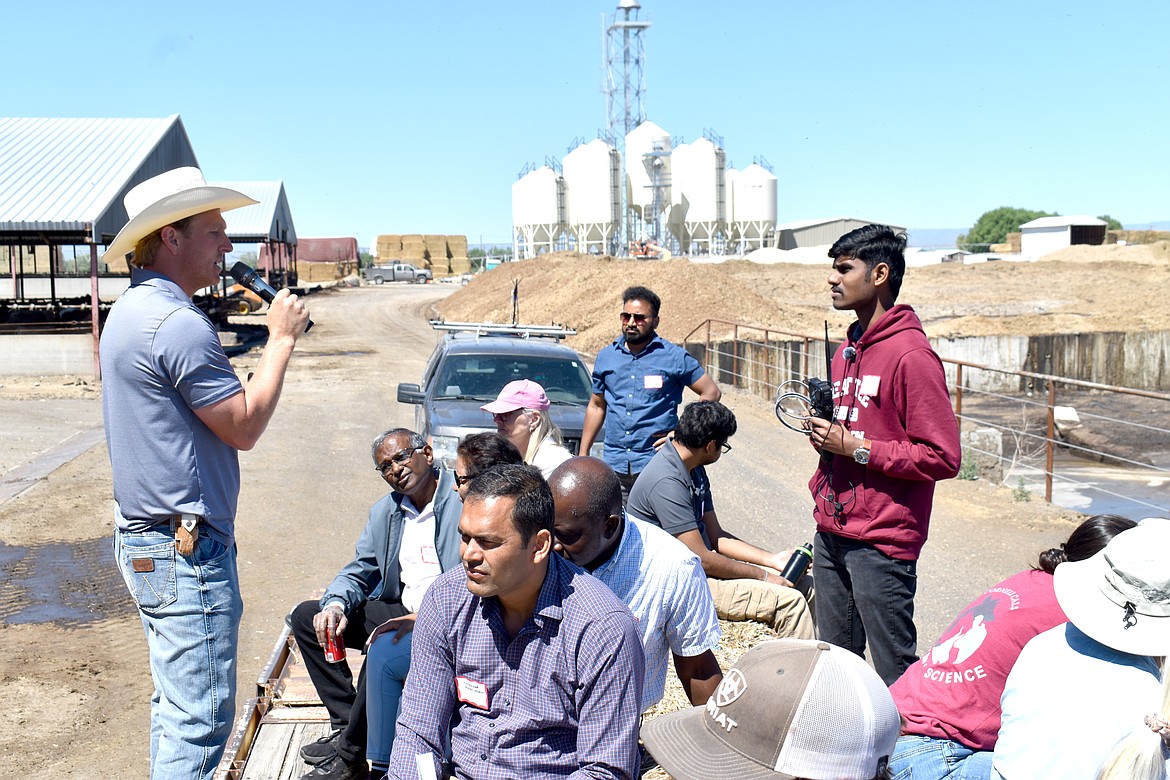
Austin Allred, left, owner of Royal Dairy, speaks to a group of Washington State University researchers and others about his operation’s sustainable agricultural processes.
Joel Martin has been with the Columbia Basin Herald for more than 25 years in a variety of roles and is the most-tenured employee in the building. Martin is a married father of eight and enjoys spending time with his children and his wife, Christina. He is passionate about the paper’s mission of informing the people of the Columbia Basin because he knows it is important to record the history of the communities the publication serves. | June 2, 2025 3:00 AM
Key points:
- Royal Dairy, part of Royal Family Farms, hosted a field day highlighting sustainable agricultural practices Friday morning.
- Staff explained that waste products from each branch of the business could be used in a way that cut costs and added efficiency to operations.
- Royal Dairy officials said their goal is to ensure farming is sustainable for coming generations.
ROYAL CITY — Words like “sustainable” and “regenerative agriculture” get tossed around a lot. But a Royal Slope farm recently showed the world how it works in reality.
Royal Dairy, about five miles west of Royal City, hosted the Climate-Smart Dairy Farming: Research & Demonstration Field Day in conjunction with Washington State University. The event demonstrated both the dairy's own methods and some of the technology it’s been testing for the university.
“In every way possible, we take our wastes and make them into soil amendments, everything from manure to fruit and cold produce and all that, compost it all down,” said Michael Hebdon, the vice president of regenerative agriculture at Royal Dairy. “And then we've partnered with a large group of apple and cherry growers to bring in their retired trees and make biochar out of that, and then blend all that together and get it back onto the farms and fields.”
About 30 people came to the field day for a tour of the farm and to see presentations from WSU and Cornell University experts about methane-sensing technology and more efficient methods for converting manure to biogas.
Hebdon drove the visitors around the farm on a flatbed trailer with hay-bale seats, while Royal Dairy owner Austin Allred explained what they were looking at. Besides the milking barns, feeding pens and other things typical of a dairy farm, guests got to see Royal Dairy’s “kitchen,” where the animal feed is made, and worm farm.
Royal Dairy is part of the much larger Royal Family Farms operation, Hebdon explained. The family owns another dairy near Moxie, as well as four feedlots, a beef processing facility, a rock quarry, 15,000 acres of potato farms and 15,000 acres of fruit orchards. That means that just about anything that one arm of the operation needs, another can supply.
The overwhelming majority of Royal Dairy’s animal feed is grown on other Royal Family farms, Allred said.
“My dad is a potato farmer,” he said. “What that means is he grows potatoes once every five or six years. In the meantime, (cattle feed) is what he grows, and he does that for a healthy rotation to keep his soil healthy and sustainable … Anytime you're growing something that our digestive system can handle, meaning potatoes, onions, carrots, those products really put a lot of pressure on the soil. You cannot plant vegetables for human consumption back-to-back to back-to-back if you want to be farming for the next decade and decades.”
Those plants are upcycled into protein as cattle feed, he said, and the manure that the cattle create in return is flushed out of the pens twice a day into a screw press to separate the liquid from the solids. The solid material is sent to be composted, and the liquid goes to the five-acre worm farm.
“After our mechanical separation systems, it gets down to where it’s about 60%, 70% cleaner than (untreated waste),” Allred said. “But once we get through the worm farm, we remove about 98% of all the solids and there’s almost no smell. (And) once the liquid manure gets through this process, the capacity to create methane is nearly 100% removed.”
The wood chips that the worms live in come from Royal Family’s orchards, Allred said, putting retired fruit trees to good use. The chips are also used to make biochar, which keeps compost from losing precious nitrogen. Nitrogen is the most expensive thing Royal Family Farms procures from outside its own operations, he said.
“For the last decade, we've been really focused on trying to grow more with less synthetic inputs, with less imports, because that allows us to be more sustainable and hopefully around longer for our kids and for the future,” Allred said. “Our biggest expense (on the farm) is fertilizer, and on the dairy our biggest expense is feed. Being able to close that loop and work that all into our system, fertilizer from the cattle, feed for the cattle, and integrating the worms and the compost and the biochar systems help us to slowly work towards reducing our dependency on synthetics.”
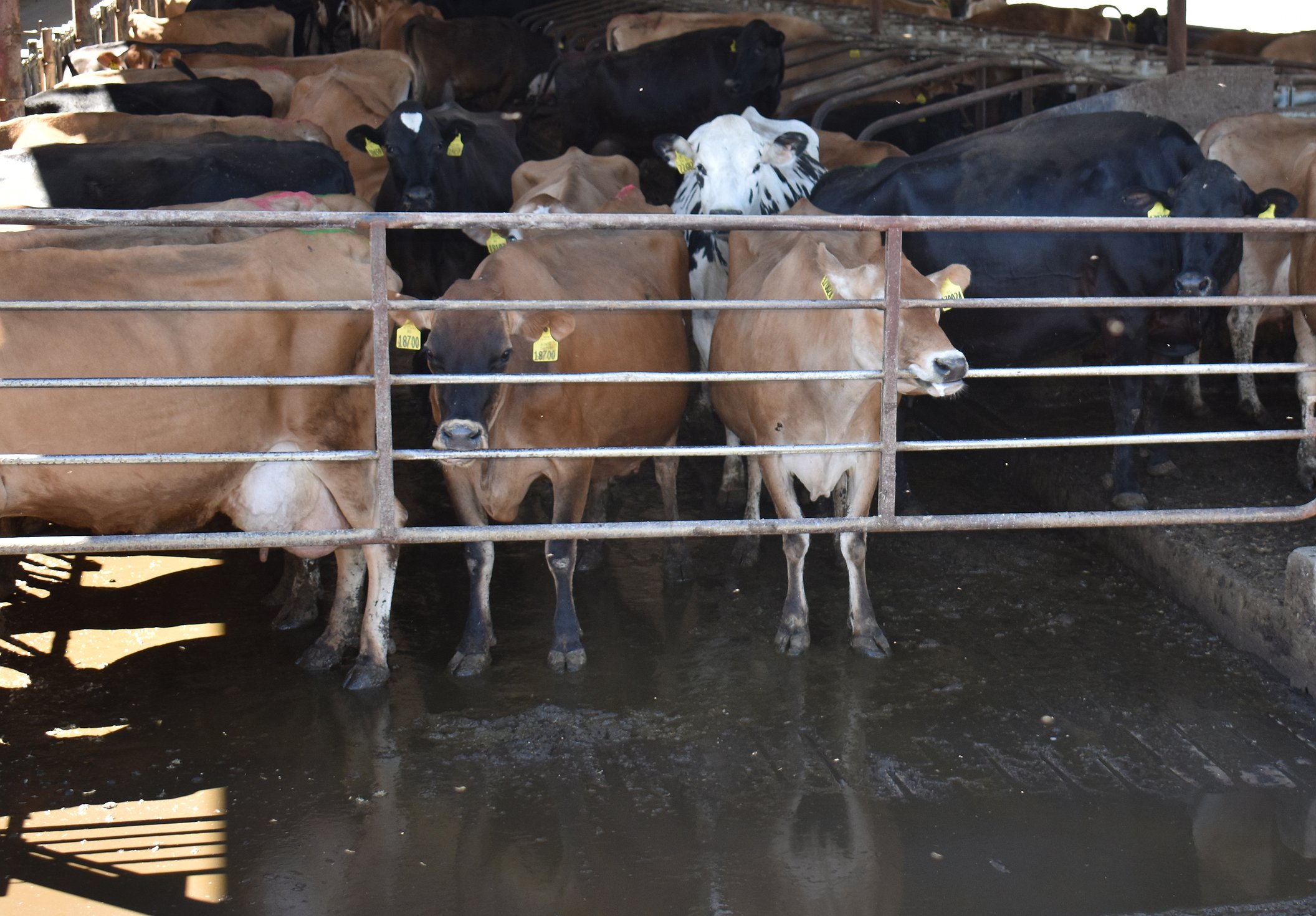 Cows at Royal Dairy watch curiously as the tour passes by at WSU’s Climate-Smart Dairy Farming: Research & Demonstration Field Day Friday.
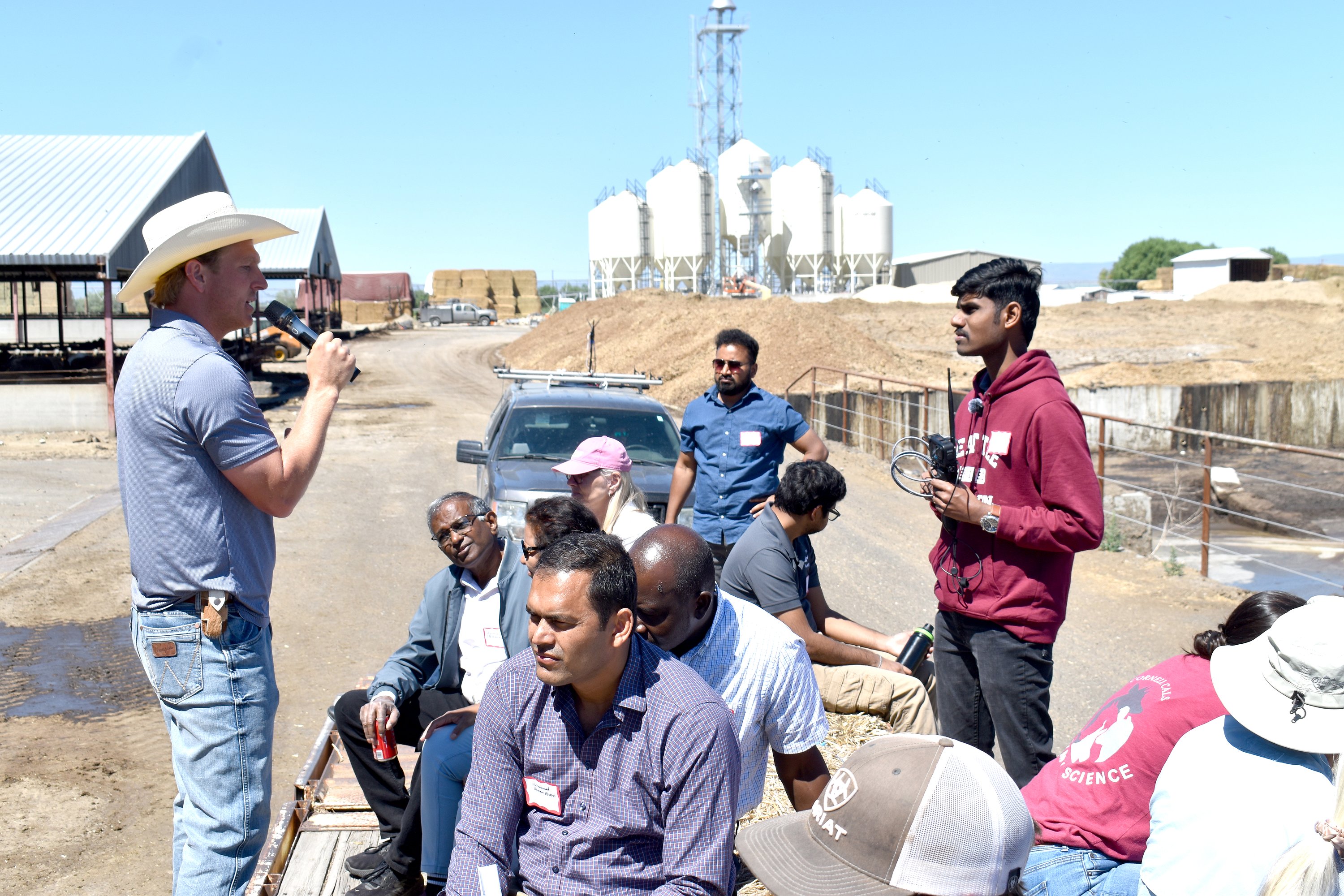 Austin Allred, left, owner of Royal Dairy, speaks to a group of Washington State University researchers and others about his operation’s sustainable agricultural processes.
ARTICLES BY JOEL MARTIN
Endless battle
Noxious Weed Control Board works to keep invasive plants under control
MOSES LAKE — Some of the nastiest plants in Grant County were the topic of a class led by Jay Johnson, a consultant with the Grant County Noxious Weed Control Board, Tuesday. The Noxious Weed Control Board, as its name would suggest, is tasked with keeping weeds under control in Grant County. That’s not a small job; the board’s website lists 129 species of noxious weeds that are found around Grant County. A noxious weed is defined as an invasive, non-native plant that threatens agricultural crops, local ecosystems or fish and wildlife habitat, according to the Noxious Weed Control Board. Washington state law requires that these weeds be identified and their spread kept to a minimum, if not completely eradicated. “We’re one of those agencies a lot of people don’t really understand,” Johnson said. “We’re a county office and … our funding is tax-based assessment. When you get your tax bill and you look down at all the expenses that you pay for, there we are.”

BASIN EVENTS: Oct. 16-24
COLUMBIA BASIN — Whether you feel like shopping, crafting, learning or seeing a show, there’s something happening for you this week in the Basin. Oct. 16 ‘My Family (Mi Familia)’ screening Spanning three generations, “My Family (Mi Familia)” is a heartfelt drama that follows the Sánchez family as they build their lives in East Los Angeles. Through love, hardship, triumph, and sacrifice, the film explores the immigrant experience, the strength of family bonds, and the traditions that connect one generation to the next. Lowrider show and taco truck before the screening. Sponsored by Columbia Basin Allied Arts, EDUBS C/S and the Moses Lake Creative District. $12 per person. Doors open at 6 p.m., film begins at 7 p.m. at the Moses Lake Civic Center Auditorium, 401 S. Balsam St. Tickets and info: www.cba-arts.org.
Moses Lake author encourages women to look beyond church culture norms
MOSES LAKE — A Moses Lake author’s book, “A Christian Woman Striving to Live Her Faith in a Man-Controlled World,” takes aim at the role to which many churches relegate the female half of their congregations. “It’s to encourage women in the faith,” Linda Curran said. “A lot of churches say, ‘Teach Sunday school, do this, do that, but don’t (evangelize.)’" In her book, Curran recounts a time when she moved to a new community and joined a church there. She was surprised to learn that, as a new female member, she had been automatically assigned church cleaning duties. When she questioned it, she wrote, she was met with condescension and her objections were brushed aside. In other churches, she said, women who were capable of teaching were relegated to “women’s ministry.”