
Daines bill would let tribal courts handle drug crimes committed by nonmembers
HAILEY SMALLEY | Hagadone News Network | UPDATED 9 months, 3 weeks AGO
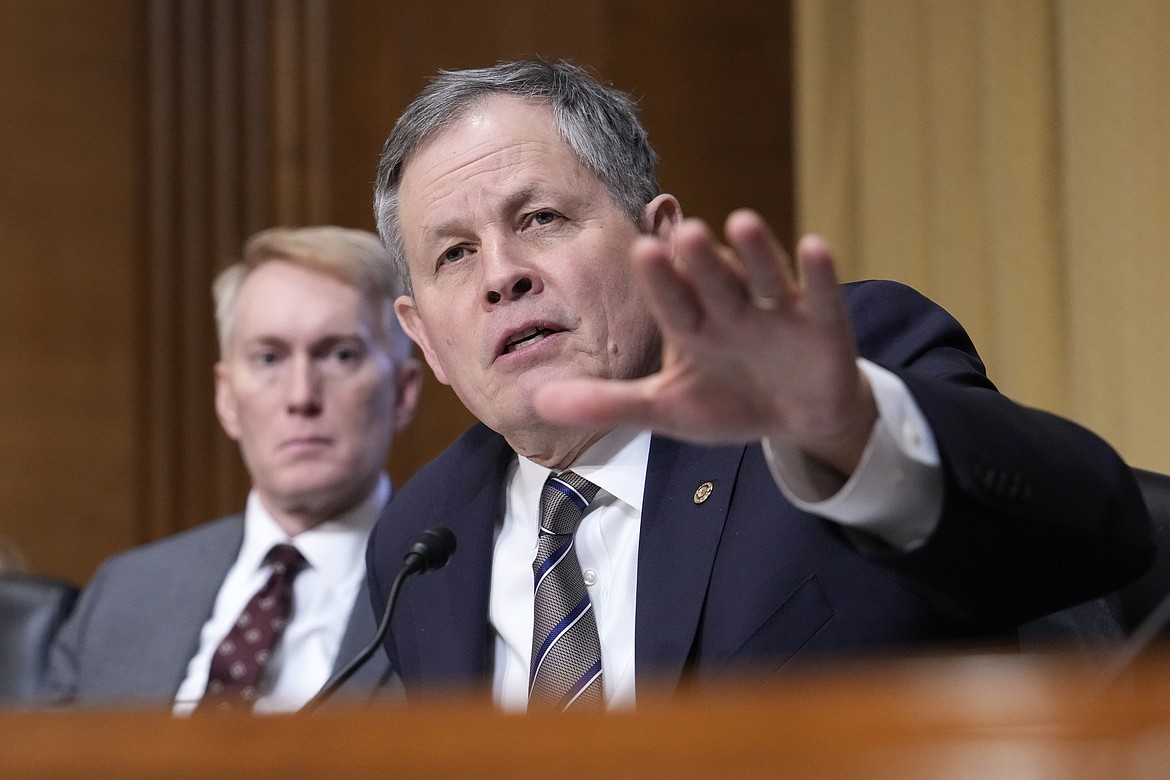
Sen. Steve Daines, R-Mont., speaks at the Senate Finance Committee confirmation hearing for Scott Bessent, President-elect Donald Trump's choice to be Secretary of the Treasury, at the Capitol in Washington, Jan. 16, 2025. (AP Photo/Ben Curtis, File)
New legislation from Republican Sen. Steve Daines aims to combat drug trafficking on reservations by expanding the powers of tribal courts.
Tribes cannot press charges against nontribal members, even if the crimes were committed on tribal lands or against tribal members. Instead, they must rely on state and federal courts to prosecute and punish criminals.
The PROTECT Act, introduced by Daines and Sen. Tina Smith, D-MN, on June 5, would change those restrictions in cases of drug possession or trafficking. If passed, the act will allow tribal courts to prosecute anyone for drug-related crimes committed on tribal land, regardless of their tribal affiliation.
“Too often, drug traffickers exploit the complex legal jurisdictions surrounding reservation land and use those loopholes to smuggle deadly drugs like fentanyl and opioids onto our reservations, which leads to an increase in violent crime and threatens the safety of those communities” Daines said of his motivations for introducing the legislation.
According to the Montana Department for Health and Human Services, Native Americans in Montana face drug overdose death rates three times those of their non-Native counterparts. Some, including Mark Macarro, president of the National Congress of American Indians, link that disparity to tribes’ limited ability to enforce drug laws.
At a Feb. 12 meeting with the Commitee of Indian Affairs, Macarro illustrated the challenges many tribal law enforcement agencies face by describing a hypothetical encounter between a tribal police officer and a nontribal member found dealing drugs on a reservation.
“They take them to the county line, and if the tribal police are lucky, there will be county police or county sheriffs to accept the criminals, but maybe not,” said Macarro. “And [the criminals] just go away and come back within hours sometimes — sometimes within a day — and do it all over again and it just doesn’t end.”
Macarro described it as a revolving door, in which the same offenders continue to commit the same crimes on reservations.
In 2013, Congress observed a similar phenomenon in domestic violence cases that occurred on reservations. Faced with escalating rates of violence against Native women, the federal government established what is now known as the Special Criminal Jurisdiction for Tribes program. Tribes that voluntarily enrolled in the program were given the jurisdiction to prosecute all domestic violence cases within the tribal court system, regardless of the defendant's race or tribal affiliation.
Within five years, 18 tribes enrolled in the program, resulting in more than 140 arrests and nearly 75 convictions for domestic violence. In 2022, the program was expanded to include other crimes, such as sexual violence, sex trafficking, stalking and endangerment of a peace officer. The language of the PROTECT ACT would further expand the Special Criminal Jurisdiction for Tribes program to include drug-related crimes.
The only tribal government in Montana currently enrolled in the program is the Assiniboine and Sioux Tribes of the Fort Peck Indian Reservation, but leaders from other reservations, including the Flathead Indian Reservation, have expressed interest in expanding their tribal court systems.
“We’ve already begun a comprehensive strategic planning effort to expand the capacity of our courts,” said Michal Dolson, chair of the Confederated Salish and Kootenai Tribal Council. “The PROTECT Act would support the vision we hold for our courts, to protect and serve while helping families climb out of the addiction cycle.”
The legislation has also garnered the support of Attorney General Austin Knudsen, the Northern Cheyenne Tribe and the Assiniboine and Sioux Tribes of the Fort Peck Indian Reservation. Congressman Ryan Zinke signed on to co-sponsor the bill in the House of Representatives.
Some of the 31 tribes currently enrolled in the Special Criminal Jurisdiction for Tribes program have received grant funds to help develop tribal court services that meet the program’s requirements. It remains unclear if the PROTECT Act would designate additional funds to tribes interested in developing drug-related law enforcement and rehabilitation services.
In email correspondence with the Daily Inter Lake, Daines’ office stated that the senator is currently focused on passing the act, though funding law enforcement remains a top priority during the appropriations process.
The PROTECT Act has not yet been scheduled for a hearing.
Reporter Hailey Smalley may be reached at 758-4433 or [email protected].
ARTICLES BY HAILEY SMALLEY

Federal judge pauses logging project near Whitefish
A 9,000-acre logging project near Whitefish is on hold after a federal judge in Missoula ruled that the U.S. Forest Service failed to properly account for potential impacts to lynx habitat.
Federal judge pauses logging project near Whitefish
A 9,000-acre logging project near Whitefish is on hold after a federal judge in Missoula ruled that the U.S. Forest Service failed to properly account for potential impacts to lynx habitat.
State plans new 48,000-acre conservation easement near Thompson Falls
State wildlife officials plan to tack on another 48,000 acres to an existing block of conservation easements near the Thompson chain of lakes.