
Ruis going full steam ahead on CFAC property
CHRIS PETERSON | Hagadone News Network | UPDATED 9 months, 1 week AGO
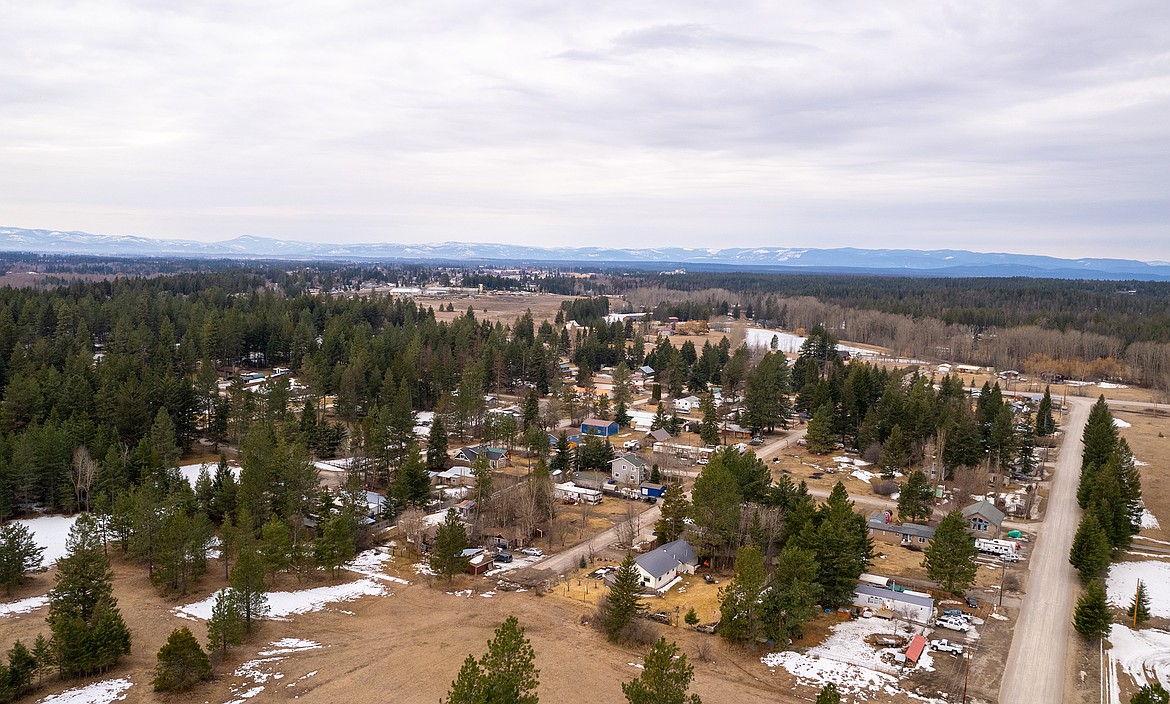
Aluminum City looking back to the west. The land in the foreground would be the first phase of a residential development of former CFAC lands, developer Mick Ruis said last week.
Chris Peterson is the editor of the Hungry Horse News. He covers Columbia Falls, the Canyon, Glacier National Park and the Bob Marshall Wilderness. All told, about 4 million acres of the best parts of the planet. He can be reached at [email protected] or 406-892-2151. | March 19, 2025 6:20 AM
Developer Mick Ruis said he’s already been hosting potential businesses interested in developing at least part of the former Columbia Falls Aluminum Co. site.
Ruis said companies that host server farms for artificial intelligence have shown an interest and he also wants to see manufacturing businesses on the site as well, he told the CFAC liaison panel last week.
Ruis earlier this month purchased about 2,200 acres of the former aluminum plant property from parent company Glencore. Glencore retains ownership of the landfills at the site, where the Superfund cleanup process is expected to begin in the next few years.
Ruis envisions residential and commercial development of the acreage. The commercial businesses would be built on the former footprint of the plant. With power lines from the Bonneville Power Administration still running to the site, electricity could be readily available, though would require the power administration's approval.
The aluminum plant, when it ran at full capacity, used hundreds of megawatts of electricity. In other areas of the country, former aluminum plants and other industrial sites are being converted to server farms that also use hundreds of megawatts of electricity.
In Massena, New York, for example, a company called Coinmint has a bitcoin operation that currently uses about 166 megawatts. The company has a total allocation of 435-megawatts produced by the nearby Moses-Saunders power dam on the St. Lawrence River, according a story in North Country Now, a newspaper in St. Lawrence County, New York.
The Hungry Horse Dam, as a comparison, can also produce more than 400 megawatts of power, although that power goes to a host of communities in the Columbia River Basin, including the Flathead Electric Cooperative, which gets most of its power from the Bonneville Power Administration.
In New York, Coinmint employs about 85 full-time workers. It’s also one of the largest taxpayers in the county.
Ruis said one company he spoke with said it would generate about $5.3 million in municipal tax revenue and another $3-plus million to schools if it comes to fruition.
He said he also plans on submitting plans soon for the first phase of residential development on property south of Aluminum Drive and just east of the Aluminum City neighborhood. He said he hopes to have the plans ready in the next couple of months.
His plan is to build homes for less than $550,000, with 2% down and owner financing, he said last week.
The city’s water main already runs nearby and city sewer would have to be extended to the north to the site, paid for by Ruis. A permit to run the sewer under the BNSF Railway line is already in hand. The city obtained one a few years ago when there was talk of developing an industrial park north of Railroad Street.
While the former aluminum plant is a Superfund site, most of the area is not contaminated, company officials said. John Stroiazzo, project manager for CFAC said testing done outside of about 200 acres that contain landfills and other dumps came back negative for contaminants.
“It was non-detect,” he said.
That included tests done at Cedar Creek, which runs through the site. The company also tested and continues to test residential wells in Aluminum City, and they have come back non-detect for contaminants as well.
The groundwater flows from the landfills north of the old plant to the south toward the river. They’ve been leaking at least 30 years. But even now, when the site is at its worst, there is little or no contamination in the groundwater plume by the time it reaches the Flathead River, according to data from test wells.
Residential and commercial development would be served by city sewer and water anyway.
'Bring in your sewer and water,” Stroiazzo said. “Do what you want.”
Having said that, there will be restrictions in perpetuity for groundwater south of dumps, as it has high amounts of cyanide and fluoride. The plan is to put a roughly 4,000-foot long “slurry wall” of bentonite around the former west landfill and wet scrubber sludge pond dumps and scrape up other contaminated soil at the site. The bad soil will put on top of the old pond (which has no water in it and looks like a field) and then cap it all off to keep groundwater from seeping into it.
The slurry wall of bentonite, which will be about 125 feet deep and three feet wide, is designed to contain the cyanide and fluoride, which is leaching from spent potliner from the plant buried years ago.
ARTICLES BY CHRIS PETERSON
Columbia Falls School District makes pitch for charter school
Columbia Falls School District Superintendent Cory Dziowgo and staff recently made a pitch to the Montana Board of Public Education for a new Columbia Falls Trades Academy.
Columbia Falls concerned sewer system could be bottleneck for growth
The City of Columbia Falls could see a significant bottleneck in future growth due to its sewage treatment plant, depending how the city and the state calculate the sewage treatment plant’s maximum treatment capacity without a major upgrade.
Columbia Falls City Council tables e-bike law
The Columbia Falls City Council last week voted to table a city ordinance that would restrict e-bikes and e-motorcycles along with other electrically powered vehicles on its sidewalks and city parks.