
Cantwell, Newhouse discuss budget impacts on Medicaid
JOEL MARTIN | Hagadone News Network | UPDATED 1 year, 6 months AGO
Joel Martin has been with the Columbia Basin Herald for more than 25 years in a variety of roles and is the most-tenured employee in the building. Martin is a married father of eight and enjoys spending time with his children and his wife, Christina. He is passionate about the paper’s mission of informing the people of the Columbia Basin because he knows it is important to record the history of the communities the publication serves. | March 26, 2025 2:05 AM
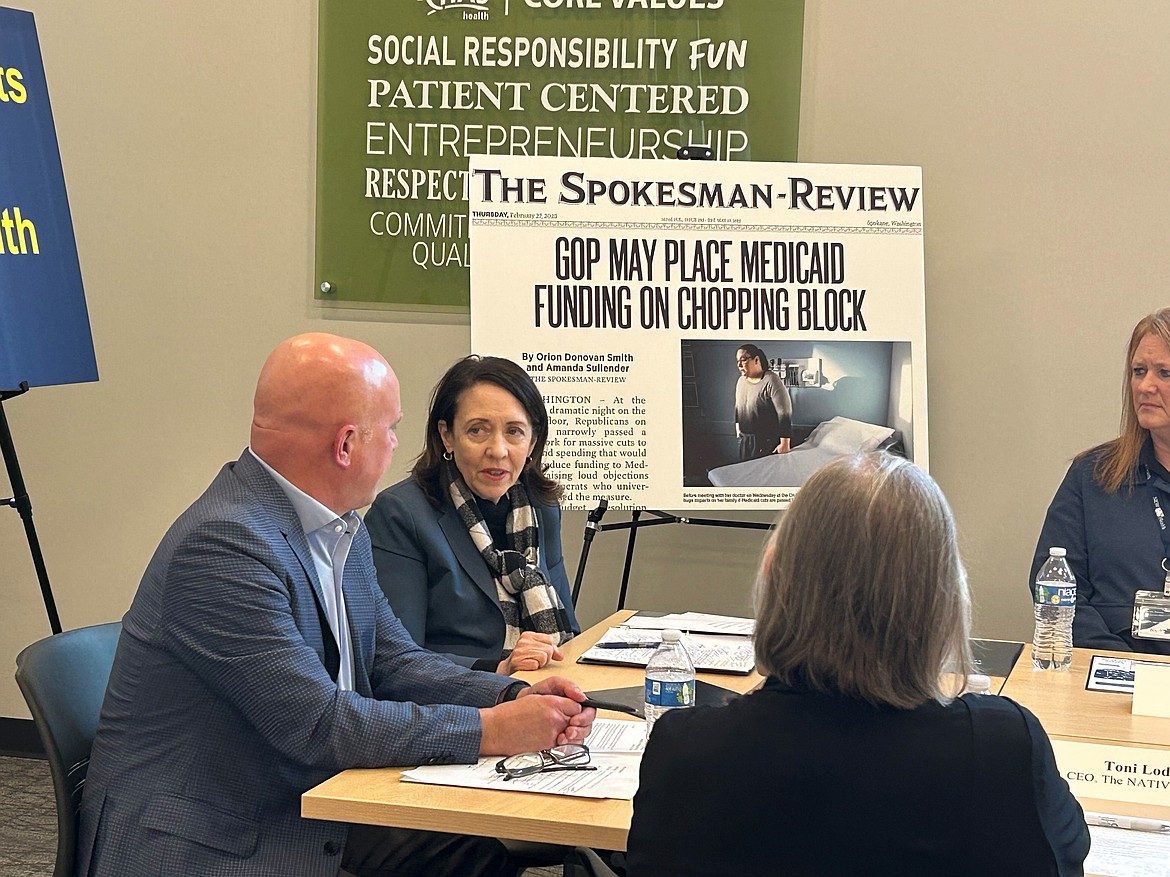
MOSES LAKE — If Congress makes cuts to Medicaid, the results could be disastrous for Central and Eastern Washington, Sen. Maria Cantwell said at town hall meetings in Spokane and Richland last week.
“This is a tsunami of cuts coming at the people of Washington and the United States of America,” Cantwell, D-Wash., said. “And I guarantee you, this is not a drill.”
The cuts Cantwell was referring to haven’t actually happened yet and may well not happen at all, said U.S. Rep. Dan Newhouse, R-Wash., who represents Washington’s Fourth District including all of Grant County and the Othello area of Adams County. The Congressional budget resolution the U.S. House of Representatives passed Feb. 25 is a long way from the final budget and makes no mention of Medicaid. The Senate still has to vote on its own version of the budget resolution, then both houses will have to wrangle out the specifics before the budget is finalized.
“I don’t think that number (in the House budget resolution) is going to stay the same,” Newhouse said Thursday. “There’s going to be a compromise between the houses, and I don’t know what that number will be.”
The House budget resolution tasks the House Energy and Commerce Committee with finding a way to reduce projected spending by $880 billion over the next 10 years. Medicaid is the largest federal program the committee has jurisdiction over and trimming that much spending without touching Medicaid would be a challenge. Also, under the auspices of the Energy and Commerce Committee is the smaller Children’s Health Insurance Program, or CHIP.
According to a letter from the Congressional Budget Office to the House, the federal outlay for Medicaid is expected to increase between 2025 and 2034 by 4-6% each year and total more than $8 trillion over those 10 years. A cut in spending on Medicaid would not result in spending going down from one year to the next; it would merely lessen the rate at which the spending rises, according to an analysis by the Empire Center for Public Policy, a non-partisan think tank in New York.
Medicaid is an important source of health care funding in Washington, as both Cantwell and Newhouse said.
“Nearly two million people in our state are on Apple Health (which is) our state Medicaid plan,” Cantwell said. “When we expanded the Affordable Care Act, our Medicaid expansion, we added hundreds of thousands of Washingtonians that got better access to care and helped drive down health care costs by not having these people show up in uncompensated care at our hospitals.”
Medicaid funded $3.3 billion of hospital care in Washington, Cantwell added. According to data released by her office, 58% of reimbursements to Othello Community Hospital come from Medicaid. That figure is 30% for Samaritan Hospital and 27% for Columbia Basin Hospital.
“(The budget resolution doesn’t) necessarily translate into reductions for Medicaid services, or … kicking people off the Medicaid program.” Newhouse said. “That’s not the goal. The goal is to make sure that all all the programs that we manage in government are done as efficiently as possible … Almost 40% of the people who live in the Fourth District utilize Medicaid, so I'm very well aware of the impact that some of the worst-case scenario decisions can have on people that I represent.”
The key isn’t to cut out services or decrease the number of people who benefit from it, Newhouse said; it’s to make more efficient use of the money.
“We are, as a country, $37 trillion in debt,” Newhouse said. “We’ve got to make sure we’re running the government as smartly as possible.”
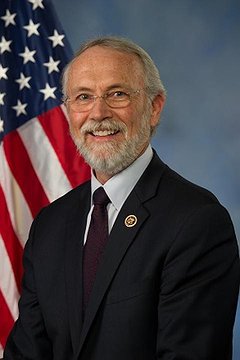 Newhouse
ARTICLES BY JOEL MARTIN

Endless battle
Noxious Weed Control Board works to keep invasive plants under control
MOSES LAKE — Some of the nastiest plants in Grant County were the topic of a class led by Jay Johnson, a consultant with the Grant County Noxious Weed Control Board, Tuesday. The Noxious Weed Control Board, as its name would suggest, is tasked with keeping weeds under control in Grant County. That’s not a small job; the board’s website lists 129 species of noxious weeds that are found around Grant County. A noxious weed is defined as an invasive, non-native plant that threatens agricultural crops, local ecosystems or fish and wildlife habitat, according to the Noxious Weed Control Board. Washington state law requires that these weeds be identified and their spread kept to a minimum, if not completely eradicated. “We’re one of those agencies a lot of people don’t really understand,” Johnson said. “We’re a county office and … our funding is tax-based assessment. When you get your tax bill and you look down at all the expenses that you pay for, there we are.”

BASIN EVENTS: Oct. 16-24
COLUMBIA BASIN — Whether you feel like shopping, crafting, learning or seeing a show, there’s something happening for you this week in the Basin. Oct. 16 ‘My Family (Mi Familia)’ screening Spanning three generations, “My Family (Mi Familia)” is a heartfelt drama that follows the Sánchez family as they build their lives in East Los Angeles. Through love, hardship, triumph, and sacrifice, the film explores the immigrant experience, the strength of family bonds, and the traditions that connect one generation to the next. Lowrider show and taco truck before the screening. Sponsored by Columbia Basin Allied Arts, EDUBS C/S and the Moses Lake Creative District. $12 per person. Doors open at 6 p.m., film begins at 7 p.m. at the Moses Lake Civic Center Auditorium, 401 S. Balsam St. Tickets and info: www.cba-arts.org.

Moses Lake author encourages women to look beyond church culture norms
MOSES LAKE — A Moses Lake author’s book, “A Christian Woman Striving to Live Her Faith in a Man-Controlled World,” takes aim at the role to which many churches relegate the female half of their congregations. “It’s to encourage women in the faith,” Linda Curran said. “A lot of churches say, ‘Teach Sunday school, do this, do that, but don’t (evangelize.)’" In her book, Curran recounts a time when she moved to a new community and joined a church there. She was surprised to learn that, as a new female member, she had been automatically assigned church cleaning duties. When she questioned it, she wrote, she was met with condescension and her objections were brushed aside. In other churches, she said, women who were capable of teaching were relegated to “women’s ministry.”