
All seven local fire departments participated in rare live fire training
Bonners Ferry Herald | UPDATED 8 months AGO
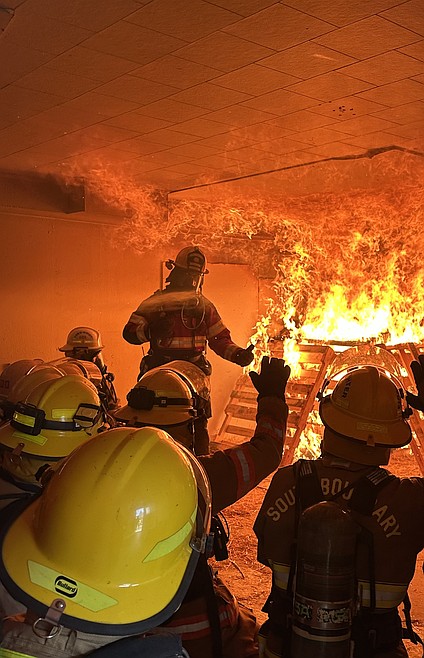
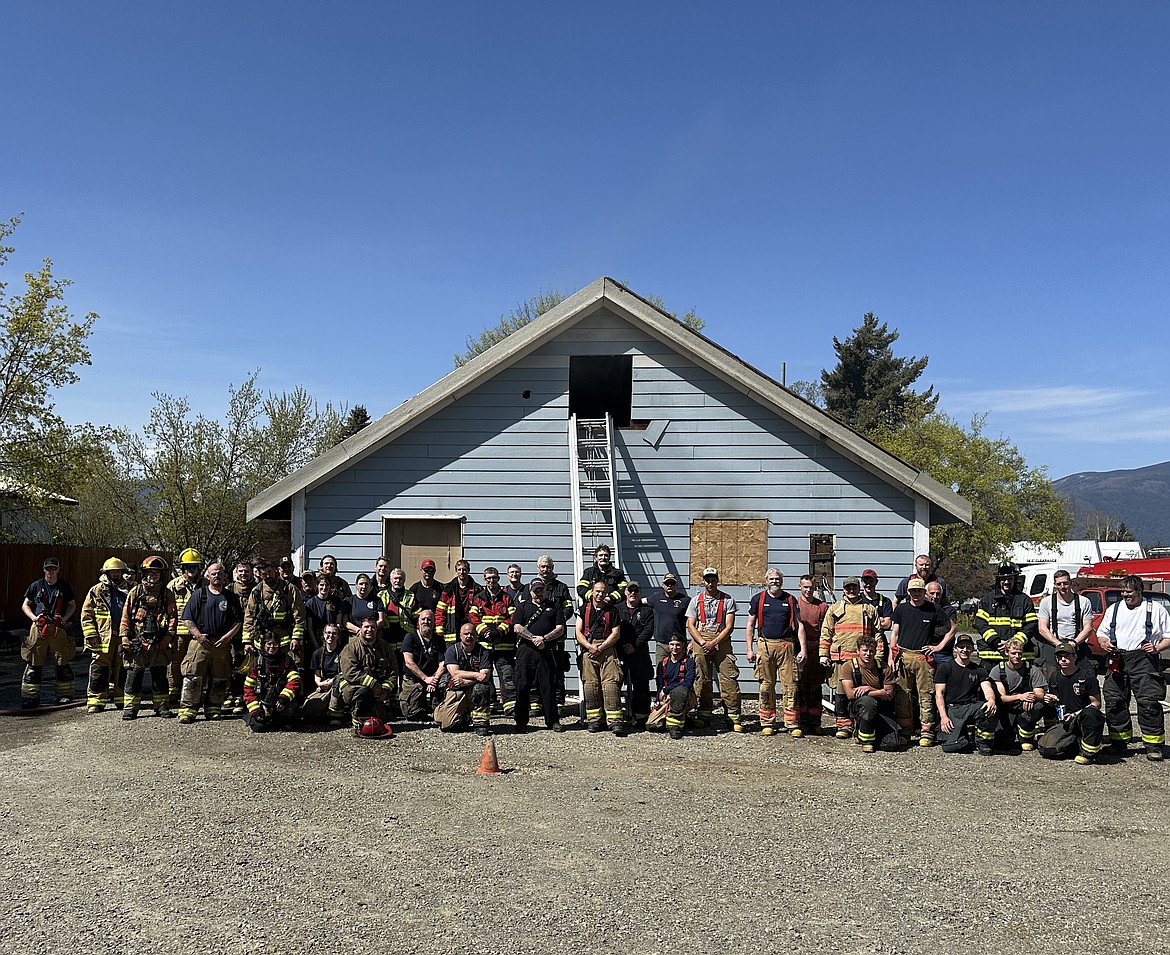
BONNERS FERRY — This house fire may have attracted every fire department in the county, but it was all in the name of experience.
All seven local fire departments participated in the rare live fire training Saturday morning, using a donated house behind Mountain Springs Church to simulate dangerous real-world firefighting conditions.
The training took place at an old house on Denver Street, behind Mountain Springs Church. The house, owned by Mountain Springs Church, was donated to the city and officials allowed the fire department to use it for training purposes, eventually burning it down.
 “These live burns are really rare because someone has to essentially donate their house to be destroyed as a training prop,” said Andrew O’Neel, emergency manager, public information officer, and volunteer firefighter with Paradise Valley Fire District. “Extensive preparation is done to the house to make it safe before training, and firefighters have already been training there for several weeks now in preparation for the big day.”
 The house used for training was supposed to have been completely burned down; however, it was decided that it would be put off for another time. This decision worked out for the firefighters because it allowed time for everyone to participate in the training.
The live fire training is useful for all firefighters, but especially for the newer firefighters who have never had the opportunity to train in live fire or have not yet been on a call where they have had to enter the structure.
One of the first exercises of the day was the confidence burn. A confidence burn introduces firefighters to what a situation may be like on a real fire, but without the threat to someone else's life or property at risk, O’Neel said. The exercise is also designed to help the individual to know that their gear will protect them.
“The environment that we’ve presented today for multiple agencies is what we call an IDLH, or Immediately dangerous to life and health, environment to experience,” O’Neel said. “Basically, it is a very dangerous situation, but we can take the component of, this is someone's property, someone’s life might be in danger, all those factors that are there, present on a real fire that we would report to. But it doesn’t take away the element and the true fact that this is a dangerous environment, that someone can get hurt and up to killed while doing these trainings, but it is the safest way that we can provide in a real-life scenario to give people that experience.”
There are also scientific factors involved in the confidence burn.
“The basic educational piece of what they are going to take from it, is that we are looking for thermal balance and smoke layers,” Wally Nyberg, firefighter with Hall Mountain Volunteer Fire Department, said. “Teaching everyone that obviously heat rises and the difference between a firefighter being down low on their knees or in the prone position verses standing up in the compartment that’s got a heat signature. Being able to see the layers of smoke as it builds and it comes down and then correctly, what we call, pencil the fire to calm it down.”
Nyberg explained how flashover and how it relates to the thermal balance. What firefighters are looking for is called flashover, which is when everything in the compartment instantly catches fire, including anything inside, including people.
“So, you can’t be in an environment with flashover, and we have to see those signs of flashover. It’s that Hollywood scene when you see the smoke going over the ceiling and then the fire going through the smoke, those are imminent signs of flashover. That’s where we have to quickly tackle that.”
During training and education about flashover and thermal balance, firefighters also learned about how much water should be used to extinguish the fire.
“It’s not a full-blown spray of water because that will flip thermal imbalance and change the heat and drop it to the bottom, and the difference between (the space) could be a matter of 500-600 degrees. I can’t say what our stuff is rated at, but I believe it’s up to about 500 degrees. Flashover starts at anywhere between 900 and 1100 degrees,” Nyberg said.
In other training events for flashover, trailers are brought up from the Idaho Fire Service that are used exclusively to show examples of flashover. Fires are set inside the metal trailers to emulate the environment, and firefighters can see the flashover and smoke.
“But it’s not wood, it doesn’t compromise, and they can do it over and over,” Nyberg said about the trailers and flashover.
After the confidence burn, the rest of the day consisted of the firefighters rotating inside the house in pairs. Teams consist of an initial attack pair and a backup pair. The primary attack team will go in and the backup team will support them. O’Neel elaborated on the process.
“The primary attack hose goes in with the first crew and the second crew has their own hose in case the first one fails, or they need more water than the first one can provide,” he added.
Use of water is also a factor when training. “What we want them to take away from it, with these small room and content fires, (is to treat it) just like we would if we were to arrive at someone's home,” Matt Solt, an officer with the Bonners Ferry Fire Department and deputy chief for Paradise Valley Fire Department, said about the training.
“The use of water and how much water to use on these fires and how to overhaul a small fire properly. Our job is to put out fires, but it’s also to save whatever we can. We’re supposed to save property,” he said. “We want to preserve what’s in that room as much as we can, and this gives them a good opportunity to do that when they know how to use as little water as possible. These fires are getting pretty big and they are seeing how little water it takes to actually knock them down.”
In a non-training environment, the use of water plays a factor depending on where the fire is located. Once outside the city of Bonners Ferry, the water is limited, and firefighters have to conserve. “So this is a good way to learn how to do that,” Solt said.
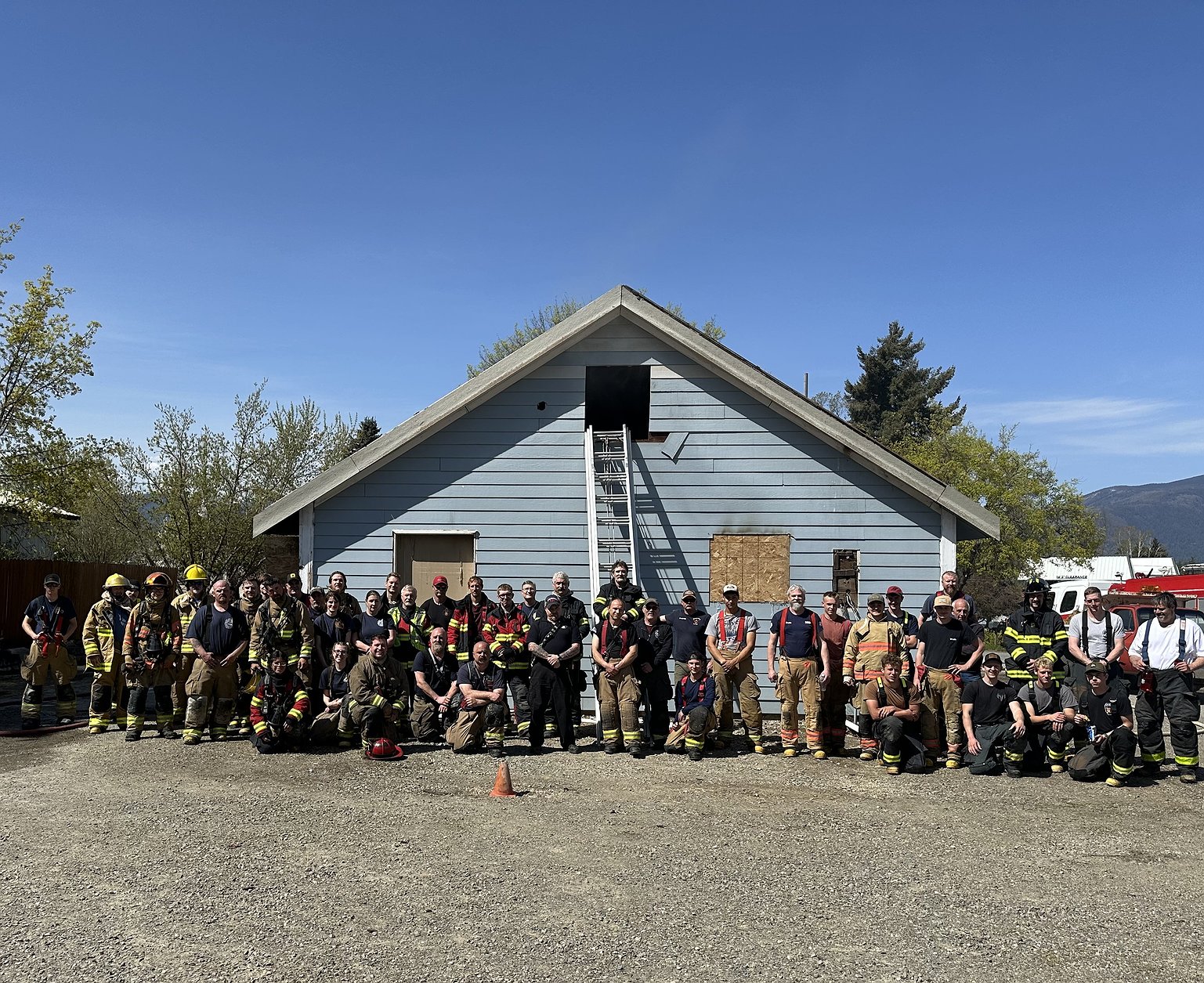
The consensus of the firefighters on scene at the training was that it was exciting to be at a live fire training, but even more because it gave all seven local fire departments a chance to participate and train together.
The newer firefighters were excited to be a part of live fire training and experience what it is like to be inside a burning structure, without the threat of other lives or property other than their fellow firefighters who were also participating.
Ry and Wally Amoth, cousins and firefighters with Hall Mountain Volunteer Fire, expressed how the most important thing they got out of the training was the mentorship from the seasoned firefighters.
“Mostly the fact that you can rely on the older firefighters. They are there and they will help you out. They are there, and you can do it, but they are there to help,” Ry Amoth said.
“The advice from people of higher knowledge.” Wally Amoth answered. “Communication and working together, that is very important stuff.”
Live fire trainings are rare, but are valuable to the education and experience of all firefighters involved.
Organizers want to thank Boundary Ambulance for being on standby during the training and also to Angel One, headed by the Boundary County Chaplain Corps for providing snacks, hydration and lunch.
Residents interested in becoming volunteer firefighters are encouraged to contact their local fire chief. Those unsure who to contact can visit the Boundary County Fire Chief’s Association webpage, where a county map lists each area’s fire chief and phone number.