
Plant exchange
JOEL MARTIN | Hagadone News Network | UPDATED 10 months AGO

The WSU Grant-Adams Master Gardeners’ drought-resistant garden outside the Moses Lake Library is an example of what homeowners can do with their yards through the Columbia Basin Conservation District’s Heritage Garden Program.
JOEL MARTIN/COLUMBIA BASIN HERALD

This arrangement of rocks and native plants was done through the Columbia Basin Conservation District’s Heritage Garden Program.

This heritage garden in Moses Lake is popular with ground fowl, pollinators and rabbits, according to the homeowner.

A heritage garden doesn’t have to be plant-heavy, as this garden in Lind demonstrates.
Joel Martin has been with the Columbia Basin Herald for more than 25 years in a variety of roles and is the most-tenured employee in the building. Martin is a married father of eight and enjoys spending time with his children and his wife, Christina. He is passionate about the paper’s mission of informing the people of the Columbia Basin because he knows it is important to record the history of the communities the publication serves. | May 2, 2025 2:55 AM
MOSES LAKE — Owning a lawn is kind of a pain, in a lot of ways. Sure, it looks nice to have that sea of lush green around the house, but it’s a lot of work to maintain, and it uses up valuable water besides.
“Every drop counts,” said Diane Escure, a WSU Grant-Adams Master Gardener. “And if you're thinking, ‘I really want to have a nice, well-kept yard, I want it to look pretty,’ a high water use is grass. The kind of grass that grows here really needs a lot of water. In the wintertime, it turns yellow and it looks kind of (bad). And sometimes in the summer when we have a lot of heat, it can look (bad).”
A solution more people are turning to is planting low-water, native plants in place of a lawn, and the Columbia Basin Conservation District’s Heritage Garden Program can help with that. The Heritage Garden Program is a free service offered by the CBCD to help landowners create water-thrifty landscapes using native plants that thrive in our desert climate.
“People can submit a site request online, or they can call or email me, and we'll do a free site visit,” said CBCD Conservation Director Dinah Rouleau. “I go out there and you tell me roughly what you're thinking. Do you want this small, little square? Do you want to do your whole yard? Why are you doing it? Are you doing it to save on water? Are you doing it because you just want low maintenance, you're just you tired of mowing the lawn, or are you doing it because you're really passionate about wildflowers?”
Rouleau also discusses with the homeowner what sort of plants they want, because not everybody has the same vision for their yard.
“When someone says they want something green. I (might be) thinking … sage green, but they might be thinking of an evergreen like kinnikinnick. Folks give me some ideas on some plants and I'm like, ‘OK, this is your aesthetic. I respect it.’ Not everybody wants sage in their yard.”
She’ll work out what the homeowner wants to do and over how much ground, Rouleau said, and then make recommendations for plants and design.
“We have (what we call) planting inspirational guides,” Rouleau said. “We have an architecture software that actually does a mock design for folks based on those plants. If you have a shady area, so we have to do part shade plants, we make sure we have bloom times through the year, spring through fall, for the pollinators.”
Rouleau can then send the homeowner some images of what the garden would look like and fine-tune their vision, then make recommendations.
“You can see what it would feel like, then you tell me you love it, or you don't,” she said. “Then we give you … a shopping list: You need three of these, two of that, one of those from your nurseries. You're getting your bloom time so you know when to expect these plants, and little water care tips and overall care tips for each of the year.”
The actual labor of putting in the garden is up to the homeowner, the CBCD website points out; the program only covers information.
If a gardener is serious about switching to native, low-water plants, they can take the extra step and have their garden officially certified as a heritage garden. To qualify for that, the garden must have at least five different species of plants, and three-quarters or more of the plants must be native to Washington state, according to the CBCD website. There are other requirements involving water use, rocks and weed control. A certified heritage garden owner can then put up a cool sign to announce the fact.
“It’s authenticating the history of where we live, the kinds of plants that do well here, that are native,” Escure said. “There are many, many heritage gardens (in the area). We have one at the Moses Lake library that our master gardeners have put together. Everything is labeled (and) different plants will come in bloom at different times.”
One thing to be aware of, Rouleau said, is timing.
“We never know what the winter and spring is going to look like,” Rouleau said. “Our favorite time for planting is late fall, after Halloween. But there's always a chance that we have an oddly weird winter where it's warmer and then the plants go out of dormancy, and then they freeze, (which) causes a lot of mortality … I tell everybody a 60% survival rate is huge.”
The other thing is that a heritage garden takes time, both Rouleau and Escure said.
“That first year, they grow really slowly,” Rouleau said. “The first year they sleep, the next year they creep, then they leap. But folks want immediate satisfaction, and a lot of times you won’t get flowers the first year. A lot of folks have trouble with letting them do their thing for a few years and (think) they died, when these plants actually are dormant. People get discouraged the first winter when they think (the plants) all died back. And that first year when they're super teeny-tiny, they're not out-competing weeds, so you have more weeds to deal with those first several years, until they're taking up and dominating that space.”
Time is the key, though.
“Then after that, maybe four or five years, people come and say, ‘What a beautiful yard. How did this happen?” Escure said. “It's not really hard to do. It's a remarkable thing.”
For more information or to request a free site visit, go to www.hgcd.info.
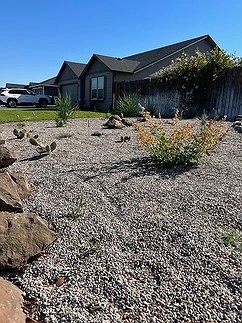 This arrangement of rocks and native plants was done through the Columbia Basin Conservation District’s Heritage Garden Program.
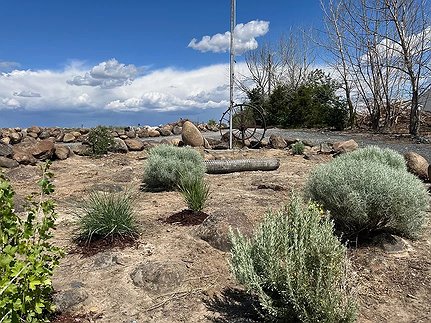 This heritage garden in Moses Lake is popular with ground fowl, pollinators and rabbits, according to the homeowner.
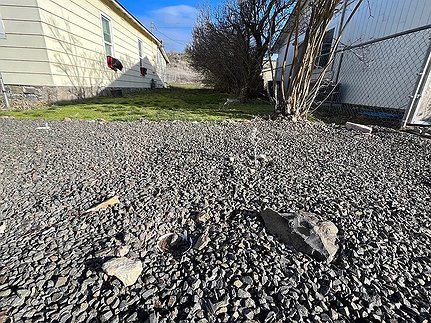 A heritage garden doesn’t have to be plant-heavy, as this garden in Lind demonstrates.
ARTICLES BY JOEL MARTIN
Space Burger booth open March 13-15
MOSES LAKE — Those who can’t wait for the Grant County Fair can get their Space Burger fix next weekend, according to an announcement from the Lioness Club of Moses Lake. The iconic Grant County sandwiches will be available at the Grant County Fairgrounds March 13-15, according to the announcement. There is no admission fee to get into the fairgrounds that weekend.
SENIOR EVENTS: March 2026
COLUMBIA BASIN — Plays, art shows, auctions and more await seniors in the Columbia Basin this month. Here are some opportunities to get out and about in March.
Valentine’s Day cards flood Brookdale Hearthstone with love
MOSES LAKE — Residents at Brookdale Hearthstone Assisted Living in Moses Lake got Valentine’s Day greetings from across the country last month. “I believe that the only states we have not received (cards from) yet are Vermont and Maine,” Lifestyle Director Imelda Broyles said Feb. 24. “We keep receiving new cards every single day. They have not stopped. My residents are in awe with every single one of the cards that we’ve been receiving.” The Hearts Across America project started as a way for children in school classrooms to exchange Valentine’s Day cards with classes in other states or even countries, but the idea has expanded to senior living facilities, according to the project’s social media.