
The best night sky events for May 2025
JOHN TAYLOR/Guest Contributor | Coeur d'Alene Press | UPDATED 7 months, 4 weeks AGO
Here are the celestial wonders that will avail themselves to us in the night sky during May 2025. Prepare for a month filled with the Eta Aquarids meteor shower, planetary and lunar conjunctions, the easily identifiable late spring constellations, and the Full Flower Moon.
May 3 — Conjunction of the moon and Mars
The moon and Mars will be close together on this night. The moon will pass just a little over 2° to the north of Mars. The moon will be 6 days old. Look to the southwest at 9 p.m. Mars will be below and to the right of the almost first quarter moon.
May 4 — First quarter moon
The first quarter moon marks the halfway point between the new moon and the full moon. It appears as a half-illuminated disk which occurs at 6:52 a.m. The right half will be visible from the Northern Hemisphere and the left half will be visible from the Southern Hemisphere. It will be visible in the afternoon and evening sky.
May 5 — Close approach of Mars and the Beehive Cluster (M44)
Mars will skirt the edge of M44, also known as the Beehive Cluster. Mars will pass within a mere 37 arcminutes of this star cluster. Look to the south at 9 p.m. A simple pair of binoculars will really enhance your ability to appreciate this star cluster.
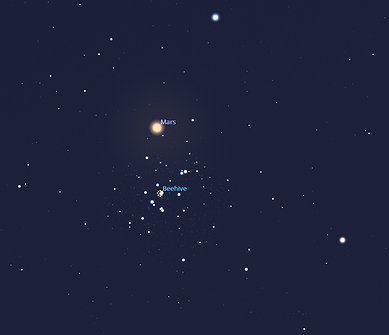 Image courtesy of John Taylor and Stellarium
May 6–7 — Eta Aquarids Meteor Shower
The Eta Aquarids is an “above average” meteor shower, capable of producing up to 60 meteors per hour at its peak. Most of the activity is seen in the Southern Hemisphere. In the Northern Hemisphere, the rate can reach about 30 meteors per hour. It is produced by dust particles left behind by comet Halley, which has been observed since ancient times. The shower runs annually from April 19 to May 28. It peaks this year on the night of May 6 and the morning of May 7. The waxing gibbous moon will block out some of the fainter meteors this year. But if you are patient, you should still should be able to catch some of the brighter ones. Best viewing will be from a dark location after midnight. Meteors will radiate from the constellation Aquarius, but can appear anywhere in the sky.
May 10 — Conjunction of the moon and Spica
The almost full moon will come within 1 degree of the bright star Spica (in the constellation of Virgo). Look for this conjunction in the east early in the morning (or late at night) around 1 a.m. Spica will be above the moon.
May 12 — The Flower Moon
This moon will be located on the opposite side of the Earth as the sun and its face will be fully illuminated. This phase occurs at 9:56 p.m. This month’s moon was known by early Native American tribes as the “Flower Moon” because this was the season when spring flowers appeared in abundance. This moon has also been known as the “Corn Planting Moon” and the “Milk Moon.”
May 13 — Conjunction of the moon and Antares
The just-past full moon will be a little over 2 degrees from the star Antares (in the constellation of Scorpio). Look for this conjunction in the east an hour after moonrise, which is fairly late at night, 11 p.m. Antares will be above the moon.
May 20 — Last Quarter Moon
The last quarter moon is the third and final quarter phase of the moon during its monthly cycle. At this point (4:59 a.m. to be precise), the moon will be exactly half-illuminated, with the left half visible from the Northern Hemisphere and the right half visible from the Southern Hemisphere. This moon is visible after midnight and throughout the morning.
May 22 — Conjunction of the Moon and Saturn
The moon will pass a little over 3 degrees from Saturn early in the morning at 4 a.m. Look east, where Saturn will appear as an orange star below and to the left of the moon.
May 26 — New Moon
The moon will be located on the same side of the Earth as the sun and will not be visible in the night sky. This phase occurs at 8:02 p.m. This is the best time of the month to observe faint objects such as galaxies and star clusters because there is no moonlight to interfere.
• • •
John Taylor is an amateur astronomer who lives in Hayden.