
Sandpoint City Council approves proposal to shrink area of impact by 70%
ERIC WELCH | Hagadone News Network | UPDATED 7 months, 3 weeks AGO
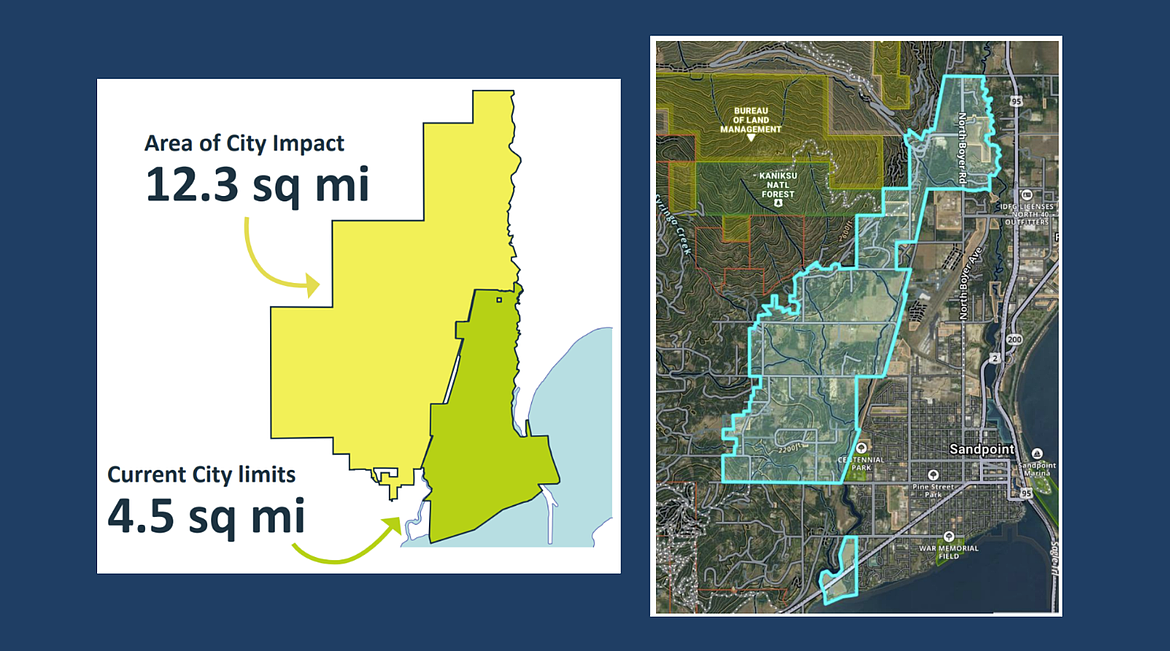
Sandpoint's proposed area of impact, right, is about 70% smaller than its existing area, left.
Photos courtesy CITY OF SANDPOINT
SANDPOINT — A majority of city councilors voted in favor of a proposal to shrink Sandpoint’s area of impact by about 70% during a Wednesday meeting.
The change, staff said, is designed to bring the city into compliance with a recently changed state law. Bonner County has final authority over areas of impact; county commissioners will determine the official boundaries by the end of the year.
The proposal to reduce the city’s area of impact originally appeared before Sandpoint’s planning and zoning commission in March. The body decided to advise city councilors to bring a new 3.4-square-mile area — down from the existing 12.3-square-mile zone — to Bonner County for final approval.
An area of impact is a designated region outside of a city’s boundaries where future growth is anticipated. Statewide changes introduced recently by Idaho lawmakers are now requiring areas of impact to extend no further than 2 miles from city limits and only include regions “very likely to be annexed within the next five years.”
Sandpoint’s existing area of impact violates the first clause, extending more than 3 miles north of city limits. The second clause, regarding the likelihood of imminent annexation, was a topic of discussion during the meeting.
In March, Jason Welker, Sandpoint’s community planning and development director, said that there is no likelihood of Sandpoint’s boundaries expanding “in the near future.”
The point was reiterated by Mayor Jeremy Grimm on Wednesday, when he told attendees that he “would be very surprised if there's any annexation happening in the rest of my term,” which extends through 2027.
Councilor Rick Howarth, the lone council member who voted against the proposal, expressed appreciation for the effort to shrink Sandpoint’s area of impact, but noted the city’s ambiguity surrounding annexation plans and described the somewhat arbitrary nature of the new boundaries as a sticking point.
Grimm said that the law’s language makes it difficult to precisely identify an appropriate area. Both Grimm and Zachary Jones, legal advisor for Sandpoint, described Idaho Code Section 67-6526 — the law dictating areas of impact — as vague and poorly written.
In recent months, local municipalities have met to discuss their revised areas and identify overlaps. Sandpoint’s lone conflict is with the city of Dover, regarding a pocket of land on the east side of Chuck Slough.
The two cities’ planning teams were unable to reach a consensus regarding which party’s area the land should fall under, meaning county officials will draw the boundaries. While Welker said he would leave the decision to Bonner County personnel, Grimm shared that he intended to advocate for Sandpoint’s claim to the sector.
Sandpoint’s revised area of impact will be determined no later than Dec. 31, 2025 — the deadline for Idaho counties to confirm redrawn area of impact boundaries.
ARTICLES BY ERIC WELCH

City personnel, community members discuss options as James E. Russell Center costs exceed revenue
Community planning and development director Jason Welker, who oversees Sandpoint’s parks and recreation programs and facilities, suggested that the city could either maintain its current approach at the facility, shrink the center’s operating hours, install new modular playing surfaces for mixed sports use on some of the courts, or recruit a nonprofit organization to operate the facility.

‘Expressions’ courses fill non-school art void
Teens participating in Gentry’s class practiced printmaking, painting and design to create works including a pop art-inspired self-portrait. “My goal when I'm teaching the kids is to just show them lots of different ways that you can make really cool art. It doesn't have to be just traditional,” she said. “The kind of art they do with me, they get to just express themselves, and it doesn't have to be perfection.”

City of Sandpoint sheds light on sewage incident outcome
On the morning of Feb. 24, an electrical control system failure caused pumps to shut off unexpectedly at Sandpoint’s municipal wastewater treatment plant — a city-owned facility that removes contaminants from sewage before discharging it into the Pend Oreille River.