
History books for people who think history is boring
Columbia Basin Herald | UPDATED 10 months AGO
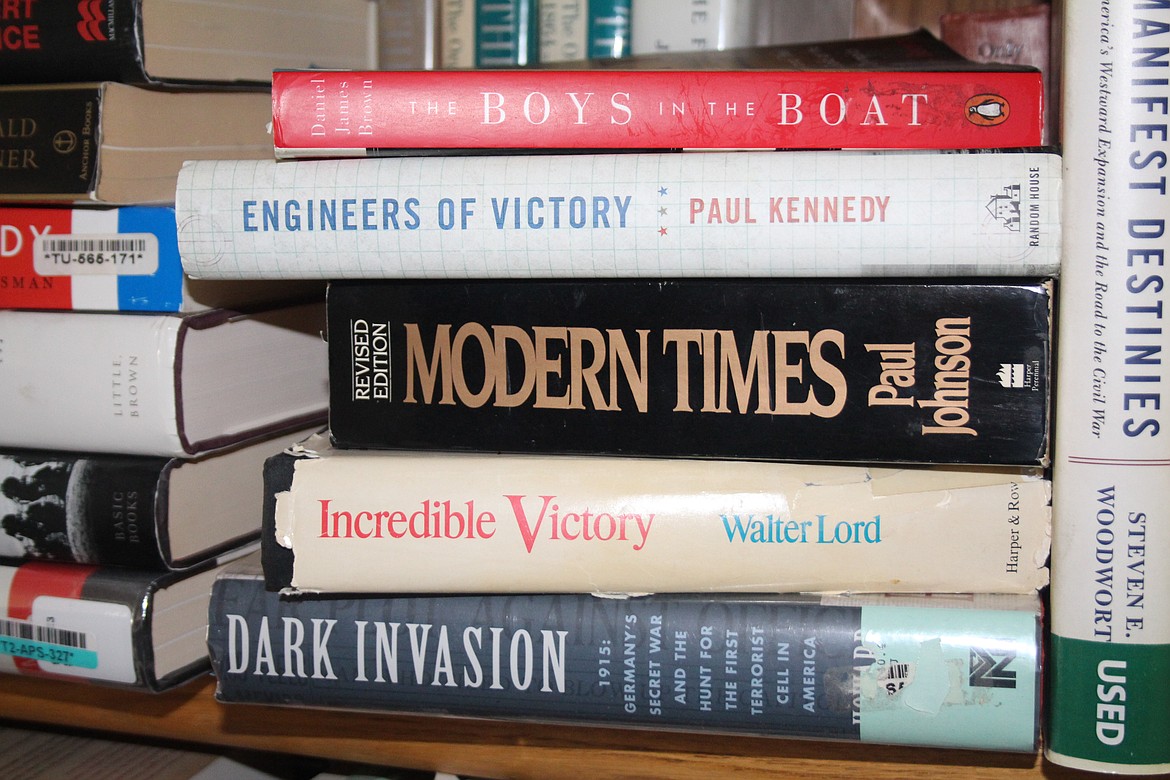
There are a lot of interesting stories in the world of history.
CHERYL SCHWEIZER/COLUMBIA BASIN HERALD
History? Oh, man, that’s sooooo boooring.
Yeah ,okay, maybe, if it’s restricted to dates and lists of British prime ministers and things. Explore a little more, and all kinds of fun/crazy/scary/creepy/just plain interesting stuff pops up, some of it in the wildest places.
I’ve been reading a lot of Japanese history lately, and it was there that I ran across the story of the gangsters back in the 1930s who were fighting over distribution rights to movies made by a popular Japanese movie star. They decided to talk it over but came prepared if things went off track. Which they did. So a gunfight ensued? Nah, it’s Japan in the 1930s — they got in a swordfight. Serious swordfight. Everybody died.
The editor asked for recommendations for some favorites, books that might get people interested in looking further into different places and times. None of these are that new; all can be found at used booksellers on the internet and are available as audiobooks or in downloadable format.
• Dark Invasion, Howard Blum, 2014. (Available in hardcover, paperback, audiobook and e-book.) Long before the U.S. got involved in World War I, a pitched battle was underway on American soil. Industrial sabotage – including blowing up most of an island, an attempt at biological warfare, a spy who left all his records on the train where the US government scooped them up. A Harvard professor who killed his first wife, disappeared, and reappeared in a very weird place – but then he was a weird dude. Blum tells the story largely through the life of NYPD Captain Tom Tunney.
• Boys in the Boat, Daniel James Brown, 2013. (Available in hardcover, paperback, audiobook and e-reader.) These guys would be famous in Washington even if they weren’t the subject of a 2024 movie – they are the University of Washington crew who won the gold medal in the premier rowing event at the 1936 Olympics. The limitations of the movie format being what they are, the film didn’t really get close to the actual story, which is mostly told through the life of Joe Rantz. He came home from school one day to find his father and stepmother moving out of the house and planning to leave him behind.
It’s not only Joe, though – it's the Englishman who figured out how to use local woods to build the fastest racing shells in the world, the teammate whose dad operated a truck farm in the middle of Seattle to support his family, the quiet slightly scary coach, among many others.
• Engineers of Victory, Paul Kennedy, 2013. (Available in hardcover, paperback, audiobook and e-reader.) So – how do you get a convoy safely across the Atlantic? How do you invade France? How do you project power across the Pacific Ocean? It all had to be figured out, and Kennedy discusses the lives of the people who did the figuring.
The British officer who found a way to use a tank to clear minefields without blowing it up too. The alcoholic US Marine major who foresaw the island-hopping campaign in the Pacific. The British escort captain who devised the tactics to protect convoys and died of overwork. The Russians who under the greatest pressure figured out how to defeat an enemy that was almost 1,000 miles into their country. It took a lot of thought, but they did it.
• Modern Times, Paul Johnson, revised edition, 2001. (Various editions available in hardcover, paperback, audiobook and e-reader.) How did the world get from 1919 to here? Paul Johnson travels around the world to detail what happened in Europe, Asia, Africa, North and South America between 1919 and the end of the century, how the world tore itself apart and tried to put itself back together.
All the important people are here, from Einstein to Churchill to Reagan and the bad guys, but a lot of other people too. Generals, movie stars, gangsters, political movements, youth rebellion, incompetent leaders – Johnson surveys them all.
• Incredible Victory, Walter Lord, 1967. (Available in hardcover, paperback, audiobook and e-reader. The hardcover and paperback copies may require some searching.) It was 10:24 a.m. June 4, 1942. It probably wasn’t true that the Japanese navy was on the verge of winning the Pacific War – the American fleet that would flatten Japan was still in the process of being built – but the road back for the Americans would’ve been much more difficult and much longer had the day ended like it was at 10:24 a.m. The Kido Butai, the Japanese navy’s First Air Fleet, felt pretty good. Victory was so close. Then the guys on the aircraft carrier decks heard the lookouts yelling.
By 10:30 a.m. more than half of the Kodo Butai was in ruins. By the end of the day, all the carriers were gone. It all happened that fast. Walter Lord talked to people who were there, and combined their stories to tell how World War II in the Pacific changed in less than 10 minutes.