
Long journey
JOEL MARTIN | Hagadone News Network | UPDATED 1 year, 5 months AGO
Joel Martin has been with the Columbia Basin Herald for more than 25 years in a variety of roles and is the most-tenured employee in the building. Martin is a married father of eight and enjoys spending time with his children and his wife, Christina. He is passionate about the paper’s mission of informing the people of the Columbia Basin because he knows it is important to record the history of the communities the publication serves. | May 13, 2025 1:20 AM
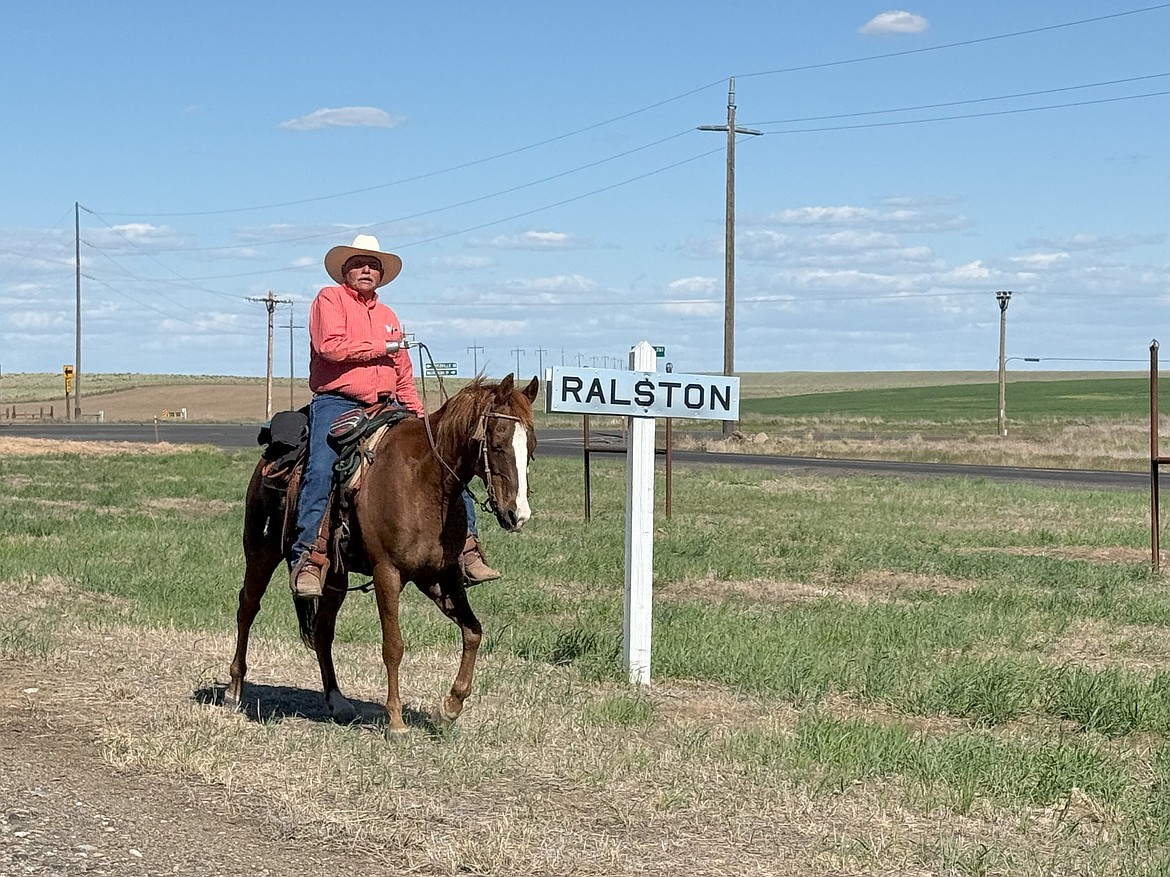
MOSES LAKE — Ron Tebow has been a long trail, and it’s a long way from finished.
“I’m halfway now,” Tebow said Friday. “Warden is right on half, 120 miles.”
Tebow and his horse Olie have been riding the 251-mile Palouse to Cascades Trail, the primitive route that runs from the Washington-Idaho State Line to North Bend on the outskirts of Seattle. It combines the John Wayne Trail east of the Columbia River with the Iron Horse Trail west of the river.
Tebow, 70, loves to ride and loves to sightsee, and this was a way to combine the two, he said.
“The perspective from sitting on a horse is different than it is on anything I've experienced,” he said. “So, I thought, I live in Washington, why not look at it, see what it is? And then somewhere along the way, I got hooked up with the John Wayne Trail (the part of the route that’s east of the Cascades), and I thought, ‘It goes all the way across the state. Well, that's perfect. Let's just ride across there and see what there is in this state.’”
The Palouse to Cascades Trail is built almost entirely on the bed of the defunct Chicago-Milwaukee-St. Paul-Pacific Railroad line, sometimes called the Milwaukee Road.
Tebow is making the ride in 20- to 25-mile increments while his wife Sue drives the truck with a living quarter horse trailer from stop to stop. Some parts of the trail are easy to navigate, but others, well, they aren’t.
“We went across a bridge over by Revere that was ties, and I could see they were starting to rot,” Tebow said. “And I'm not so sure (Olie) didn't poke a foot through between them. He didn't fall or lose his balance or anything, but I would never go across that bridge again. I would do pretty near anything but go across that bridge.”
The two trails connect at the bridge over the Columbia River at Beverly, and from there, the terrain rises until Tebow reaches the Snoqualmie Pass Tunnel. According to the Palouse to Cascades Trail Coalition, that tunnel is 2.3 miles long, the longest tunnel on a rail trail in the U.S. Even in the summer, the coalition says, the tunnel is chilly, and Washington State Parks recommends that those who venture through it wear a headlamp.
Tebow’s not making the ride to prove anything or set any records, he said, so he’s not too concerned about riding every inch of the tail. Several areas in the eastern part of the route were impassible because of fallen bridges or fire damage, and rather than take the prescribed detours, he just drove on around them and resumed his ride on the other side.
When it’s over, Tebow said, he’s just going to go home and be satisfied with having made the ride.
“It's almost like it's not an accomplishment to me,” he said. "It's just a thing I've done.”
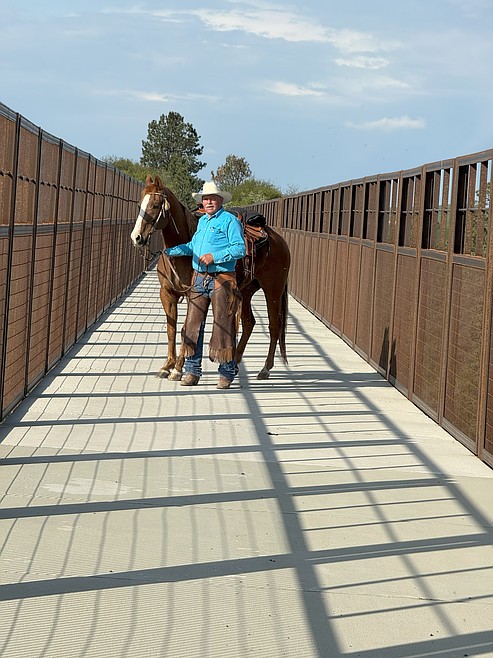
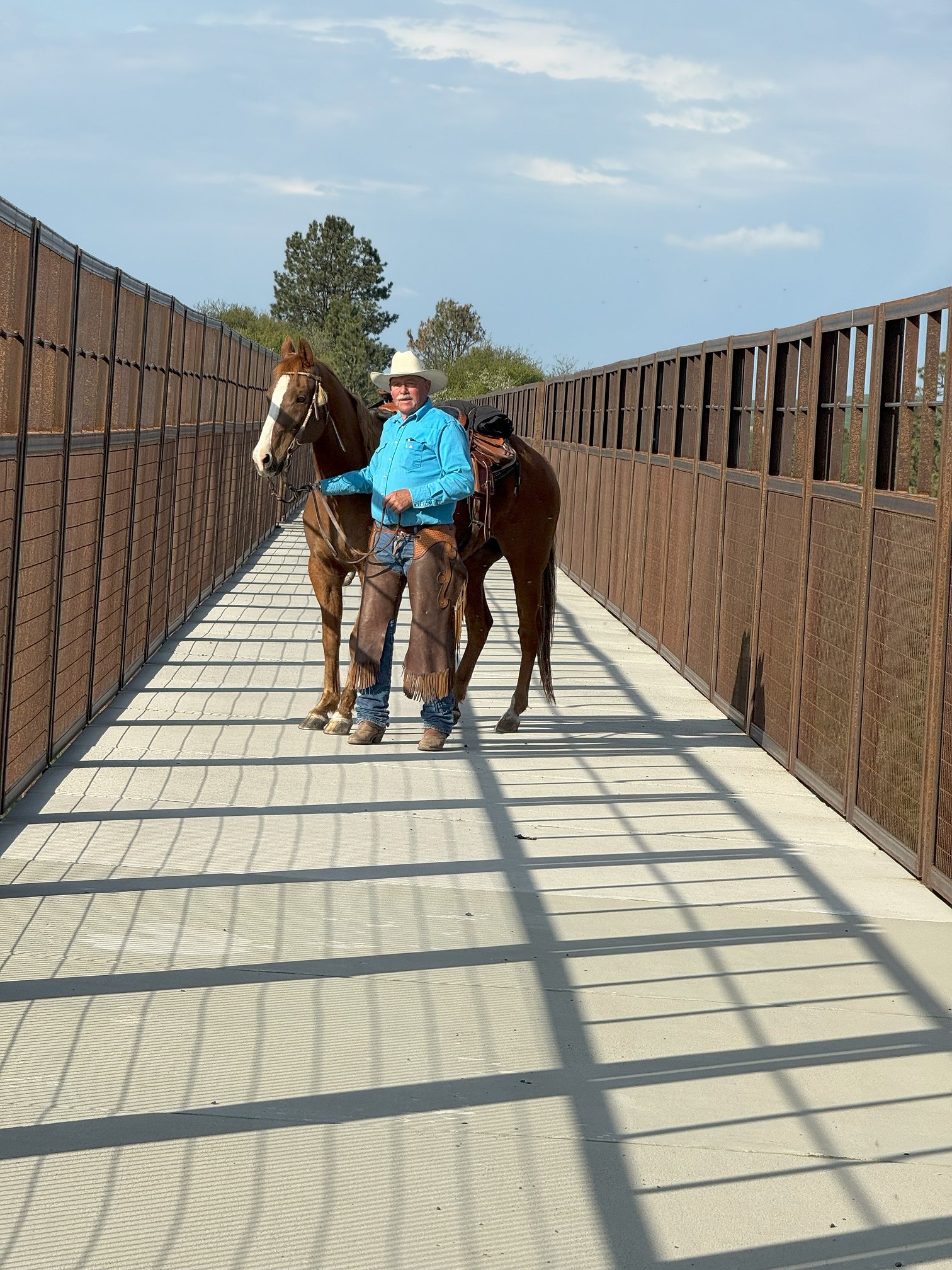 Ron Tebow stops on the 295-foot-long Tekoa Trestle that carries the Palouse to Cascades Trail over a large valley.
ARTICLES BY JOEL MARTIN

Endless battle
Noxious Weed Control Board works to keep invasive plants under control
MOSES LAKE — Some of the nastiest plants in Grant County were the topic of a class led by Jay Johnson, a consultant with the Grant County Noxious Weed Control Board, Tuesday. The Noxious Weed Control Board, as its name would suggest, is tasked with keeping weeds under control in Grant County. That’s not a small job; the board’s website lists 129 species of noxious weeds that are found around Grant County. A noxious weed is defined as an invasive, non-native plant that threatens agricultural crops, local ecosystems or fish and wildlife habitat, according to the Noxious Weed Control Board. Washington state law requires that these weeds be identified and their spread kept to a minimum, if not completely eradicated. “We’re one of those agencies a lot of people don’t really understand,” Johnson said. “We’re a county office and … our funding is tax-based assessment. When you get your tax bill and you look down at all the expenses that you pay for, there we are.”

BASIN EVENTS: Oct. 16-24
COLUMBIA BASIN — Whether you feel like shopping, crafting, learning or seeing a show, there’s something happening for you this week in the Basin. Oct. 16 ‘My Family (Mi Familia)’ screening Spanning three generations, “My Family (Mi Familia)” is a heartfelt drama that follows the Sánchez family as they build their lives in East Los Angeles. Through love, hardship, triumph, and sacrifice, the film explores the immigrant experience, the strength of family bonds, and the traditions that connect one generation to the next. Lowrider show and taco truck before the screening. Sponsored by Columbia Basin Allied Arts, EDUBS C/S and the Moses Lake Creative District. $12 per person. Doors open at 6 p.m., film begins at 7 p.m. at the Moses Lake Civic Center Auditorium, 401 S. Balsam St. Tickets and info: www.cba-arts.org.

Moses Lake author encourages women to look beyond church culture norms
MOSES LAKE — A Moses Lake author’s book, “A Christian Woman Striving to Live Her Faith in a Man-Controlled World,” takes aim at the role to which many churches relegate the female half of their congregations. “It’s to encourage women in the faith,” Linda Curran said. “A lot of churches say, ‘Teach Sunday school, do this, do that, but don’t (evangelize.)’" In her book, Curran recounts a time when she moved to a new community and joined a church there. She was surprised to learn that, as a new female member, she had been automatically assigned church cleaning duties. When she questioned it, she wrote, she was met with condescension and her objections were brushed aside. In other churches, she said, women who were capable of teaching were relegated to “women’s ministry.”