
Flathead Lake Biological Station adds second erosion control beach
TAYLOR INMAN | Hagadone News Network | UPDATED 1 year, 4 months AGO
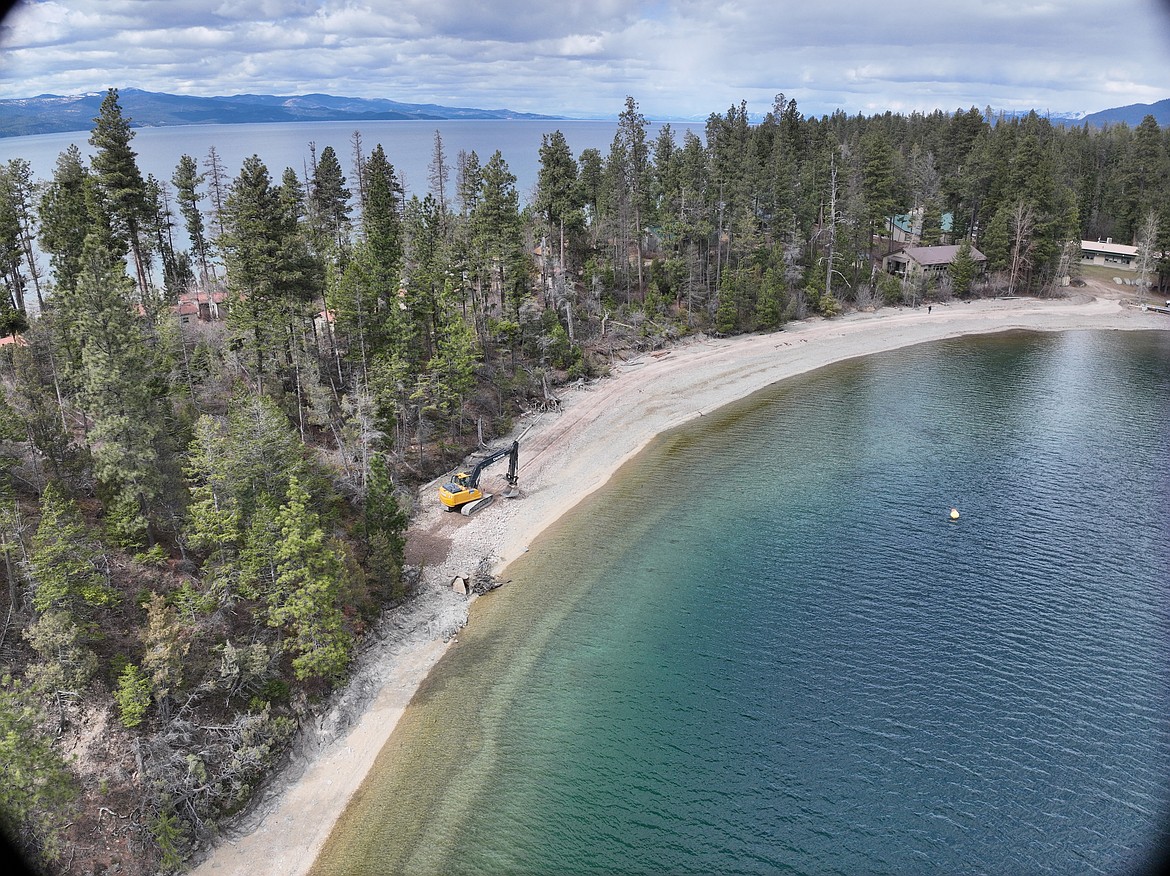
A new dynamic erosion control beach on the interior of Yellow Bay. (photo provided)
REPORTER AND PODCAST HOST Taylor Inman covers Bigfork and the north shore of Flathead Lake for the Bigfork Eagle and the Daily Inter Lake. Her reporting focuses on local government, community issues and the people who shape life in Northwest Montana. Inman began her journalism career at Murray State University’s public radio newsroom and later reported for WKMS, where her work aired on National Public Radio. In addition to reporting, she hosts and contributes to Daily Inter Lake podcasts including News Now. Her work connects listeners and readers with the stories shaping communities across the Flathead Valley. IMPACT: Taylor’s work expands local journalism through both traditional reporting and digital storytelling. | May 14, 2025 12:00 AM
A second dynamic erosion control beach has been established at Flathead Lake Biological Station on Yellow Bay to help prevent land from being washed away by waves.
The property lost nearly 3 acres between 1991 and 2006 alone, according to Associate Director Tom Bansak.
There’s been significant shoreline loss since the construction of the Se'lis Ksanka Qlispe' (formerly Kerr) dam in the 1930s. Bansak said the Biological Station has used funds awarded from class action lawsuits over the years to build its dynamic erosion control beaches. Those lawsuits were targeted at the companies who used to operate the dam and any shoreline homeowner could apply for the settlement funds, Bansak said.
“This new beach is on the inside of Yellow Bay, in a place that has some pretty significant erosion. So a lot of our campus is Yellow Bay Point, which is a peninsula out into the lake, and it was eroding from both sides,” Bansak said. “We don't want Yellow Bay Point to turn into Yellow Bay Island because we have a lot of infrastructure out there ... we had to prioritize places to build beaches that had the greatest impact for protecting our property.”
In 2020, the Biological Station partnered with former research faculty and erosion control beach engineer Mark Lorang to construct its first erosion control beach on the shoreline west of the site’s residential cabins.
The beaches work by dissipating energy from waves as they break on the shoreline, taking away its erosive power.
The design involves getting the right size gravel and stones to make up the beach by calculating average wind speeds and what direction they typically blow in from. Bigger waves can move bigger particles, so the station opted for larger stones, knowing that Flathead Lake would quickly wash away tiny pebbles.
“It's a natural thing, and that's how it works all over the planet. Waves break on the beaches and the particles move around, then those waves are dissipated, and their energy is dissipated,” Bansak explained. “But when waves hit a hard structure like a human-made seawall, that wave power is still there. It just is transferred either laterally down the shoreline or bounced back across the lake and erodes property somewhere else.”
It’s common to see property owners on Flathead Lake build concrete walls to help try and stop erosion. Not only does this take away the opportunity to have a beach to recreate on, but it causes erosion down the shoreline. It all depends on the amount of material needed for each property owner, but Bansak said it can oftentimes be cheaper to put in a dynamic erosion control beach, rather than pour concrete.
It also helps protect against nutrients getting into Flathead Lake.
“A concrete wall is an artificial barrier between the land, the terrestrial environment, and the water, the aquatic environment. Shoreline erosion causes the suspension of soil from the land, and soil has nutrients in it, so if your shoreline is eroding away, ultimately, your property is adding nutrients to the lake that will turn it green,” he said.
He said Lorang has worked with homeowners on Flathead Lake to put in these beaches and is currently working on a guidebook for others who are interested. Lorang completed his doctorate on the coast, looking at shoreline erosion from ocean waves. Bansak noted these soft structures are used widely around the world, but they're a fairly new tool for the interior Rocky Mountain west.
“Over the last 90 years, we've lost 1,000 year's worth of beaches due to the lake level regulation in Flathead Lake. And so this is just a way to put naturally occurring structures back in place in the areas that we want protection,” Bansak said.
To learn more about the Flathead Lake Biological Station, visit flbs.umt.edu/.
Reporter Taylor Inman can be reached at 406-758-4440 or by emailing [email protected].
ARTICLES BY TAYLOR INMAN

No measles cases identified in Flathead County following recent exposure alert
The Flathead City-County Health Department hasn’t identified any measles cases in the county following an exposure alert that originated in the West Glacier area at the beginning of September.
Deep Dive: Outdoor Lab part one, watermelon snow and bumble bee detectives
Daily Inter Lake reporter Hailey Smalley talks with host Taylor Inman about the first of her two stories in her Outdoor Lab series - snow algae at Logan Pass and a bumble bee survey in an alpine meadow.

Logan Health nurses union ratifies new contract with major across-the-board raises
Nurses at Logan Health in Kalispell say their newest union contract includes "life changing" pay raises that benefit both tenured and new nurses.