
PUD access fee decision delayed
CHERYL SCHWEIZER | Hagadone News Network | UPDATED 7 months AGO
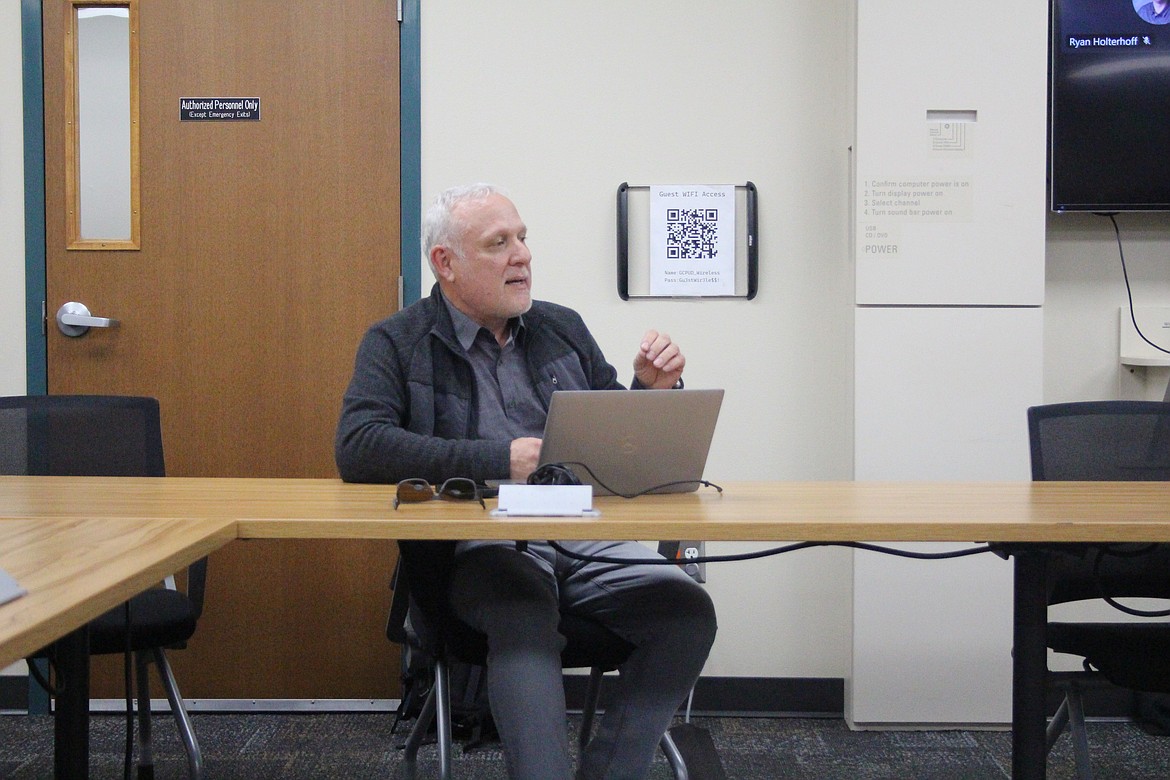
Andy Wendell, PUD senior manager of large power solutions, explains the reasoning behind proposed revisions to application fees at a PUD commission workshop Tuesday.
CHERYL SCHWEIZER/COLUMBIA BASIN HERALD
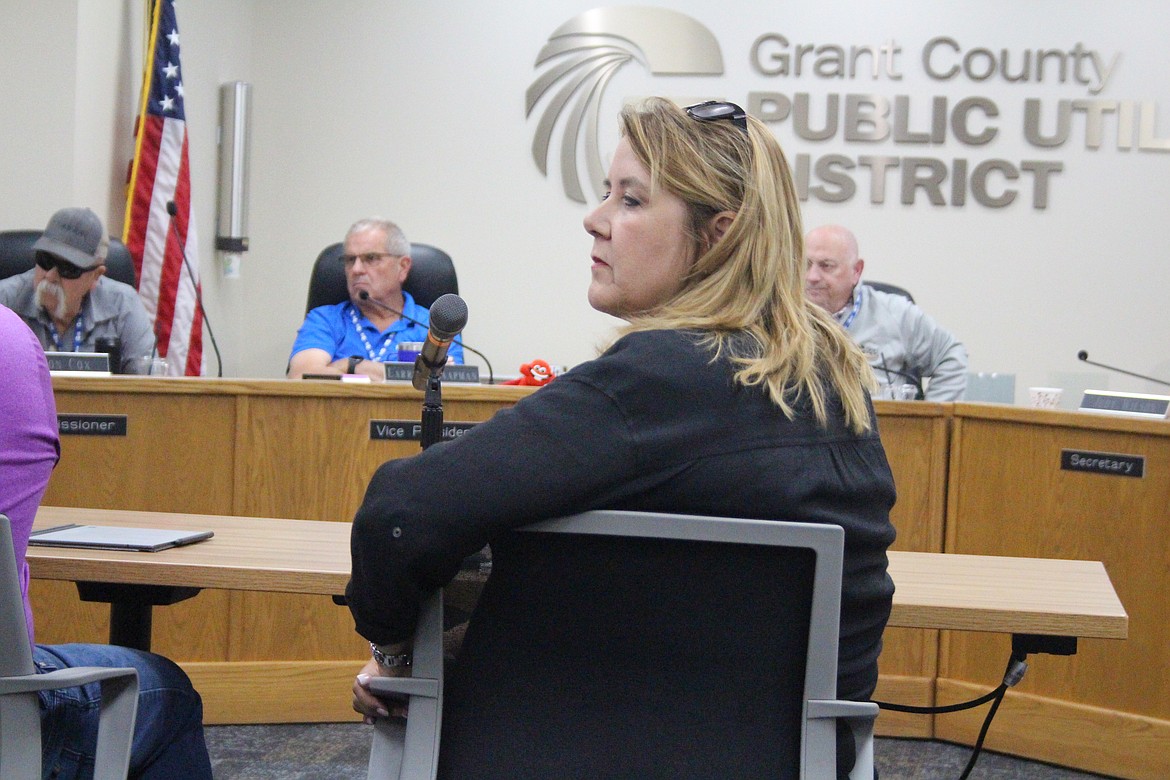
Lisa Karstetter of the Grant County Industrial Alliance listens to discussion of proposed PUD application fees.
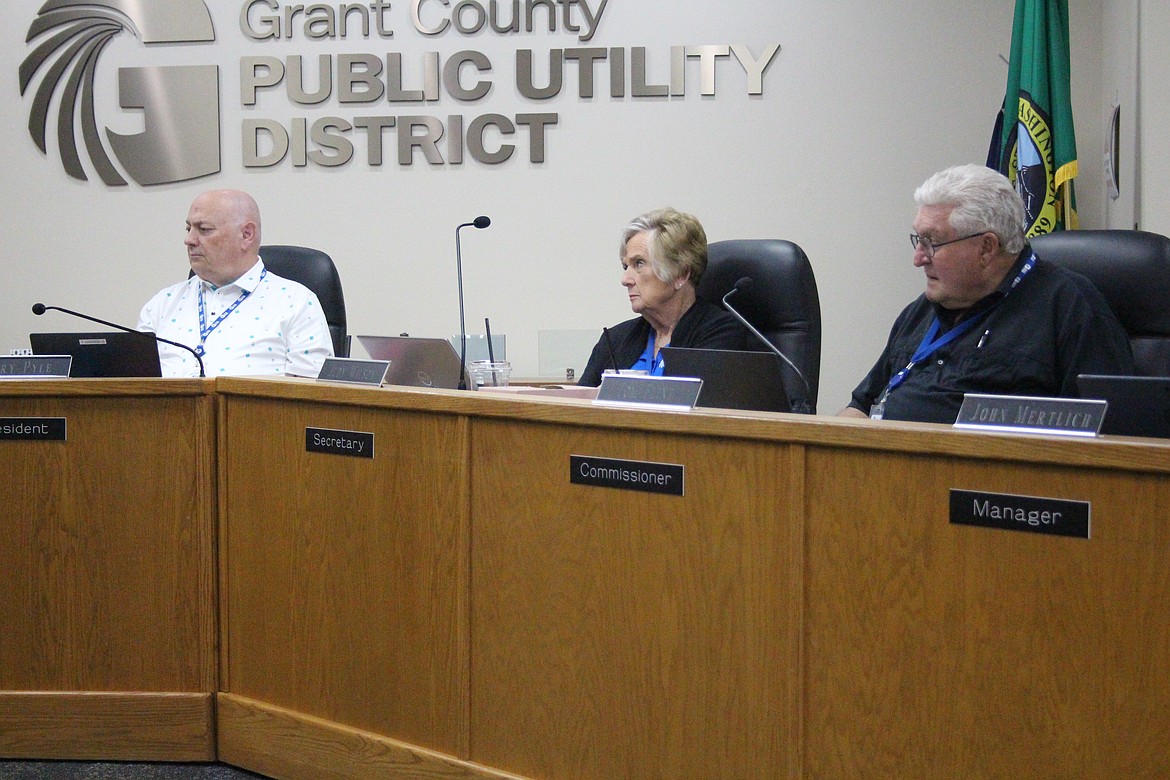
Grant County PUD commissioners, from left, Terry Pyle, Judy Wilson and Tom Flint, pictured at the May 13 meeting, asked for more information and options before making a decision on new application fees.
Senior Reporter Cheryl Schweizer is a journalist with more than 30 years of experience serving small communities in the Pacific Northwest. She began her post-high-school education at Treasure Valley Community College and enerned her journalism degree at Oregon State University. After working for multiple publications, she has settled down at the Columbia Basin Herald and has been a staple of the newsroom for more than a decade. Schweizer’s dedication to her communities and profession has earned her the nickname “The Baroness of Bylines.” She covers a variety of beats including health, business and various municipalities. | May 22, 2025 8:11 PM
EPHRATA — Grant County Public Utility District commissioners will delay consideration of a proposed policy to raise application fees for some classes of customers. The decision followed questions and concerns, some from customers and some from commissioners, at a PUD workshop Tuesday.
Chief Customer Officer Ty Ehrman said Thursday the delay will allow PUD employees to get more information.
“We’re going to want to have a discussion with the commission on what a level of (application) fee would be before we get the documents in order and send them back (for consideration),” Ehrman said.
The fees wouldn’t have changed for customers asking for up to five megawatts of power. Applications for more than 10 megawatts would’ve been charged by the megawatt, with the fee depending on the amount requested. Customers asking for 40 to 80 megawatts would’ve paid $100,000 per megawatt. A customer requesting 75 megawatts would’ve paid $7.5 million to apply.
Customers who are already in line would be required to pay the new fees, minus the fee they’ve already paid.
That prompted a letter from the Grant County Industrial Alliance and testimony from representatives of some large industrial customers.
Eric Hoegger, senior director of power and energy for Cyrus One, said that while the company understands the PUD’s goal of managing load growth, the proposed fees were too high.
“While we understand the intent behind the proposed restructure, we might respectfully note that the $100,000 per customer is significantly higher than what we’ve observed in other regions,” Hoegger said.
Cyrus One has worked with utilities in another state to help them manage their costs and keep the application fees affordable, he said. Hoegger also suggested a study of application fees nationwide.
Andy Wendell, PUD senior manager for large power solutions, said during the workshop that PUD officials are trying to determine which customers are really serious and which aren’t. The number of requests has slowed down the process, he said.
“There are cases where folks have been in the (application) queue for years,” Wendell said.
The PUD processes applications in the order they were received, and Wendell said the existing fees and the district’s inexpensive electricity have resulted in a flood of applications.
“Unfortunately, we have such a huge volume that it’s taking months, if not years, to advance to that top (of the queue) position,” he said.
Along with that, the PUD had a shortage of qualified personnel, Ehrman said, which also slowed down the process. The utility is working to add the necessary staff, he said, so the waiting period is expected to drop.
Chuck Sutton, GCIA president, said customers aren’t assured of getting power even after they apply, and that too is a problem.
“The proposed structure would require millions in non-refundable fees simply to start the application process,” Sutton said, quoting the GCIA letter. “With no assurances of power delivery, these costs introduce unacceptable risk.”
Wendell said the PUD’s goal is to have an answer for customers within 16 months. Lisa Karstetter, also with GCIA, said that’s a substantial commitment, both in money and time.
“If one of our industrials signs up for the queue, but they’re down (the list), you’re going to take their money – a lot of money – up front, but they might be further down the queue. Then they have to sit for two years waiting to even get to where the study would happen, and it could be 16 months. That is just a lot,” Karstetter said.
She suggested the PUD could charge a series of fees at different stages of the process, rather than one payment.
Wendell said the PUD is also trying to reduce the amount of money and time the utility invests in projects that might not happen. Ryan Beebout of Sabey Data Centers, and GCIA secretary, said he understands the PUD’s position, but that the fees are much higher than what’s being charged in other locations.
“Having millions of dollars sitting in a holding account for an unknown amount of time, not even knowing if the project is going to come to fruition, it just doesn’t make sense,” Beebout said. “We’ve been here for 14 years, and I can tell you we’re serious. We’ve grown steadily over the years, and we want to keep doing that. I feel like there’s got to be another way to figure out who’s serious and not without (leaving applicants with) millions of dollars sitting there doing nothing.”
Commissioner Larry Schaapman said the suggestions made during the workshop deserve more study, and that the PUD needs to establish some performance benchmarks for itself. Commissioner Tom Flint agreed, saying that the goal is to provide both the utility and the customers with the information they need to make informed decisions.
“The commission’s goal is to get speculation out of the queue so it’s realistic, and when we get that out of there, we’ll be more efficient in what we’re doing as well,” Flint said.
The PUD is reaching the limits of its share of electricity generated by Priest Rapids and Wanapum dams, and additional power is going to come at a cost, Schaapman said.
“We had a lot of power that we could utilize over the last 10, 12 years, and we really made a lot of hay with that, but we’ve kind of reached the end of our rope right now,” he said. ‘We’re looking at new resources, we’re looking at more transmission, and all that stuff costs a lot of money.”
The PUD can’t spend money on planning for customers who aren’t serious, Schaapman said.
Commissioner Nelson Cox said more study was probably a good idea.
“I think we need to take a little bit of a pause and relook at some stuff,” Cox said.
He didn’t support a long delay, Cox said, but additional study could be beneficial.
Commissioner Judy Wilson said she understood the customer concern, and the need for the PUD to deliver.
“I feel we would owe the customers a real estimate of both time and money,” she said.
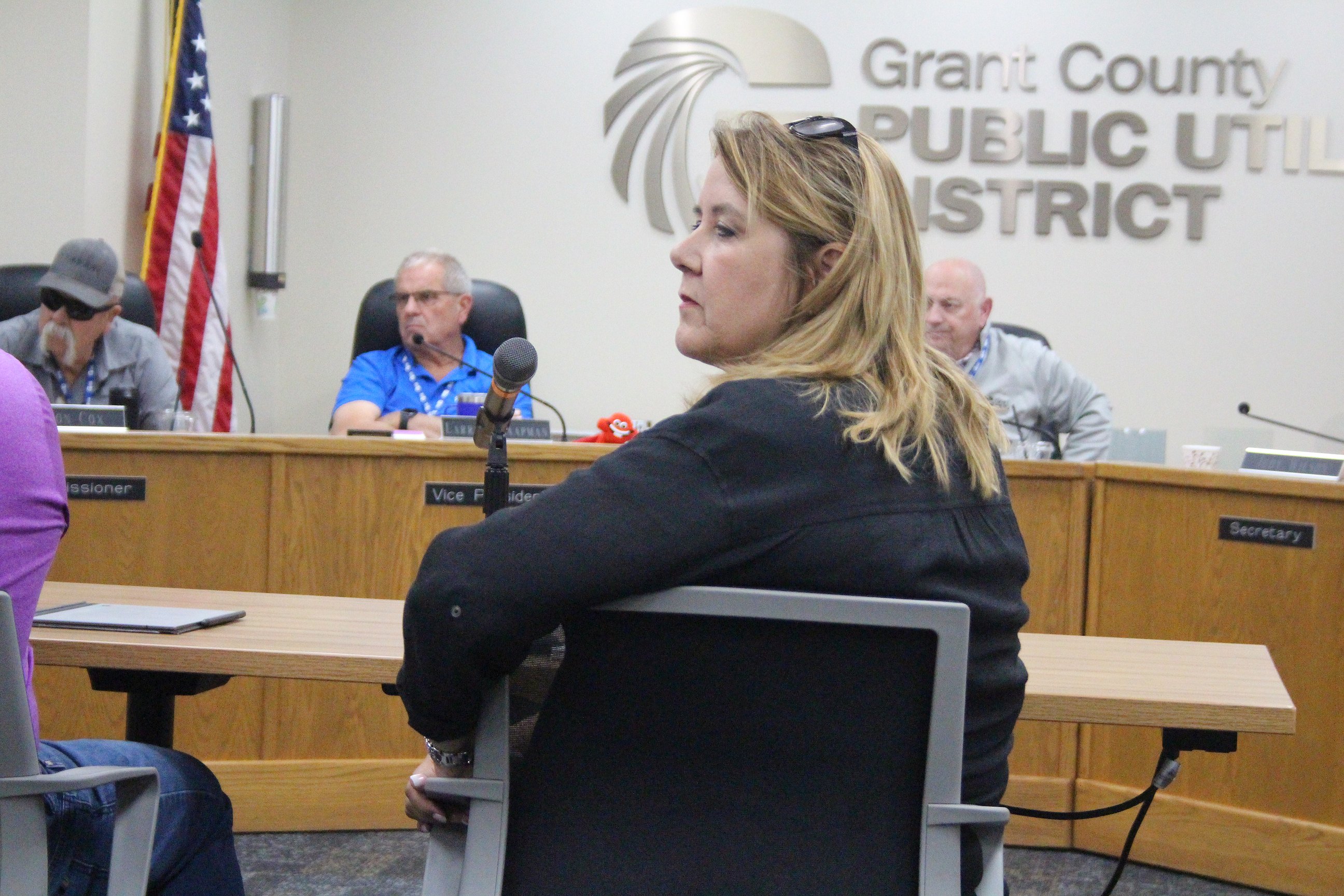 Lisa Karstetter of the Grant County Industrial Alliance listens to discussion of proposed PUD application fees.
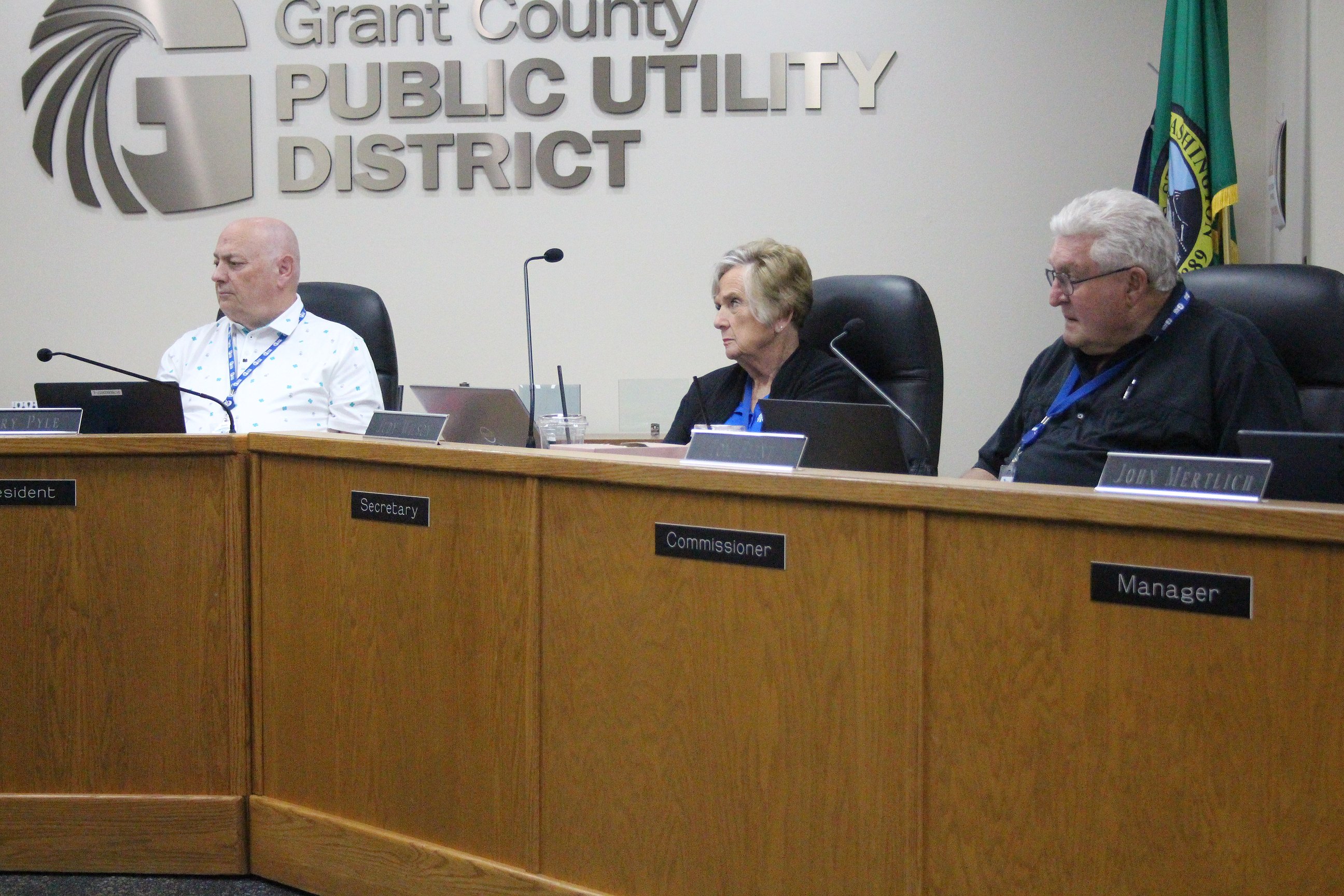 Grant County PUD commissioners, from left, Terry Pyle, Judy Wilson and Tom Flint, pictured at the May 13 meeting, asked for more information and options before making a decision on new application fees.
ARTICLES BY CHERYL SCHWEIZER

3 arrested in Royal City area thefts case
ROYAL CITY — Three men were arrested and booked into the Grant County Jail on suspicion of possessing stolen property after a search was served on a home near Beverly Thursday.

More park improvements planned for Royal City in ‘26
ROYAL CITY — Lions Park in Royal City now has a soccer field, so city officials will be working on the next phase of improvements in 2026. The first phase of upgrades to Apple Avenue also is scheduled for 2026, and both are among the projects reflected in the city’s 2026 budget. The budget was approved by Royal City City Council members Tuesday.

Sleep Diagnostic Center physician pleads guilty to Medicaid fraud
Charges involve charging Apple Health for recalled, altered CPAP devices
BREWSTER — A Brewster physician who operates a sleep diagnostic clinic in Moses Lake and Wenatchee will be sentenced March 24 as part of a Wednesday plea deal on Medicaid fraud charges.