
Newhouse reintroduces Farm Workforce Modernization Act
JOEL MARTIN | Hagadone News Network | UPDATED 10 months, 2 weeks AGO
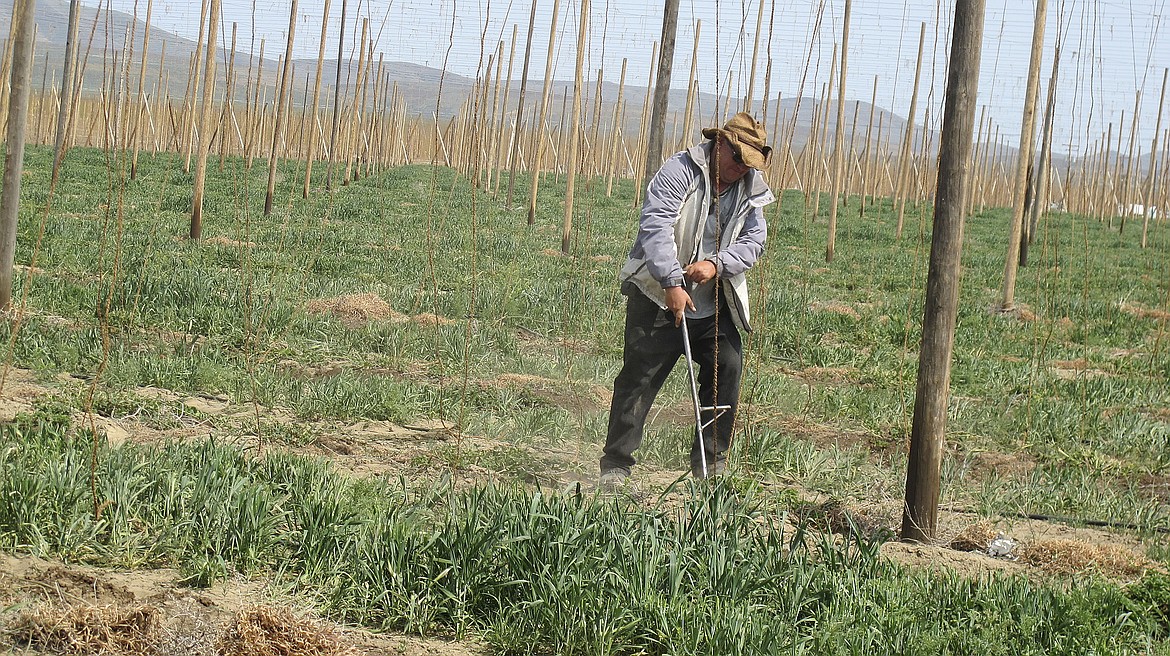
A farm worker installs twine in a hop field near Moxee. A bill reintroduced in Congress would enable a large number of undocumented farm workers in Washington a way to work legally.
AP
Joel Martin has been with the Columbia Basin Herald for more than 25 years in a variety of roles and is the most-tenured employee in the building. Martin is a married father of eight and enjoys spending time with his children and his wife, Christina. He is passionate about the paper’s mission of informing the people of the Columbia Basin because he knows it is important to record the history of the communities the publication serves. | May 29, 2025 4:11 PM
WASHINGTON, D.C. — A bipartisan bill to make hiring and retaining foreign farm workers more feasible was introduced in the U.S. House of Representatives May 7 by Reps. Dan Newhouse, R-WA, and Zoe Lofgren, D-CA.
The Farm Workforce Modernization Act of 2025 would establish a new category for foreign nationals living in the U.S. and working on farms and ranches. To qualify as a certified agricultural worker, or CAW, an immigrant would have to have worked in the U.S. for at least 180 days in the last two years and be inadmissible or deportable but be under a grant of deferred departure or hold temporary protected status, according to a fact sheet from Newhouse’s office. A CAW’s spouse and children could also be eligible to remain in the U.S. as certified agricultural dependents. A CAW would be eligible to work in the U.S. year-round, unlike seasonal workers admitted under the H2-A visa program.
“In the past few years, we’ve seen labor shortages contribute to high food prices. If it wasn’t obvious before, the pandemic made clear that our country’s agricultural workforce rules are in dire need of reform,” Lofgren wrote in a statement. “The men and women who work America’s farms feed the nation. The Farm Workforce Modernization Act stabilizes the workforce, which will protect the future of our farms and our food supply. It’s well past time we get this legislation that serves the best interests of our country to the president’s desk.”
The FWMA also would streamline the H-2A visa application process by funneling all applications through a single electronic platform, allowing employers to file one petition for different seasonal needs, provide H-2A workers with three-year visas and solidify wage standards, including freezing wages for one year and capping wage fluctuations for the next nine.
This isn’t the first time the FMWA has been introduced. A similar bill passed the House of Representatives with bipartisan support in 2019 and 2021, but failed narrowly in the Senate in 2022. Sen. Mike Crapo, R-Idaho, wrote in an op-ed that that bill, dubbed the Affordable and Secure Food Act, would have artificially driven up farm work wages, encouraged laxer border control and increased the burden of taxpayers for benefits.
“Introduction of the Affordable and Secure Food Act prioritized expediency over finding a genuine solution to the agriculture labor shortage. That bill included several items not under discussion in our many months of negotiations, such as the provision that would make Certified Agricultural Workers, who are currently undocumented, eligible for federal benefits like health care tax credits and food purchasing benefits for low-income Americans and families,” Crapo wrote.
The 2025 incarnation of the FMWA specifically bars CAWs and their families from receiving federal means-tested public benefits, tax credits and Affordable Care Act benefits that aren’t available to illegal immigrants.
The FMWA also provides a means for CAWs to adjust their status to that of lawful permanent residents after four to eight years as a CAW. The applicant would have to pay a penalty fee of $1,000, be up to date on all federal taxes and go through an application process with the Department of Homeland Security. Spouses and children of CAWs would also be eligible for this path to legal residency.
The FMWA has garnered support from not only legislators on both sides of the aisle, but also farm worker advocacy groups like the United Farm Workers of America.
“For years, agricultural employers have been reporting agricultural labor shortages to Congress – this is Congress’ chance to solve that problem.” UFW President Teresa Romero wrote in a statement. “The farm workers who feed America have earned the right to stay in America – and any agricultural labor reform legislation must start by accepting this basic moral fact.”
However, the Food Chain Workers Alliance believed the legislation didn’t go far enough.
“The FWMA … expands the H-2A program without providing necessary oversight or adequate protections, and makes e-verify mandatory for all agriculture employers,” the FCWA wrote in 2019. “It excludes many workers from a pathway to status, sets up a very long path to finally acquire residency status, and requires farmworkers to continue working in agriculture for up to 8 years to qualify.”
Nearly half of Washington’s agricultural workers, 46.6%, were undocumented as of 2019, according to a study by the New American Economy Research Fund.
“The workforce crisis has come to a boiling point for farmers across the country,” Newhouse wrote. “Reintroducing the Farm Workforce Modernization Act sends a clear message to farmers that we are working hard to find solutions that ease the burdens brought on by the current state of the H-2A program. This legislation is necessary to lay the groundwork for continued negotiations, and I am committed to working closely with my colleagues to enact long-term, durable reforms to our agriculture guest worker programs. This issue has been, and remains, my top priority.”
ARTICLES BY JOEL MARTIN

Grand tour
‘Around the World in 80 Days’ takes audience on a global adventure
SOAP LAKE — There’s adventure, comedy and mystery in the Masquers Theater’s production of “Around the World in 80 Days,” opening Friday. “You have elephants, you have typhoons, you have a (scene in India) where they’re being chased by people who are shooting at them,” said director Cynthia Beyer. “A lot of action.” “Around the World in 80 Days” has 32 characters and was originally written for a cast of six people, Beyer said. That was a little bit much for the Masquers to take on, she said. “One actor was supposed to do 15 parts, another was supposed to do 12,” she said. “And I’m like, yeah, we’re not professionals here. We’re community theater.”

A sea of color
Palmer’s Adventure Farm debuts Tulip Fest
MOSES LAKE — Palmer’s Adventure Farm has begun its first annual Inland Northwest Tulip Fest.

Active listings up, sales steady in Washington statewide
MOSES LAKE — More homes were on the market in March 2026 than a year earlier, but sales are about the same, according to data from the Northwest Multiple Listing Service, which tracks real estate trends in 27 of Washington’s 39 counties.