
GCSO to purchase new drug detection K-9
NANCE BESTON | Hagadone News Network | UPDATED 5 months, 1 week AGO
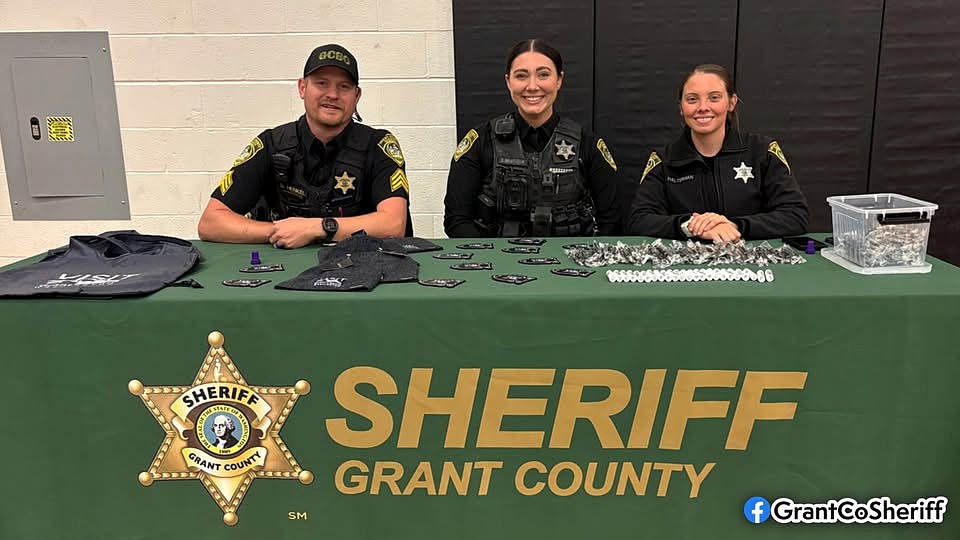
Grant County Sheriff’s Office Deputy Seth Hinkle, left, will be trained to be a K-9 drug detection handler. The K-9 will be working in jail around the beginning of 2026. Also pictured are deputies Sarah Bradshaw and Regan Halterman.
COURTESY PHOTO/GRANT COUNTY SHERIFF’S OFFICE
EPHRATA – The Grant County Sheriff’s Office is currently in the process of purchasing a drug detection K-9 for use both inside the Grant County Jail and for deployment into the field.
"The addition of a drug detection K-9 not only adds safety for inmates and jail employees but also helps improve the quality of professional service our corrections staff delivers to the community," said Phil Coats, Chief Deputy of Corrections, in a statement from GCSO. "This enhancement will start at the existing jail and will move with us as we enter our new jail in 2026."
The K-9 is being funded in part by settlement money received from Washington state lawsuits filed against three U.S. opioid-distribution companies for their role in the opioid epidemic. GCSO is investing nearly $28,000 to purchase the K-9, train it and its handler and provide opioid overdose-reversal kits.
“They are in the process of purchasing the dog. They are working on matching a canine with Deputy Seth Hinkle,” GCSO Public Information Officer Kyle Foreman said.
Once the dog is purchased, it will be trained and certified, Foreman said. The K-9 will detect heroin, cocaine, methamphetamines and fentanyl that may be smuggled into the jail.
On Aug. 12, 2018, an inmate died of acute morphine intoxication inside of the Grant County Jail.
“We have since then purchased a full body scanner and mail scanner to help close off those routes of smuggling into the jail,” Foreman said. “We have learned that we need to have a multi-pronged (approach to) finding and cutting off the path that drugs enter the jail. The drug detection K-9 is trained to do facilities, so inside the jail or other buildings. Outside of a structure, we will also be able to examine vehicles.”
Foreman said any type of dog can be certified as a drug-detection K-9. Dogs used in drug detection must have the ability to prey, hunt, retrieve, follow odors, be active and trainable.
GCSO currently has two Patrol K-9s who aid in tracking people and helping with arrests. The drug K-9 will not be used for this purpose but could be used for helping investigators conduct drug investigations in buildings, vehicles and outside areas, Foreman said. Previously, from 2009 to 2016 GCSO had a drug detection K-9, Maddox.
Maddox did the same thing the upcoming K-9 will do, which is detection in buildings and vehicles, but not humans.
“Seth Henkel is the K-9’s handler, and so to properly care for the dog, the dog will need a shelter, a concrete pad for a kennel, funding for food and medical care,” Foreman said. “The K-9 will live with Henkel, just like any of our other K-9s.”
He said those needs are not funded by the money received from the settlement. GCSO is seeking support from the public to help purchase those items. To contribute to the cause, visit the Columbia Basin Foundation donation page at bit.ly/3Lfrlyf and specify the donation is for the Correctional Narcotics Investigative Team. Donations can also be made in person at the Columbia Basin Foundation office at 101 Basin St. NW in Ephrata.
Foreman said they are hoping to have the K-9 trained and ready to begin work by early to mid-2026.
“We are in the early stages of canine selection, matching the K-9 with its handler, training the handler and K-9 together and all of those will take several weeks,” Foreman said. “I would expect to see the K-9 in service doing its job in 2026.”
ARTICLES BY NANCE BESTON
1 arrested after Highway 17 stop; detectives recover fentanyl, firearms
MOSES LAKE — The Moses Lake Street Crimes Unit conducted a traffic stop on Highway 17 near Randolph Road and executed a search warrant Friday morning as part of an ongoing narcotics investigation.
4th-year drought declaration in WA, subtle effects in the Columbia Basin
EPHRATA — Washington’s fourth straight year of drought is expected to hit some regions hard, but in Grant and Adams counties, the impacts will look different – quieter, less visible and centered underground. Statewide, the Department of Ecology issued an emergency drought declaration after a warm winter left Washington with about half its usual snowpack, raising concerns about low summer streamflows, stressed fish populations and heightened wildfire risk. Seven of the past 10 years have included drought somewhere in the state. “If you look at our mountains, the challenge we are facing is clear,” Gov. Bob Ferguson said during a press conference Wednesday. “We’re taking emergency action to protect fish, farmers and communities across Washington.”
Sleep Diagnostic Center to close after doctor’s sentencing
MOSES LAKE — The Central Washington Sleep Diagnostic Center announced it will be closing its doors effective April 30. This includes locations in Moses Lake, Spokane Valley, Brewster and Wenatchee. The announcement follows the March 25 guilty plea from Dr. Eric Edward Haeger, 57, in United States District Court to adulterating and misbranding medical devices with the intent to defraud or mislead, according to a statement from the U.S. Attorney’s Office. “The adulterations by Dr Haeger show a dangerous disregard for the safety of his patients,” Washington Attorney General Nick Brown said in a statement. “This is a win for patient safety, for protecting public dollars from fraud, and for ensuring citizens of Washington get necessary healthcare. This case exemplifies the great work our team is doing in collaboration with our federal partners to fight fraud and protect Washingtonians.”