
Considering dementia's warning signs
JOEL MARTIN | Hagadone News Network | UPDATED 3 months, 4 weeks AGO
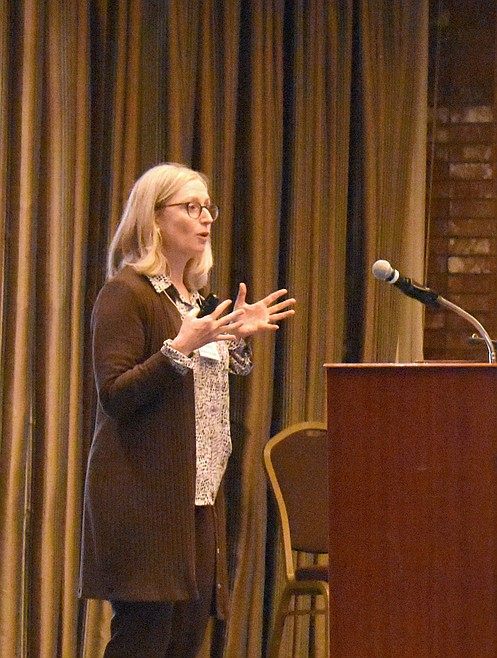
Dr. A. Carroll Hayman speaks about dementia at the Mobile Integrated Health Symposium in Kennewick in October.
JOEL MARTIN/COLUMBIA BASIN HERALD
Joel Martin has been with the Columbia Basin Herald for more than 25 years in a variety of roles and is the most-tenured employee in the building. Martin is a married father of eight and enjoys spending time with his children and his wife, Christina. He is passionate about the paper’s mission of informing the people of the Columbia Basin because he knows it is important to record the history of the communities the publication serves. | November 5, 2025 3:05 AM
MOSES LAKE — About 42% of adults over 55 will develop dementia eventually, according to the National Institutes of Health. Yet for such a common phenomenon, it’s very little understood.
“There's still a lot of stigma around dementia,” said Dr. A. Carroll Hayman, a Seattle physician who specializes in Alzheimer’s and other dementias, at a symposium in Kennewick in October. “It's a scary word. People don't want to say they have it, a little bit like cancer was like 50 years ago. Everybody wanted to pretend it didn't exist. For the people living with dementia, that is often actually a feature of the illness, that their brain doesn't understand that they have deficits.”
Part of the reason is that there’s not just one kind of dementia, Hayman said. Alzheimer’s disease is the most common type, but the Alzheimer’s Association identifies at least nine others. To make matters more confusing, sometimes the different dementias occur together, ganging up on the patient to make diagnosis more difficult.
The first step, Hayman said, is identifying dementia. Just as there’s no single type, there’s no one-size-fits-all diagnosis, or even a way to be sure if it’s dementia at all. After all, doesn’t everybody get a little forgetful as they get older? What’s the dividing line between that and something as serious as dementia?
“Sometimes people say dementia, sometimes they say Alzheimer’s … just as a word that means something’s not quite right,” Hayman said. “Dementia is a clinical syndrome. It’s the loss of memory and thinking that’s severe enough to interfere with daily life.”
The distinction, according to Johns Hopkins University’s website, is in the severity and the circumstances. If you sometimes put down your keys and can’t recall where, that’s one thing. If you put them someplace bizarre like under the sink, or you suspect somebody has stolen them, that’s something else entirely. Likewise, if you lose your way occasionally and have to reset to get your bearings, you’re probably in the same boat with most other folks. If you get lost without realizing you are, or you lost the ability to read a map or follow landmarks and signs, that’s a sign there’s something serious going on.
The Food and Drug Administration approved a blood test in May that has the potential to make early diagnoses, according to the FDA’s website, but that only tests specifically for Alzheimer’s and must be done in conjunction with other testing.
“As of today, we can’t tell for certain whether or not a person has Alzheimer’s,” Hayman said. “If they’re old and they have potential, I just say yes. That’s not to make light of it, but to recognize that it doesn’t really matter what we do.”
That’s because there’s no cure and none on the horizon, she explained. There isn’t even really a treatment. There are a couple of drugs that have shown promise in slowing it down if it’s caught early, Hayman said, but those are very expensive and not available everywhere.
“I always say the first things to go are pills and bills,” Hayman said. “They can’t manage their (medications), and they can’t pay their bills, or they pay their bills seven times. There was a study that … looked back at people diagnosed with Alzheimer’s, and for like a decade before they were diagnosed, they were making bad decisions.”
Alzheimer’s is caused by proteins that clog up the neural connections in the brain, killing the neurons, Hayman said. Neurons, unlike many other parts of the body, don’t regenerate when they die. So the neural death leads to an irreversible decline in brain function. The best treatment doesn’t come from doctors or drugs, Hayman said, but from the people around the patient.
“If I had a magic wand and I could do one thing for everybody in the world who has dementia, I would get them and their care partner, people in their lives, education and support about what's going to happen, just like we do with pregnancy,” Hayman said. “What to expect over the next few months, what to expect over the next few years … We just want people to know and understand what's coming and how they can prepare. People sometimes say there's no treatment for dementia, and I disagree. The treatment is support.”
The December edition of Senior News will look at how dementia patients and caregivers can prepare themselves for the future.
10 Warning Signs of Alzheimer’s
1. Memory loss that disrupts daily life.
2. Challenges in planning or solving problems.
3. Difficulty completing tasks at home, at work or at leisure.
4. Confusion with time or place.
5. Trouble understanding visual images and spatial relationships.
6. New problems with words in speaking or in writing.
7. Misplacing things and losing the ability to retrace steps.
8. Decreased or poor judgment.
9. Withdrawal from work or social activities.
10. Changes in mood or personality.
ARTICLES BY JOEL MARTIN
Space Burger booth open March 13-15
MOSES LAKE — Those who can’t wait for the Grant County Fair can get their Space Burger fix next weekend, according to an announcement from the Lioness Club of Moses Lake. The iconic Grant County sandwiches will be available at the Grant County Fairgrounds March 13-15, according to the announcement. There is no admission fee to get into the fairgrounds that weekend.
SENIOR EVENTS: March 2026
COLUMBIA BASIN — Plays, art shows, auctions and more await seniors in the Columbia Basin this month. Here are some opportunities to get out and about in March.
Valentine’s Day cards flood Brookdale Hearthstone with love
MOSES LAKE — Residents at Brookdale Hearthstone Assisted Living in Moses Lake got Valentine’s Day greetings from across the country last month. “I believe that the only states we have not received (cards from) yet are Vermont and Maine,” Lifestyle Director Imelda Broyles said Feb. 24. “We keep receiving new cards every single day. They have not stopped. My residents are in awe with every single one of the cards that we’ve been receiving.” The Hearts Across America project started as a way for children in school classrooms to exchange Valentine’s Day cards with classes in other states or even countries, but the idea has expanded to senior living facilities, according to the project’s social media.