
Considering dementia's warning signs
JOEL MARTIN | Hagadone News Network | UPDATED 11 months, 2 weeks AGO
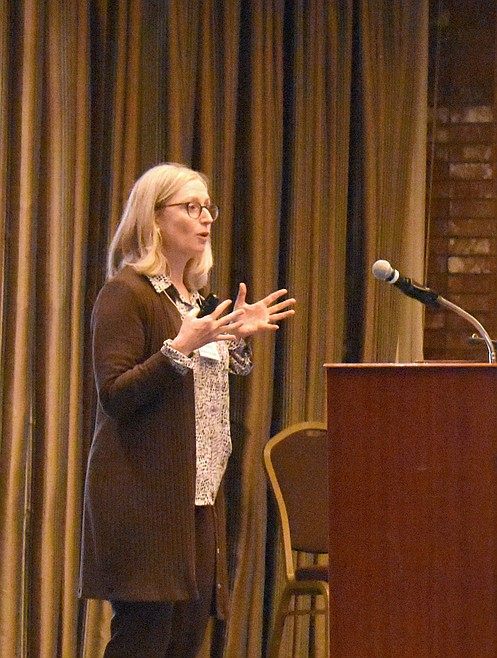
Dr. A. Carroll Hayman speaks about dementia at the Mobile Integrated Health Symposium in Kennewick in October.
JOEL MARTIN/COLUMBIA BASIN HERALD
Joel Martin has been with the Columbia Basin Herald for more than 25 years in a variety of roles and is the most-tenured employee in the building. Martin is a married father of eight and enjoys spending time with his children and his wife, Christina. He is passionate about the paper’s mission of informing the people of the Columbia Basin because he knows it is important to record the history of the communities the publication serves. | November 5, 2025 3:05 AM
MOSES LAKE — About 42% of adults over 55 will develop dementia eventually, according to the National Institutes of Health. Yet for such a common phenomenon, it’s very little understood.
“There's still a lot of stigma around dementia,” said Dr. A. Carroll Hayman, a Seattle physician who specializes in Alzheimer’s and other dementias, at a symposium in Kennewick in October. “It's a scary word. People don't want to say they have it, a little bit like cancer was like 50 years ago. Everybody wanted to pretend it didn't exist. For the people living with dementia, that is often actually a feature of the illness, that their brain doesn't understand that they have deficits.”
Part of the reason is that there’s not just one kind of dementia, Hayman said. Alzheimer’s disease is the most common type, but the Alzheimer’s Association identifies at least nine others. To make matters more confusing, sometimes the different dementias occur together, ganging up on the patient to make diagnosis more difficult.
The first step, Hayman said, is identifying dementia. Just as there’s no single type, there’s no one-size-fits-all diagnosis, or even a way to be sure if it’s dementia at all. After all, doesn’t everybody get a little forgetful as they get older? What’s the dividing line between that and something as serious as dementia?
“Sometimes people say dementia, sometimes they say Alzheimer’s … just as a word that means something’s not quite right,” Hayman said. “Dementia is a clinical syndrome. It’s the loss of memory and thinking that’s severe enough to interfere with daily life.”
The distinction, according to Johns Hopkins University’s website, is in the severity and the circumstances. If you sometimes put down your keys and can’t recall where, that’s one thing. If you put them someplace bizarre like under the sink, or you suspect somebody has stolen them, that’s something else entirely. Likewise, if you lose your way occasionally and have to reset to get your bearings, you’re probably in the same boat with most other folks. If you get lost without realizing you are, or you lost the ability to read a map or follow landmarks and signs, that’s a sign there’s something serious going on.
The Food and Drug Administration approved a blood test in May that has the potential to make early diagnoses, according to the FDA’s website, but that only tests specifically for Alzheimer’s and must be done in conjunction with other testing.
“As of today, we can’t tell for certain whether or not a person has Alzheimer’s,” Hayman said. “If they’re old and they have potential, I just say yes. That’s not to make light of it, but to recognize that it doesn’t really matter what we do.”
That’s because there’s no cure and none on the horizon, she explained. There isn’t even really a treatment. There are a couple of drugs that have shown promise in slowing it down if it’s caught early, Hayman said, but those are very expensive and not available everywhere.
“I always say the first things to go are pills and bills,” Hayman said. “They can’t manage their (medications), and they can’t pay their bills, or they pay their bills seven times. There was a study that … looked back at people diagnosed with Alzheimer’s, and for like a decade before they were diagnosed, they were making bad decisions.”
Alzheimer’s is caused by proteins that clog up the neural connections in the brain, killing the neurons, Hayman said. Neurons, unlike many other parts of the body, don’t regenerate when they die. So the neural death leads to an irreversible decline in brain function. The best treatment doesn’t come from doctors or drugs, Hayman said, but from the people around the patient.
“If I had a magic wand and I could do one thing for everybody in the world who has dementia, I would get them and their care partner, people in their lives, education and support about what's going to happen, just like we do with pregnancy,” Hayman said. “What to expect over the next few months, what to expect over the next few years … We just want people to know and understand what's coming and how they can prepare. People sometimes say there's no treatment for dementia, and I disagree. The treatment is support.”
The December edition of Senior News will look at how dementia patients and caregivers can prepare themselves for the future.
10 Warning Signs of Alzheimer’s
1. Memory loss that disrupts daily life.
2. Challenges in planning or solving problems.
3. Difficulty completing tasks at home, at work or at leisure.
4. Confusion with time or place.
5. Trouble understanding visual images and spatial relationships.
6. New problems with words in speaking or in writing.
7. Misplacing things and losing the ability to retrace steps.
8. Decreased or poor judgment.
9. Withdrawal from work or social activities.
10. Changes in mood or personality.
ARTICLES BY JOEL MARTIN

Endless battle
Noxious Weed Control Board works to keep invasive plants under control
MOSES LAKE — Some of the nastiest plants in Grant County were the topic of a class led by Jay Johnson, a consultant with the Grant County Noxious Weed Control Board, Tuesday. The Noxious Weed Control Board, as its name would suggest, is tasked with keeping weeds under control in Grant County. That’s not a small job; the board’s website lists 129 species of noxious weeds that are found around Grant County. A noxious weed is defined as an invasive, non-native plant that threatens agricultural crops, local ecosystems or fish and wildlife habitat, according to the Noxious Weed Control Board. Washington state law requires that these weeds be identified and their spread kept to a minimum, if not completely eradicated. “We’re one of those agencies a lot of people don’t really understand,” Johnson said. “We’re a county office and … our funding is tax-based assessment. When you get your tax bill and you look down at all the expenses that you pay for, there we are.”

BASIN EVENTS: Oct. 16-24
COLUMBIA BASIN — Whether you feel like shopping, crafting, learning or seeing a show, there’s something happening for you this week in the Basin. Oct. 16 ‘My Family (Mi Familia)’ screening Spanning three generations, “My Family (Mi Familia)” is a heartfelt drama that follows the Sánchez family as they build their lives in East Los Angeles. Through love, hardship, triumph, and sacrifice, the film explores the immigrant experience, the strength of family bonds, and the traditions that connect one generation to the next. Lowrider show and taco truck before the screening. Sponsored by Columbia Basin Allied Arts, EDUBS C/S and the Moses Lake Creative District. $12 per person. Doors open at 6 p.m., film begins at 7 p.m. at the Moses Lake Civic Center Auditorium, 401 S. Balsam St. Tickets and info: www.cba-arts.org.

Moses Lake author encourages women to look beyond church culture norms
MOSES LAKE — A Moses Lake author’s book, “A Christian Woman Striving to Live Her Faith in a Man-Controlled World,” takes aim at the role to which many churches relegate the female half of their congregations. “It’s to encourage women in the faith,” Linda Curran said. “A lot of churches say, ‘Teach Sunday school, do this, do that, but don’t (evangelize.)’" In her book, Curran recounts a time when she moved to a new community and joined a church there. She was surprised to learn that, as a new female member, she had been automatically assigned church cleaning duties. When she questioned it, she wrote, she was met with condescension and her objections were brushed aside. In other churches, she said, women who were capable of teaching were relegated to “women’s ministry.”