
'The airman they never forgot'
Hungry Horse News | Hungry Horse News | UPDATED 10 months, 4 weeks AGO
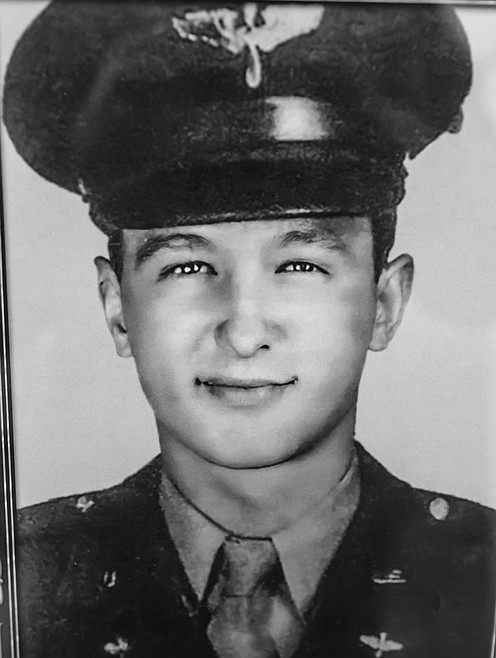
Lt. Norbert Herriges.
The Northwest Montana History Museum will host an open house 5 p.m. Tuesday, Nov. 11, to unveil a new exhibit honoring Lt. Norbert William Herriges, a World War II fighter pilot from Whitefish who gave his life to protect a French village. The exhibit, titled “The Airman They Never Forgot,” tells the remarkable story of Herriges, who on his 35th mission in August 1944 shot down two German bombers headed toward the village of Pourrières, France Herriges’ own plane was hit in the battle, and he was killed in action.
Since then, the people of Pourrières have remembered and honored him for saving the town from destruction.
Among the artifacts on display are a handcrafted sculpture from the people of Pourrières, photographs of Herriges, a letter of appreciation from the village, and a model of a P-47 Thunderbolt — the aircraft Herriges flew in combat.
Museum volunteer and historian Jane Renfrow of Columbia Falls has been researching Herriges and his fantastic story.
Lt. Herriges was born Dec. 3, 1919, in Watson, Saskatchewan, Canada, the second child of 11 in the family of Nicholas and Anastasia Strunk Herriges.
They moved to Whitefish, where Norbert graduated from high school in 1938. In 1941 he married Jean E. Harrison. They had a son, John Nicholas. He worked for Great Northern Railway in Whitefish as an office clerk.
When the United States joined the Allies in WWII, Herriges decided to volunteer; he could either go to Canada to enlist or become a U.S. citizen. Judge Dean King of Kalispell held a special Saturday hearing to grant citizenship, and Norbert joined the U.S. Army Air Corps.
After completing advanced flight training, he was commissioned as second lieutenant and awarded his Silver Wings.
In 1942, he served as a fighter pilot of the P-47 Thunderbolt bomber with the 12th Air Force, 522nd Fighter Squadron in Europe stationed at Serragia Airfield on the island of Corsica. His squadron’s mission was to engage the enemy and destroy its supply lines in southern France because the Allies were about to land troops from the Mediterranean in Operation Dragoon.
On Aug. 12, 1944, on his 35th mission and three days before the Allied invasion of Provence, Herriges flew his P-47 Thunderbolt Bomber on his way to destroy a railroad supply line. He encountered two German ME 109s heading toward the village of Pourrières, a town of around 1,000 people in the Var region of France.
According to fellow squadron pilot 2nd Lt. William Hay, Herriges engaged and shot down both enemy planes, but his own aircraft was hit and crashed in a nearby field.
A local farmer found the wrecked plane, the body of Herriges with a bullet in his head and an unopened parachute. At great personal risk, his body was hidden in the vault of the old people’s home while the Germans searched the area.
Two days after the air battle, villagers of Pourrières and the surrounding Arc River Valley conducted a funeral attended by an estimated 3,000 people—a remarkable act of courage and display of gratitude.
The Germans thought the villagers were recognizing dead from World War I, not the pilot, whose body they desperately wanted.
Herriges’s body was returned to Whitefish in 1949 after the War, but his family didn’t know the true scope of his heroism until decades later.
In 1973, Norbert’s brother Dan, who was only four at the time of his brother being shot down and killed, went to France to learn more of the incident.
“I found out the information about what happened to him when we traveled there,” Dan said in a 2021 Whitefish Pilot interview. “I spoke with the owner of the farm who was the son of the owners of the farm when it happened.”
Dan visited the town’s city hall where they had an entry in the town register of Norbert’s death and other men who died in the battle. An obelisk in the early 2000s was dedicated in the town square to Norbert.
“They’ve kept Norbert as an important part of the town’s heritage,” Dan said.
Pourrières continues to hold a yearly ceremony to honor Allied soldiers including Lt. Norbert Herriges and the French Resistance fighters.
August 9, 2004 a plaque bearing the inscription commemorating Lt. Herriges was attached to the large stone war memorial pillar in the village square.
“For Lieutenant Norbert W. Herriges. A fighter pilot in the 27th Fighter Group Died for the liberation of France at Pourrieres, August 12, 1944,” it reads.
As part of the evening, the museum also will screen the French documentary by Lionel Kabac (with English subtitles) Un Été en Provence (A Summer in Provence), which recounts Herriges’ story and the village’s enduring gratitude.
Members of the Herriges family, who still reside in the Flathead and Montana, will attend the event and share family memories of Norbert’s service and legacy.
“He was a man they held in regard for saving their town even though they never met him,” says Margaret Herriges, another relative of Norbert’s. “He’s become my hero now, too.”
Taps will be played by Flathead High trumpeter Jack Provo.
The public is invited to attend the open house and view the exhibit.