
Eyewitness to History: WWII veteran witnessed Japan’s historic surrender
EMILY MESSER | Hagadone News Network | UPDATED 3 months, 3 weeks AGO
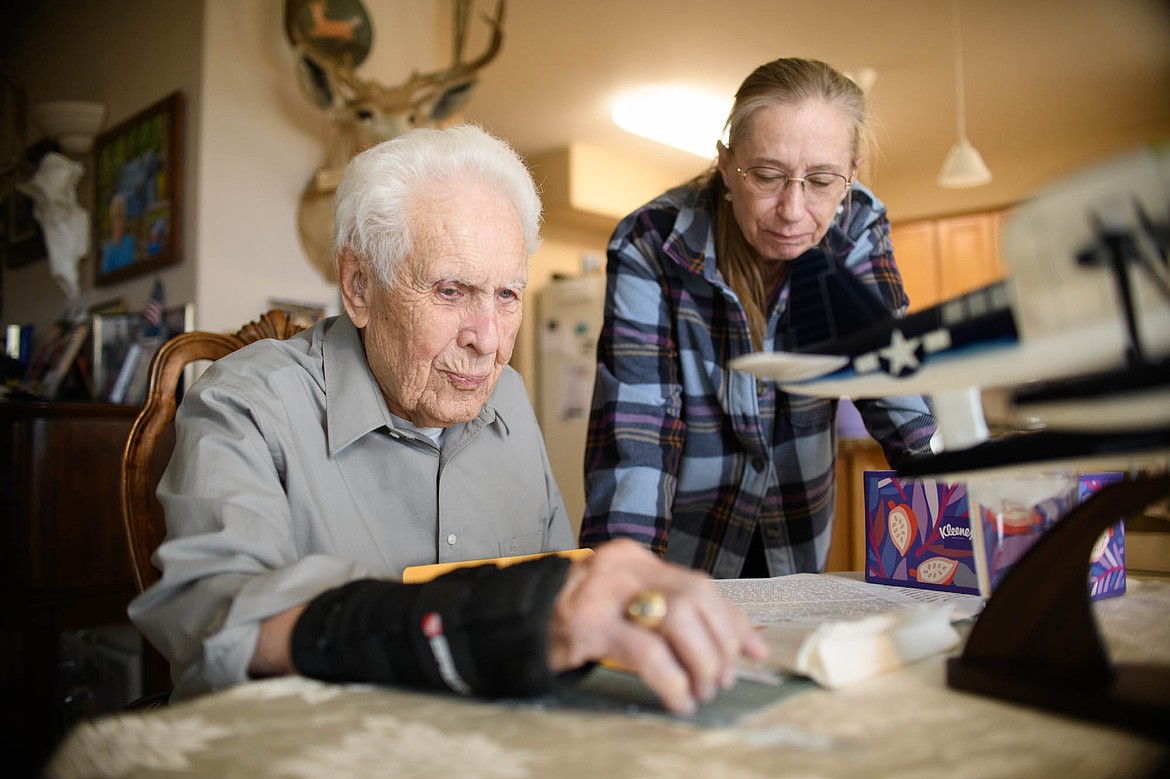
Jim Sivelle sits at the kitchen table as his wife Leigh Ann reads the typed letter he mailed home to his parents. While Sivelle witnessed the Japanese Instrument of Surrender in Tokyo Bay, he got a typewriter out, and documented the moment. (Emily Messer/Leader)
Emily Messer joined the Lake County Leader in July of 2025 after earning a B.A. degree in Journalism from the University of Montana. Emily grew up on a farm in the rolling hills of southeast Missouri and enjoys covering agriculture and conservation. She's lived in Montana since 2022 and honed her reporter craft with the UM J-School newspaper and internships with the RMEF Bugle Magazine and the Missoulian. At the Leader she covers the St. Ignatius Town Council, Polson City Commission and a variety of business, lifestyle and school news. Contact Emily Messer at [email protected] or 406.883.4343 | November 12, 2025 11:00 PM
From the moment he heard about Pearl Harbor at 15 years old, Jim Sivelle said he knew he would join the service and “go fight.”
The Polson resident, 99 years old, still has vivid memories of World War II and bore witness to Japan’s surrender more than 80 years ago.
It took three years before Sivelle was on his way to the very place where the catastrophic event occurred on Dec. 7, 1941. As a young seaman in his chambray shirt and denim trousers, he eagerly gathered details about the attack from his fellow sailors who had been there.
Sivelle said from the moment he left the shore of California, he just wanted to “hurry up and get there.”
“We left San Francisco. Six hours later, we were in Pearl Harbor,” Sivelle said. “I was really, really anxious to see that, you know, see where they've been, because these guys on the ship were always telling me about different things that happened. They shot down a couple of Japanese airplanes.”
Sivelle grew up in Illinois before his parents moved to California when he was a young teenager. While most of his friends had quit high school to enlist, he waited to graduate before going overseas.
Sivelle was stationed on the USS Detroit, a light cruiser that spent eight years with a scouting fleet. The cruiser was small— about 450 feet long and 55 wide— and held roughly 450 men when Sivelle was aboard.
The ship was primarily a supply and escort carrier, and toward the end of the war, it was a flagship that did replenishment operations. Sivelle spent a year at sea around the islands of Ulithi, Okinawa and Iwo Jima as a first-class seaman during the last year of WWII.
Sivelle had many notable stories, including cleaning up Okinawa, watching Japanese suicide planes hit and miss ships around him – one of which struck a carrier outside of Ulithi, killing 79 sailors and nine officers. One day, while watching a movie on the upper deck, he witnessed a Japanese plane fly by.
“As I stood up, I swear this one plane was coming down sideways over our ship. I felt I could reach out and grab his tail,” Sivelle said. “We weren't prepared in any way for any airplane, but that plane went across the island and dove into an aircraft carrier.”
He recalled a time when a typhoon lifted his ship up, and as it crashed back into the ocean, he heard the rivets snapping. He remembered when President Franklin D. Roosevelt died on April 12, 1945, and when President Harry S. Truman dropped the first atomic bomb on Hiroshima, Japan, on Aug. 6, 1945.
On Aug. 21, 1945, he and his shipmates were warned they may see a Japanese airplane painted white with green crosses. They were told not to shoot it down because this plane carried a group of Japanese negotiators.
Eight days later, Sivelle’s ship was ordered to set sail for Tokyo, where the Japanese Instrument of Surrender would be signed on Sept. 2, 1945. He said his ship was tied up next to the USS Missouri, where the ceremony took place.
“The Japanese came out to sign the surrender in full white uniforms – such beautiful uniforms, with all kinds of pins and decorations and carrying swords that had diamonds and rubies and everything,” Sivelle said.
The young sailor stood in the back behind the two airplanes on the USS Detroit and had a good vantage point. He said the sky was a black fog from all the aircrafts flying around. While he couldn’t see Mount Fuji from the bay, he said Navy Adm. William Frederick "Bull" Halsey Jr. must have brought every carrier the Navy had in service.
“You couldn't see them from where we were. But they just kept coming and coming and coming,” Sivelle said. “There must have been 4,000 airplanes in that group, everything we had. And can you imagine being Japanese, looking up at the sky?”
During the ceremony, Sivelle pulled out a typewriter and wrote a letter to his parents. He started the letter off with an introduction, letting his parents know he was at the signing and wouldn’t have traded a million dollars for the view he had of history. He attached a two-page letter that explained what he got out of the ceremony.
“Today is one of the greatest days in the history of the United Nations,” Seville wrote.
Seville explained a broadcast of the signing on the USS Missouri would be sent from Tokyo and then relayed to San Francisco and Washington, D.C.
“Each representative is now signing the official Surrender Document, Japan’s representative being the first to sign, followed by General Douglas MacArthur singing for the United Nations, then Fleet Admiral Chester W. Nimitz signs for the United States …” Seville typed as he watched.
“The Surrender has just been signed, and PEACE is once more throughout the World, three years, eight months, and twenty-five days after Pearl Harbor,” Seville concluded.
He ended the letter noting that the overcast weather had broken and the sun shone through. Now Mount Fuji “could look down upon the Greatest Fleet in the World, riding at anchor in Tokyo Bay. V-J DAY.”
After the signing, Seville was assigned to be a patrol officer on Tokyo Bay. Following the bombings in Tokyo, he said there was not a building standing. He described it as one of the greatest experiences to be among the first Americans to touch that shore.
Seville spent most of his time living in California and spent 40 years working for JC Penny. He moved to Polson in 2006 after his daughter moved to the area.
He hosted a USS Detroit reunion in Polson in 2009, when only 40 shipmates were still alive. Now, 80 years after the surrender, Seville believes he may be one of the last living witnesses — or at least one of the last living from his ship.
He said his military experience is worth “millions of dollars” to him and believes it is one of the best things that could have ever happened to anyone, including himself. 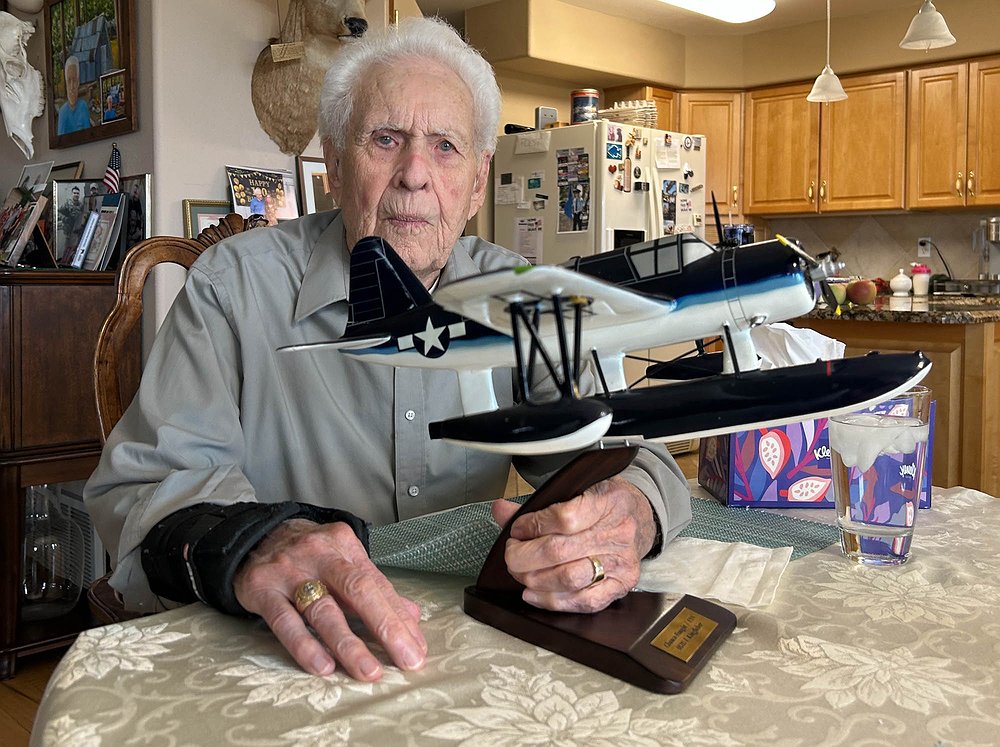 Jim Sivelle shows off his model airplane of the Vought OS2U Kingfisher. Two of these airplanes were on the USS Detroit with Sivelle, and were attached to catapults due to the short distance of the ship. (Emily Messer/Leader)
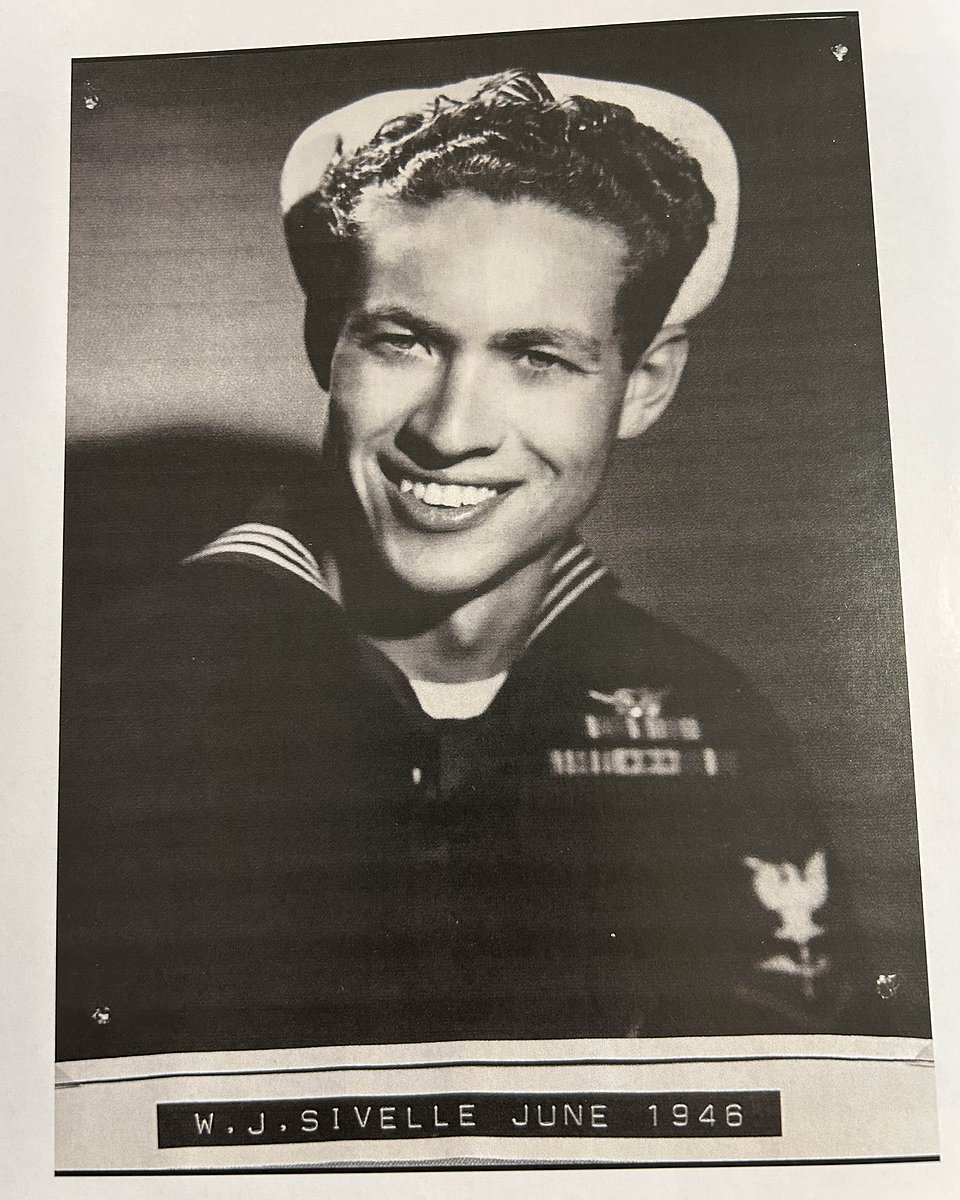 Jim Sivelle’s granddaughter created a book with all his memorial moments of WWII, including this photo of Sivelle in 1946. (Emily Messer/Leader)
ARTICLES BY EMILY MESSER

Polson commissioners hear plan for reducing E. coli in Flathead Lake
Representatives from the Flathead Lakers and the Polson Bay Golf Course presented a plan to the Polson City Commission last Wednesday to reduce stormwater runoff, which had caused increased levels of E. coli in Flathead Lake near Boettcher Park.
City Commission finalizes Salt Cafe grant, hears from market vendors
The Polson City Commission council chambers were full of support Monday night for Andrew Perkins, owner of Salt Cafe, who has been awaiting funding from the Tax Increment Finance District grant he received nearly three years ago.
Foundation established for Polson Police
A non-profit called the Polson Police Foundation was launched at the end of 2025 to support the department by contributing to training, officer wellness, critical equipment and community initiatives.