
Ranchers call for free markets as feds attempt to corral rising beef prices
HAILEY SMALLEY | Hagadone News Network | UPDATED 4 months, 2 weeks AGO
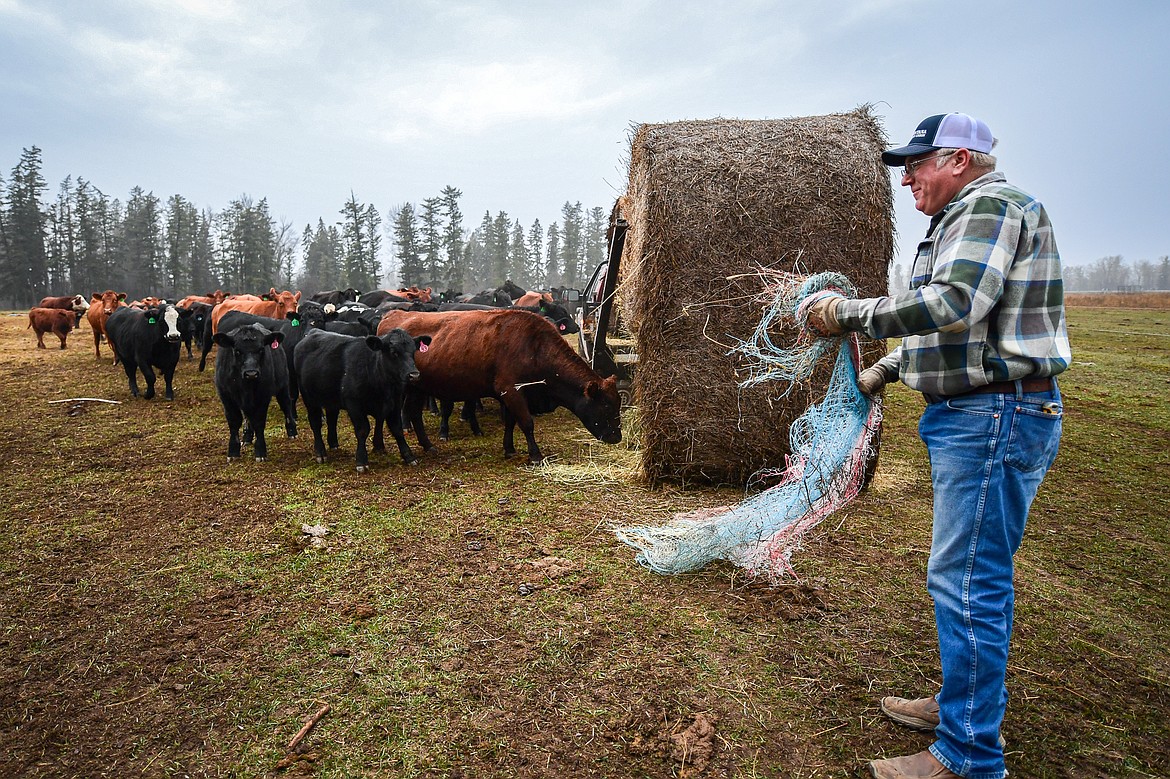
Mark Siderius feeds his cattle at Siderius Family Farm in Kalispell on Thursday, Nov. 13. (Casey Kreider/Daily Inter Lake)
Casey Kreider
The Trump administration’s efforts to drive down beef prices are raising concerns for Montana ranchers, who say market meddling will only hurt producers in the long run.
“It’s really a slap in the face to us as producers,” said Mark Siderius, who owns and operates a 240-acre cattle ranch near Kalispell.
Like many ranchers, Siderius has faced tough market conditions over the past few years. Lingering drought conditions in many of the nation’s top cattle producing areas and rising operating costs forced many of his fellow cattlemen to cull their herds.
A shrinking supply of domestic cattle, paired with steady consumer demand, has driven the price of many beef products to record highs. One pound of ground beef costs 55% more today than it did five years ago, according to data gathered by the Federal Reserve Bank of St. Louis.
For ranchers, the bump in prices is proof the free market is slowly correcting itself.
“The price is really where it should be,” said Siderius. “This is the price where we can exist, we can stay in business, we can pay our bills.”
But the price of U.S. beef is a problem for the White House, which has promised to cut prices at the grocery store.
“The Cattle Ranchers, who I love, don’t understand that the only reason they are doing so well, for the first time in decades, is because I put Tariffs on cattle coming into the United States … It would be nice if they would understand that, but they also have to get their prices down,” wrote President Donald Trump in an Oct. 22 post to social media.
The callout came just two days after the federal government quadrupled low-tariff beef imports from Argentina. Economists and ranchers were quick to criticize the plan.
“Not everyone, but a majority of the ranchers are in agreement that they don’t want market manipulation,” said Lesley Robinson, the president of the Montana Stockgrowers Association.
She worried that increasing beef imports undercuts American ranchers while providing scant relief for consumers. The United States is already importing 13% more beef than it did last year, according to the U.S. Department of Agriculture. That influx has done little to trim beef prices.
“The consumers and the demand for the product is what sets the price,” said Robinson. “Bottom line is, it’s just important that our market stays strong.”
Members of Montana’s Congressional delegation expressed similar concerns about the president’s plan to lower beef prices. Rep. Troy Downing joined a handful of other GOP representatives in writing a letter to Trump asking for clarity on the increase in Argentinian beef imports while Sen. Steve Daines urged the president to “let markets recover” during an interview with Newsmax.
Sen. Tim Sheehy reportedly met with Trump behind closed doors shortly before the president ordered the Department of Justice to investigate “Majority Foreign Owned Meat Packers” on Nov. 7.
Trump did not name specific companies in the social media post announcing the inquest, but a subsequent White House news release noted that the “Big Four” meat packers, JBS, Cargill, Tyson Foods and National Beef, collectively own 85% of the U.S. beef processing market.
Both JBS and National Beef are subsidiaries of Brazilian companies. Cargill and Tyson Foods are primarily U.S. owned.
In the Flathead Valley, Siderius said the administration’s refocus on the Big Four is “absolutely on point.”
He avoids working with the packing giants by processing his cattle through the Glacier Processing Cooperative in Columbia Falls and marketing the final products directly to consumers. But he still must compete with industry prices that are largely set by the industry’s major players.
“It absolutely is market manipulation, and there’s been market manipulation for years. We’re at the mercy of the Big Four packers,” said Siderius. “Enforcement needs to happen, and it needs to have teeth.”
A 2020 investigation into the companies ordered by Trump during his first term resulted in no major enforcement actions or reforms. Former President Joe Biden likewise accused the Big Four of anticompetitive behavior and issued a 2021 executive order aimed at addressing the industry bottleneck by funding small- and mid-sized meat processing facilities.
Last month, Tyson Foods and Cargill paid a combined $87.5 million to settle a 2019 price-fixing lawsuit brought on behalf of American consumers. JBS and National Beef were also named in the case and remain in litigation. In May, JBS paid $83.5 million to settle a separate price-fixing lawsuit against the Big Four. Cargill, Tyson Foods and National Beef continue to litigate that suit.
Siderius hopes the recently ordered investigation will push for reforms that prioritize the needs of American ranchers and independent processers.
“We’re working to feed the community,” he said. “We’re working to build relationships and build trust and deliver products to consumers.”
Reporter Hailey Smalley can be reached at 758-4433 or [email protected].
ARTICLES BY HAILEY SMALLEY

Winging it through winter: Rare Anna's hummingbird finds shelter in Bigfork backyard
The bird turned out to be an Anna’s hummingbird — a rare find in western Montana. The Montana Natural Heritage Program’s bird distribution database has logged only 158 sightings of Anna’s hummingbirds in the state, including 21 sightings in Flathead County.

Business groups sue to stop proposed ban on political spending in Montana
The Kalispell Chamber of Commerce is one of several organizations to file suit over a proposed ballot initiative to ban corporate spending in politics, arguing it infringes on the free speech rights of businesses.

Mexican man who led deputies on high-speed chase in Kalispell receives federal prison sentence
A Mexican national arrested after a high-speed chase through Kalispell in June 2025 received an 18-month sentence for illegal reentry in federal court last week.