
Cattle ranchers want packers "to play by the rules"
BERL TISKUS | Hagadone News Network | UPDATED 4 months, 1 week AGO
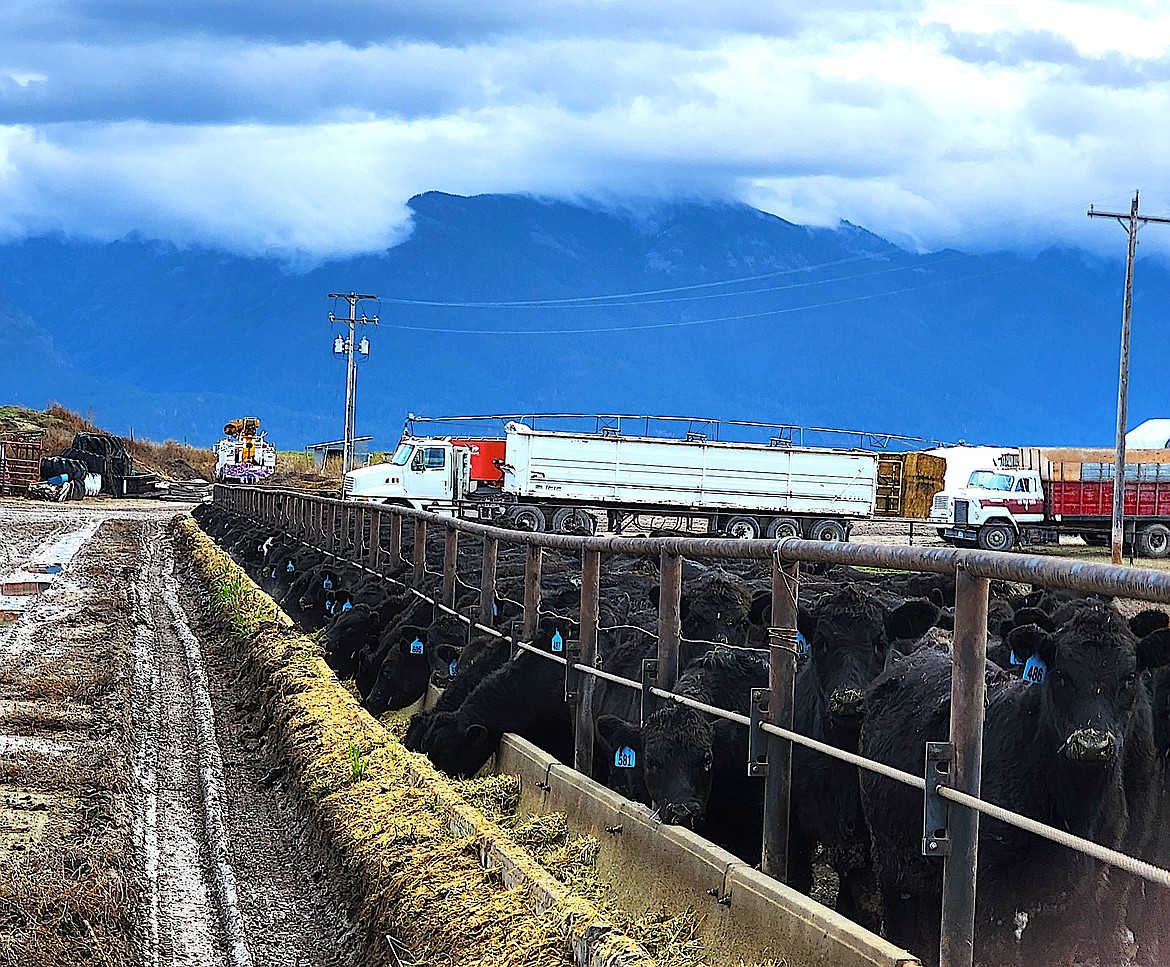
With a sunny day, mountains in the background and hay in the manger, it's a good day to be a steer at the Sherman feedlot in Ronan. (Berl Tiskus/Leader)
Reporter Berl Tiskus joined the Lake County Leader team in early March 2023, and covers Ronan City Council, schools, ag and business. Berl grew up on a ranch in Wyoming and earned a degree in English education from MSU-Billings and a degree in elementary education from the University of Montana. Since moving to Polson three decades ago, she’s worked as a substitute teacher, a reporter for the Valley Journal and a secretary for Lake County Extension. Contact her at [email protected] or 406-883-4343. | November 19, 2025 11:00 PM
The beef industry has been in the news lately, after the White House announced a plan to quadruple the amount of beef that it imports from Argentina at lower tariff rates and the Department of Justice launched an investigation into the national consolidation of meat-packing plants.
“The key thing is we need some food stabilization,” said Dusty Smith, president of the Western Montana Stockmen’s Association. “And it’s tough when it’s just three or four suppliers.”
Smith, a Ronan rancher and businessman, was speaking to the issue of the four giant companies that process beef cattle for public consumption. The “big four” are JBS (Brazil), Cargill, Tyson Foods, and National Beef, and according to a White House brief, they currently dominate 85% of the market.
“Through COVID, we didn’t have a safe food supply, food stabilization or food security,” he said, and consolidation in the packing industry doesn’t help.
Walter Schweitzer agrees. In a recent statement, the president of Montana Farmers Union called the DOJ’s recently launched investigation into the packers “long overdue.”
He noted that Farmers Union recently settled a lawsuit with the packers over anti-competitive practices for more than $130 million.
“Forcing the packers to play by the rules will lower consumer beef prices, create a fair market, and encourage ranchers to rebuild our cattle herds,” he wrote.
Bill Bullard of Billings, CEO of R-CALF USA, which represents cattle ranchers, also hailed the move to to investigate the beef supply chain.
“There has long been a disconnect between cattle prices and beef prices, and we believe this is evidence of market failure,” he said in a statement. “We welcome this investigation to ensure that cattle producers receive competitive prices for their cattle, and that consumers pay prices set by a competitive market rather than a monopolistic one.”
Smith also thinks the COVID/packer disconnect is why the government has recently helped fund small slaughterhouses to work with local producers.
Beef prices are at an all time high, but this quality protein source is also in high demand. Plus, Smith said, inflation has raised grocery prices across the board.
“A pound of burger is $7.99, but how much is a latte, which everyone gets every day?” he asked.
Interest rates are also up, with the prime rate perched at seven percent. A bred cow is worth $4,500, and it’s $400 just to pay the interest, and that doesn’t count feeding her, according to Smith.
During the last 10 years, Smith said, “I just notice people want to know where their beef is produced, know you treat your cattle humanely — a face behind every package.”
In response, several ranchers around the area are selling Mission Valley-raised and processed beef directly to consumers, including Smith, who has been selling halves of beef.
One of those producers is Cathey Cattle Company on Irvine Flats near Polson. Brittany and Wacey Cathey sell grass-finished beef born, raised and processed in the Mission Valley.
Demand for their product is fairly consistent, Brittany said. Since the live cattle market is so high, they can’t currently grow the consumer side of their business. But the Catheys are prepared to ramp it up when the market goes down.
White’s Wholesale Meats in Ronan processes the Cathey beef since it’s a state and federally inspected slaughterhouse.
The Catheys’ beef is grass finished. There is a segment of customers who are looking to avoid the corn and grain that are used to finish cattle, or who like a leaner product, Brittany said. Hunters tend to enjoy leaner beef, too.
Brittany said she gets lots of comments that grass-fed meat is more flavorful. But some people just like a “big old steak from a cornfed steer.”
Independent ranchers like the Catheys think it’s essential for the USDA to make Country of Origin (MCOOL) labelling mandatory on American beef. MCOOL was passed in 2002 as part of the Farm Bill, then repealed in 2015 in response to a trade dispute with Canada and Mexico.
Legislators have tried to reinstate it since then, but so far have failed. Montana Rep. Ryan Zinke is taking another run at it as cosponsor of the Mandatory Country of Origin Labeling Act. But unless it gains enough traction to pass, labeling will remain voluntary, and packers won’t label imported beef unless required by law.
Imports not apt to impact prices
As to the question of importing Argentinian beef, Smith said he thinks that meat will not make it to the grocery shelves but will mostly be purchased by food-service suppliers.
Cathey agrees. “The announcement ticked so many people off; it upset the industry,” she said. But she believes the amount of imports from Argentina aren’t apt to affect consumer prices at all. “There wasn’t enough behind it.”
Schweitzer concurs. “American consumers are buying more beef today than they did 10 years ago,” he wrote. “Argentina accounts for roughly 2.1 percent of beef imports. Quadrupling imports from them will have very little impact on total beef supply.”
More important, according to Smith, are ongoing efforts to make ranching more affordable.
“Yeah, you hope the USDA is working on programs to get young producers to come back into the business,” he said.
In fact, on Oct. 22, the USDA announced a plan to fortify the American beef industry, listing three priorities:
• Protect and improve the business of ranching. Strengthening the foundation of U.S. cattle production through endangered species reforms, enhanced disaster relief, increased grazing access and increased access to capital and affordable risk management tools.
• Expand processing, consumer transparency and market access. Lowering long-term costs, increasing marketing options and ensuring consumers have clear, truthful information about American beef.
• Build demand alongside domestic supply. Growing the domestic herd while boosting domestic and international demand so that ranchers are not trapped in the boom/bust cycle that has defined past cattle markets.
With U.S. beef herds at their lowest levels since 1961, Schweitzer says passing MCOOL labeling and forcing monopolistic packers “to play by fair market rules” would make a big difference for struggling ranchers.
ARTICLES BY BERL TISKUS
Ronan Council extends vacation deadlines, meets with Mission West
At the Ronan City Council meeting last week, Police Chief Robert Jacobson asked the council to consider an option to extend officer vacation time past the “use it or lose” deadline on March 31, 2026, or have an option to pay it out.
Car Class: Ronan students gain automotive know-how
The automotive shop at the Boys and Girls Club in Ronan looks like the real deal. The three-bay shop boasts a lift in one bay, compliments of Don Aadsen Ford, and is equipped with automotive supplies and tools, vehicles and parts. The young mechanics working there are Ronan Charter Academy students, who attend either a morning or an afternoon session three days a week.

Rain fails to quench St. Paddy’s Day parade or spirits
It’s always a guessing game on St Patrick’s Day - will it be stormy or sunny (or both)? As someone whose birthday is on March 17, I can tell you the scales tip heavily towards stormy and last Tuesday was no exception.