
Faster snowpack melt may impact aquifer
KAYE THORNBRUGH | Hagadone News Network | UPDATED 4 weeks AGO
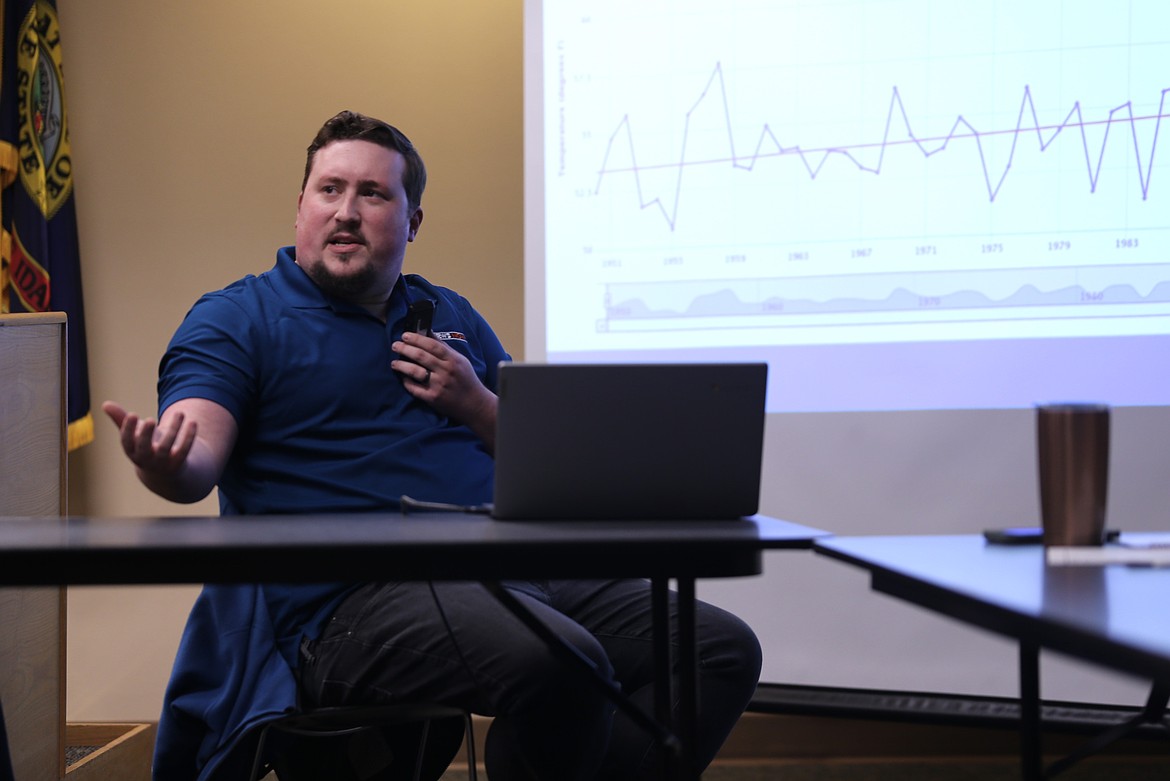
Meteorologist Matt Gray addresses the Aquifer Protection District Wednesday.
KAYE THORNBRUGH/Press
Kaye Thornbrugh is a second-generation Kootenai County resident who has been with the Coeur d’Alene Press for six years. She primarily covers Kootenai County’s government, as well as law enforcement, the legal system and North Idaho College. | November 20, 2025 1:08 AM
COEUR d’ALENE — Rising temperatures and faster melting is turning the snowpack into a “dwindling resource,” according to experts.
Meteorologist Matt Gray addressed the Aquifer Protection District during its regular meeting Wednesday at the Kootenai County Administration Building, presenting data on weather, the snowpack and river flows in the Inland Northwest.
“We really are experiencing, especially in the warm seasons, things getting progressively warmer over time,” Gray said.
He pointed to historical data showing that the hottest months recorded in Spokane since 1881 were all within the last decade. Spring temperatures have been consistently warmer and drier in recent years than in decades past, Gray said, and summer seasons are scorching.
These patterns have an impact on the snowpack that feeds the Spokane Valley-Rathdrum Prairie Aquifer, the source of almost all drinking water for the Coeur d’Alene and Spokane regions. The aquifer encompasses 370 square miles, most of which lie beneath Kootenai County.
From 1983 until 2003, the peak snowpack recorded in the Spokane River basin was 29 inches. Between 2003 and 2013, the peak snowpack was 26 inches.
The peak snowpack was 24 inches between 2013 and 2023 — a dramatic change over time, Gray said, and the result of faster melting in the spring.
“That is an enormous difference,” Gray said. “It shows you that spring melting and a faster runoff, at least at this point, I think is a more impactful issue than the gradual decrease in the snowpack overall.”
Meteorologists anticipated a low water year in 2025, Gray said. But it was a jarring scene in late August when stretches of the Spokane River ran completely dry, exposing the rocky riverbed.
“This is a part of the river that loses water consistently to the aquifer and the water table below it,” Gray said. “Not only is it a shock to the general public, but it makes you think about what’s going on underneath here.”
Spokane Riverkeeper, a nonprofit group that monitors the river’s health and advocates for the watershed, reported that the low flows and dry conditions were caused by a combination of weather patterns, drought connections and the river’s connection to the aquifer.
The dry riverbed posed an immediate threat to fish, wildlife and the overall health of the river ecosystem, according to Spokane Riverkeeper.
Looking ahead to the coming year, Gray said the region has yet to see snowfall. The snowpack could be better, he said, but it’s possible conditions will improve.
“As we head into December, we’re going to start to see some changes,” he said. “There are already some hints that things will head into a cooler direction as we get into the week of Thanksgiving.”
ARTICLES BY KAYE THORNBRUGH

Jury deliberates town hall battery case
The question of whether Paul Trouette committed criminal acts when he helped drag a woman out of a legislative town hall at Coeur d'Alene High School and put his hands on three other people is now in the hands.

Town hall attendees recount removals
When Teresa Borrenpohl decided to attend a legislative town hall put on by the Kootenai County Republican Central Committee, she said it was because she wanted local elected leaders to receive feedback from a broad spectrum of constituents.

Town hall battery trial begins
Defense attorney says client acted at sheriff's command
The trial of a man accused of battering several people during a chaotic legislative town hall in the Coeur d'Alene High School auditorium is underway.