
IDL detects spongy moth in Sandpoint for second consecutive year
JACK FREEMAN | Hagadone News Network | UPDATED 4 months, 2 weeks AGO
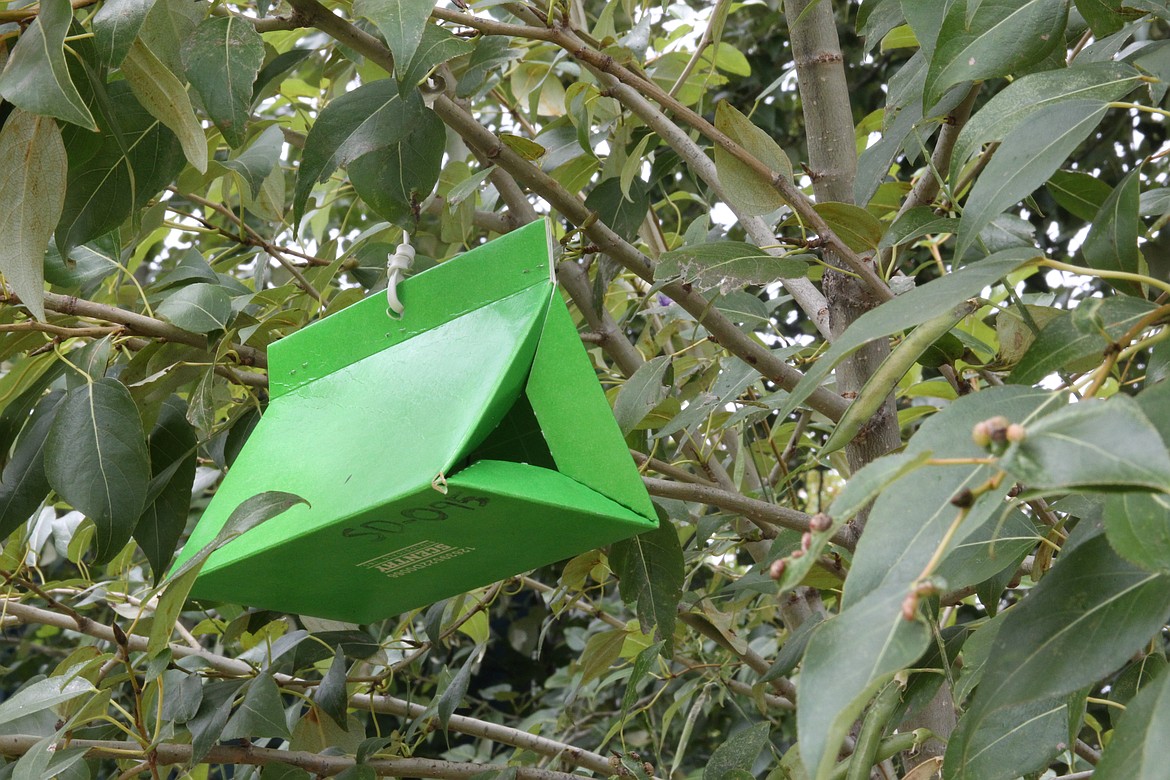
A trap placed by the Idaho Department of Lands sits off the side of the road in Sandpoint.
Photo by Jack Freeman
SANDPOINT — The Idaho Department of Lands said it found three male spongy moths in Sandpoint, marking the second year in a row the invasive species has been found in the city.
The IDL undertook expanded trapping efforts in the area after a lone spongy moth was captured for the first time in 30 years at the intersection of Oak Street and Division Avenue. Department officials said the captures reflect the first time that a potential spongy moth population has been detected in the region since 1991.
After follow-up work on the ground, the IDL said it did not find any evidence of spongy moth eggs or damage visible. Erika Eidson, head of the IDL’s spongy moth trapping efforts, said the IDL’s entomologists currently estimate the population to be very small, if any.
“It landed us in a gray area because it wasn’t like we went from one moth to a bunch of moths in the same localized area,” Eidson said. “We also didn’t find zero moths that would allow us to rest assured that [2024] was a one-off ... that’s why we want to do even heavier trapping.”
The spongy moth is an invasive species that is most dangerous in its caterpillar phase, when it eats the leaves of broadleaved trees. An outbreak of the moth can defoliate trees in an area, leaving them weak or killing them in extreme circumstances.
The IDL said two of the moths were found in a trap located near Monroe and Poplar, and an additional moth was found further east near the meeting of Chuck Slough and Syringa Creek.
The moth does not have a foothold in Idaho, which makes the capture of spongy moth in 2025 unusual, according to the IDL. Eidson said previous follow-up trapping attempts have not yielded any captures since 1993.
“For the state of Idaho, it is unusual,” Eidson said of the captures. “Being that we only detected the one single moth in Sandpoint and that was the most typical pattern, I wasn’t really hoping not to find any additional moths this year, but of course that’s why we check.”
The IDL will be moving forward with expanded trapping efforts in 2026, by placing 50 traps per square mile within a half mile radius of the two positive capture sights and an additional 36 traps per square mile in the surrounding areas.
“With such a low number of months and the negative number of traps between the two capture sites, even trying to delineate an eradication area would be really difficult with a presumably small population,” Eidson said. “Everything points to very low population, if there is a reproducing population.”
Eidson said these efforts will help the IDL determine if eradication efforts are needed and narrow down a limited area for the IDL to focus on. The department will also be checking the traps midseason for a more immediate response.
For those reasons, Eidson asks that residents leave the traps undisturbed during the trapping efforts next summer.
“There might be some opportunity for folks to sign up to host a trap in their yards,” Eidson said. “We did that last year and one of the positive traps was a trap that a private homeowner volunteered to let us hang in his yard.”
The IDL said while it is responsible for monitoring the spongy moth population, the U.S. Department of Agriculture's Animal and Plant Health Inspection Service would oversee an eradication effort.
In the history of the Idaho spongy moth trapping program, there have only been five instances of treatment. The most recent treatment came in 2005, when a specimen of the more unknown and dangerous Asian spongy moth was captured the year prior in Kootenai County.
Sandpoint experienced a breakout of the spongy moth in the late 1980s but eliminated the population by 1991, according to the IDL. Eidson said the best way to limit the spread of the invasive species is to check any smooth outdoor surfaces, like firewood or furniture, from out of state for eggs.
"Don’t move firewood long distances,” Eidson said. “If you’re making a move or bringing things from the Eastern U.S., where the population is established, to Idaho check those things for any of the buff-colored spongy looking hairy egg masses that spongy moths create.”
ARTICLES BY JACK FREEMAN

Outgoing POP executive director wins statewide award
That effort combined with the construction of nearly 20 miles of new trail and a new trail management plan has earned her the 2026 Professional Award for Parks, Trails, or Conservation from the Idaho Recreation and Parks Association.

APRIL NIBJ: Nonprofits help people follow their life’s compass
Kanning’s story isn’t unique, ask any worker at one of the 500 nonprofits in Bonner County are you’ll likely hear the same reason for working: it feels right.

Ponderay to begin Black Rock clean-up project
With the approval of a memorandum of agreement with Sandpoint on Wednesday evening, the city of Ponderay is now able to begin its Black Rock clean-up project next week.