
CSKT hires a new disaster and emergency coordinator
EMILY MESSER | Hagadone News Network | UPDATED 3 months, 1 week AGO
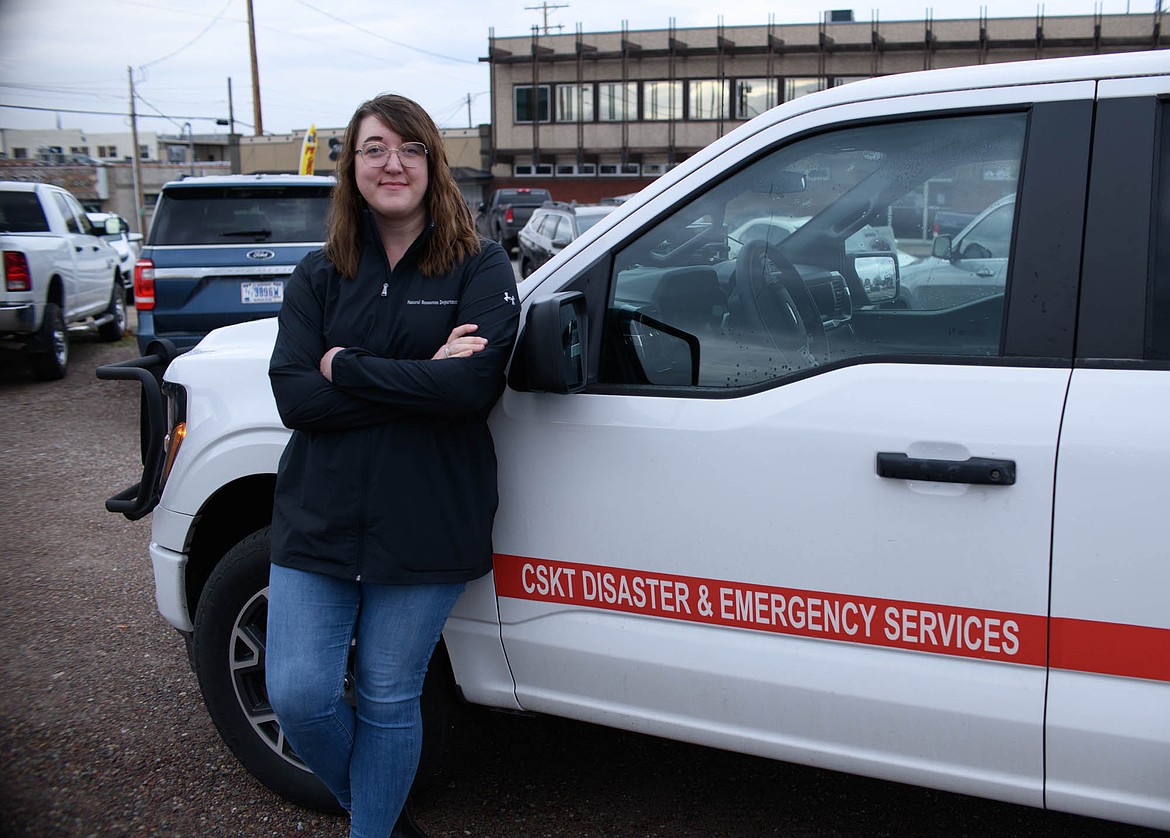
The Confederated Salish and Kootenai Tribes new Tribal Disaster Preparedness & Emergency Services coordinator, McKennah Andrews poses with her rig. In that back of her F-150 she has cones, water and shovels. (Emily Messer/Leader)
Emily Messer joined the Lake County Leader in July of 2025 after earning a B.A. degree in Journalism from the University of Montana. Emily grew up on a farm in the rolling hills of southeast Missouri and enjoys covering agriculture and conservation. She's lived in Montana since 2022 and honed her reporter craft with the UM J-School newspaper and internships with the RMEF Bugle Magazine and the Missoulian. At the Leader she covers the St. Ignatius Town Council, Polson City Commission and a variety of business, lifestyle and school news. Contact Emily Messer at [email protected] or 406.883.4343 | November 26, 2025 11:00 PM
The Confederated Salish and Kootenai Tribes hired a new Tribal Disaster Preparedness & Emergency Services coordinator this summer, who is embracing the role by connecting with the community, learning as much as she can and updating disaster plans for the community.
McKennah Andrews is a Montana local from Butte and has lived in Missoula for the past 10 years. She completed her bachelor's at the University of Montana in communication studies with a minor in German and certificate in entertainment management. She also completed a master's degree in international educational leadership.
Andrews spent years working for various departments and agencies within her field of international relations. She started at the Global Exchange Office at UM as the sole coordinator for inbound and outbound student exchanges. Continuing her work at the Maureen and Mike Mansfield Center under the U.S. Department of State, she was a program officer for the Young Southeast Asian Leader Initiative.
Her final position in Missoula was as a sub grantee under the American Council for International Education before the program was cut due to federal grant funding.
She spent some time looking for a new position before finding this opportunity with the Tribes. However, she explained that the experience and background have a lot of correlation to her new position.
“When I saw the job position that I now have, I was initially very excited because the job description sounded so cool. It sounded meaningful,” Andrews said.
As a disaster and emergency services (DES) coordinator, Andrews is not responding to every dispatch call. But in the case of a larger emergency or disaster, she would respond by calling appropriate parties, setting up an incident command and finding needed information.
“It's been a very welcoming and warm field to enter, because at the end of the day, while there are different jurisdictions, we all want to work together to preserve property, save lives and recover from bad days,” she said. “So, everyone has been really great and helpful that I've encountered, and that's made the transition a lot better.”
Andrews took on the position in June, and is embracing the role by building contacts, learning the area and culture, while updating the mitigation and emergency operations plans on the website.
Andrews said she is still learning her role but taking it at an organized pace. While updating plans she is considering all the hazards the reservation could face, whether it’s man-made or natural.
“Worst-case scenario McKennah”
“I have a fantastic imagination. I have a friend who, in middle school, started calling me ‘worst-case scenario McKennah,’ because I would always be like, ‘what if this happens?’” Andrews said. “So, I truly flourish in a role where I can have those thoughts and then spend my day trying to find solutions, draft up plans and find the people that need to be pulled into that plan making.”
Emergency operations plans are broken down into functional emergencies and hazard emergencies. Functional emergencies include setting up evacuation shelters, whereas hazard plans include how to survive. Andrews explained that the plans are a balance between realistic and too much content.
Her position was previously under the CSKT Division of Fire and is now in the National Resources Department, where it had been before. Andrews feels that this has shifted the focus of her position more towards environmental protection, as she is surrounded by water quality, air quality and shoreline protections departments in the office.
Her most recent predecessor was known as “the hazmat guy” and the person before that was known for hosting training and workshops. Andrews is still trying to find her niche, but feels her skills are in communication, and her strength is developing mutual aid between jurisdictions.
Andrews works most commonly with the Tribes and her direct DES coordinator counterparts inside county government and around Lake County. Along with these relationships, she also has direct contact with the Federal Emergency Management Agency (FEMA), Bureau of Indian Affairs and the State of Montana.
“I really like working with people, so my priority lately has just kind of been to have a really strong contact list for who do we call when a, b and c is happening,” Andrews said.
Andrews explained that she was flabbergasted when she took this position to learn that there are so many levels of emergency planning. She feels like people most commonly hear about FEMA when disasters strike, but every emergency starts locally.
Andrews said that her position supports the Tribes and its members with three R’s: Readiness, Representation and Resiliency.
As DES coordinator, she brings readiness, helping tribal communities feel well-informed, well-trained or well-equipped for how to respond to emergencies. She represents the Tribes’ values, priorities and needs in planning, response and recovery operations across agencies. And she hopes to contribute towards a resilient community morale through her role.
Andrews encouraged people to sign up for local county alerts to be aware when a disaster may strike Lake County. People often think they are automatically enrolled, but a person has to go to the Lake County Emergency Management website to sign up, Andrews said.
Currently emergency operation plans can be downloaded at cskt.org/disaster-emergency-services/. Andrews will update these plans in the near future. She can be reached at [email protected].
ARTICLES BY EMILY MESSER

Polson commissioners hear plan for reducing E. coli in Flathead Lake
Representatives from the Flathead Lakers and the Polson Bay Golf Course presented a plan to the Polson City Commission last Wednesday to reduce stormwater runoff, which had caused increased levels of E. coli in Flathead Lake near Boettcher Park.
City Commission finalizes Salt Cafe grant, hears from market vendors
The Polson City Commission council chambers were full of support Monday night for Andrew Perkins, owner of Salt Cafe, who has been awaiting funding from the Tax Increment Finance District grant he received nearly three years ago.
Foundation established for Polson Police
A non-profit called the Polson Police Foundation was launched at the end of 2025 to support the department by contributing to training, officer wellness, critical equipment and community initiatives.