
USApple aims to support apple growers
CHERYL SCHWEIZER | Hagadone News Network | UPDATED 3 weeks AGO
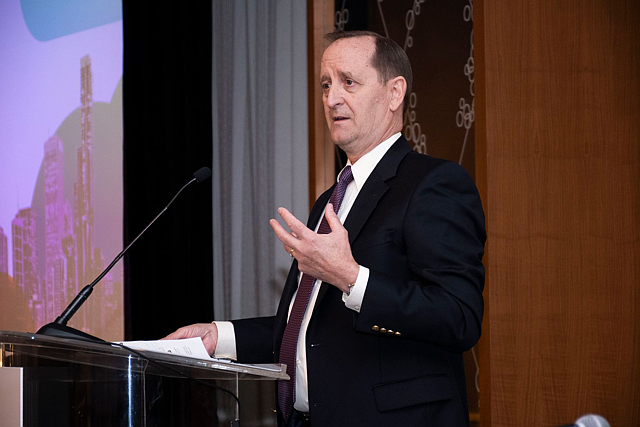
USApple President and Chief Executive Officer Jim Bair gives a speech at the organization’s 2025 Outlook conference.
COURTESY PHOTO/USAPPLE
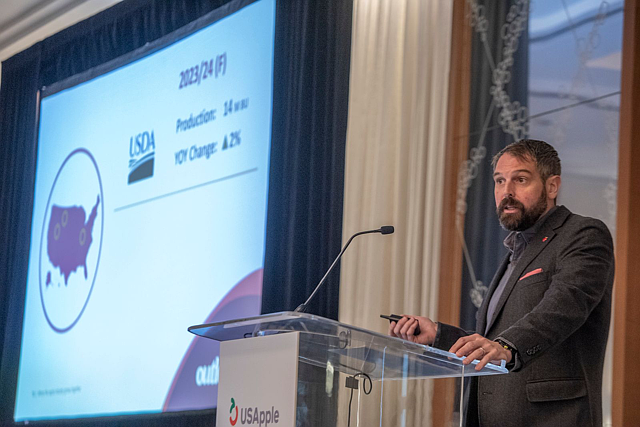
Chris Gerlach, vice-president of insights and analysis for USApple, discusses the state of apple production at the 2025 Outlook conference.
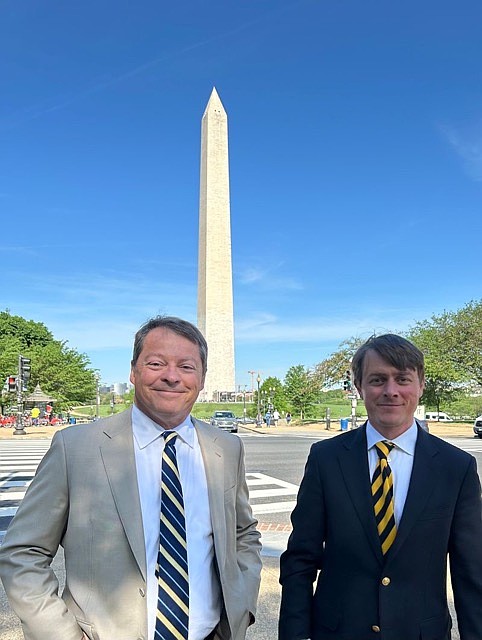
Steve Smith of Washington Fruit, Yakima, left, and Phillip Glaize III of Glaize Apples, Winchester, Virginia, right, stop for a picture between meetings with Trump Administration officials. Smith is the board chair for USApple, and Glaize is the organization’s vice-chair.
COURTESY PHOTO/USAPPLE
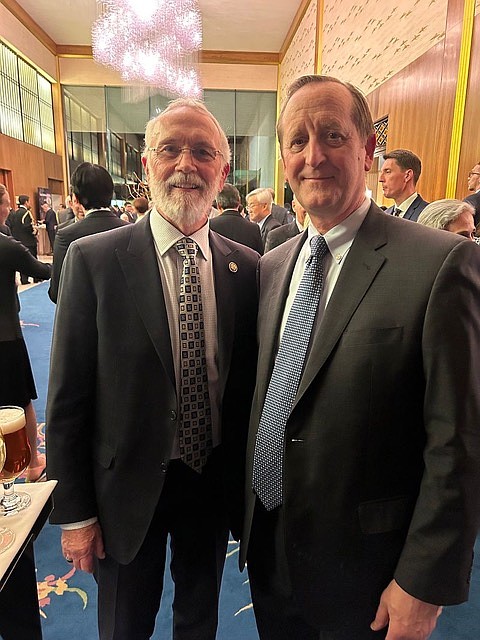
Washington Fourth District Congressman Dan Newhouse, left, meets with USApple president Jim Bair, right, at a reception in Washington, D.C.
COURTESY PHOTO/USAPPLE
Senior Reporter Cheryl Schweizer is a journalist with more than 30 years of experience serving small communities in the Pacific Northwest. She began her post-high-school education at Treasure Valley Community College and enerned her journalism degree at Oregon State University. After working for multiple publications, she has settled down at the Columbia Basin Herald and has been a staple of the newsroom for more than a decade. Schweizer’s dedication to her communities and profession has earned her the nickname “The Baroness of Bylines.” She covers a variety of beats including health, business and various municipalities. | November 26, 2025 3:58 PM
As any farmer knows, when it comes to export markets and trade, regulatory policy, labor regulation and combating misinformation are a challenge. American apple growers founded USApple to help them navigate some of the challenges that affect the industry.
“We represent the 27,000 apple growers in the US,” said Jim Bair, USApple president and chief executive officer. “We try to focus like a laser on the things that we’re good at, and that would be government affairs here in Washington, crisis communication, public messaging about apples.”
USApple is supported by growers, packers, processors and other groups in the apple industry to advocate for industry interests at the federal level, as well as working to provide accurate information about apples and apple production. Steve Smith, vice-president of marketing at Washington Fruit, Yakima, and the current USApple board chair, said the organization focuses on government affairs at the federal level.
“They’re the primary advocacy group for the industry, federally,” Smith said. “They work with any type of Congressional (or) federal policies that affect apple growers.”
Apple growers, wherever they are, have some challenges in common, and USApple helps them work on those issues of common interest.
“Federally, we all have the same goals,” he said. “We don’t compete for better immigration policy.”
Bair said the organization also works with the US Department of Agriculture to ensure it too is working with accurate information and can react accordingly when there’s a problem. Its USDA contacts came in handy about a decade ago, when a food-borne illness was traced to an orchard in California.
“Part of what we try to do is maintain contact with all the regulators in DC, so that when problems do arise – as they inevitably will, from time to time – that we can have those direct conversations,” Bair said.
The grower produced two specific varieties of apples, and the first reaction of the Food and Drug Administration was to advise consumers to avoid those two varieties, no matter where they were grown. Bair said USApple argued vehemently against that.
“Why would you want to penalize growers who have no involvement in this recall whatsoever, who have grown a perfectly healthy product? Why would you want to impact those growers, and why would you want to confuse consumers?’ Fortunately, they changed the recall notice,” Bair said. “If they had (issued) that, we’d still probably be impacted by that, 10 years later.”
USApple works to get the industry’s message across to federal agencies as well as Congress and each new administration, Bair said, a task that requires patience. It also means accepting that it may take a while to alleviate a problem. He cited labor regulations as an example.
Tree fruit growers nationwide use a lot of temporary labor that comes from out of the country through the H2A visa program. Growers believe it needs reform, he said, but it’s been a long process with no answer yet.
“That’s a daily conversation here in DC. We’ve been at this for 20 years, and it’s still not fixed,” Bair said. “We got close, several years ago, to changing the H2A visa. We got it passed through the House of Representatives twice, the Farm Workforce Modernization Act. Among other things, it would have, for the people that are here on that are working – not just apples, but in all kinds of fresh produce, highly labor-intensive agriculture – those workers would have paid a fine, and then it would have put them on a path toward a legal work status. That’s not citizenship, it’s different, but at least it would have allowed them to work here legally. We see some of the ramifications of that bill not being taken up by the Senate in the daily news.”
While specific issues may change over time, the fact the apple business faces challenges is eternal. Complicated, long-term problems usually need complicated, long-term solutions, and Smith said the fact that it takes time promotes cooperation.
“Our issues aren’t as Republican or Democrat as a lot of issues are,” Smith said.
That makes solving challenges, whether they’re trade barriers or labor rules, a non-partisan job, Bair said.
“I always say we’d be really bad at our jobs if we only worked with the politicians that we like,” Bair said. “A politician’s position on a social issue is really of no concern to US Apple. We only care, do they support the apple industry? That’s where we try to focus our attention, generating support for (apple industry) issues.”
Smith said the work done by USApple is beneficial.
“Very,” he said. “We as an industry are very heavily influenced by federal policy. USApple addresses issues that affect us daily.”
 Chris Gerlach, vice-president of insights and analysis for USApple, discusses the state of apple production at the 2025 Outlook conference.
 Steve Smith of Washington Fruit, Yakima, left, and Phillip Glaize III of Glaize Apples, Winchester, Virginia, right, stop for a picture between meetings with Trump Administration officials. Smith is the board chair for USApple, and Glaize is the organization’s vice-chair.
COURTESY PHOTO/USAPPLE
 Washington Fourth District Congressman Dan Newhouse, left, meets with USApple president Jim Bair, right, at a reception in Washington, D.C.
COURTESY PHOTO/USAPPLE
ARTICLES BY CHERYL SCHWEIZER
Local legislators discuss 2026 session
MOSES LAKE — Washington 13th District legislators previewed what they see as the challenges of the upcoming 2026 session at a meeting with Moses Lake city officials and residents Tuesday. State Senator Judy Warnick, R-Moses Lake, and Representative Tom Dent, R-Moses Lake along with Rep. Alex Ybarra, R-Quincy, outlined some of their plans and ideas as well as the major business of the 2026 legislative session. Warnick said the state faces some challenges.
Dorow appointed to Othello City Council
OTHELLO — Chris Dorow has been appointed to a vacant position on the Othello City Council. Dorow was appointed by unanimous vote after candidates for the seat were interviewed at the Dec. 8 council meeting. There was no discussion. Dorow replaces Denae Valdez, who resigned from the council in November. “We had seven members of the public apply for this position,” said Othello Mayor Shawn Logan.

Grant PUD seeks rate input
EPHRATA — Grant County Public Utility District customers have until Dec. 23 to submit their comments on proposed rate hikes that would go into effect in April 2026. Comments can be submitted at Grant PUD: Commission Meetings. Customers commenting at the last PUD commission meeting of 2025 said higher rates are going to be a challenge. Commissioner Terry Pyle said the PUD is facing challenges too.