
The future of Idaho's kokanee
CAROLINE LOBSINGER | Hagadone News Network | UPDATED 2 weeks, 4 days AGO
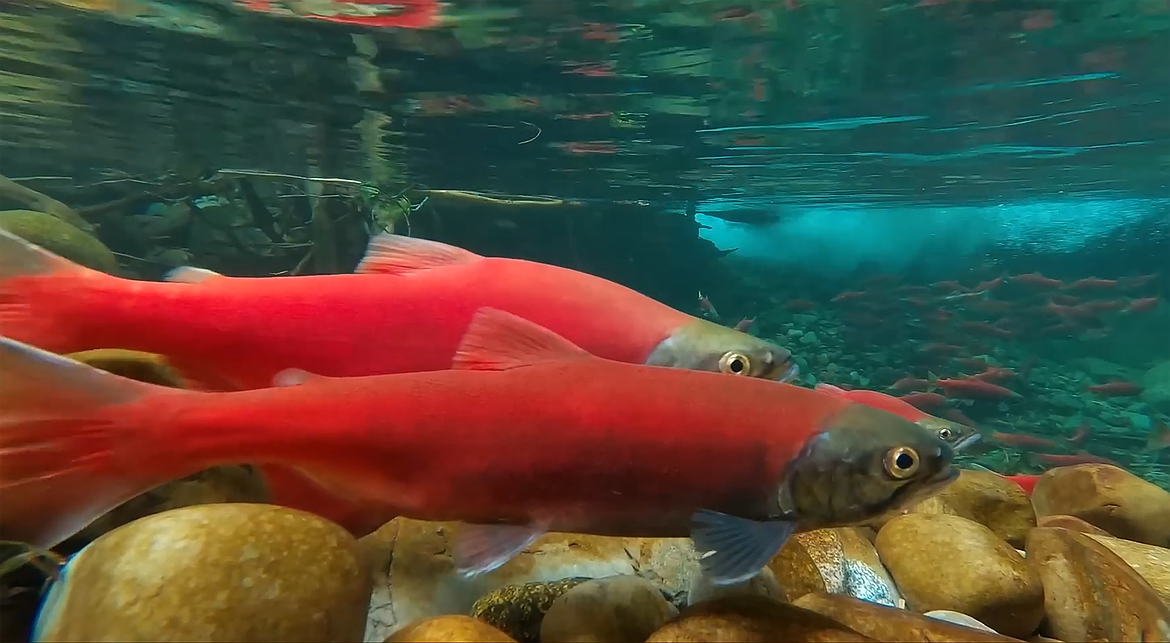
Kokanee are pictured in a screenshot from a video by Idaho Department of Fish and Game on the state's new captive broodstock program. IDFG officials say the new program will help supplement eggs taken from "wild" fish.
Photo courtesy IDAHO DEPARTMENT OF FISH & GAME
I grew up in the Tri-Cities, Wash., and have always loved to write. I attended the University of Washington, where I earned a double major in journalism and political science, with an area of emphasis in history. I am the fifth out of six kids — don't believe any of the stories that my siblings tell. To be able to tell others stories and take photos for a living is a dream come true — and I considered myself blessed to be a community journalist. When I am not working, I enjoy spending time with family and friends, hiking and spending time outdoors, genealogy, reading, and watching the UW Huskies and the Seattle Seahawks. I am a servant to my cat, Frankie, who yes, will eat anything and everything in sight … even wedding cookies. | November 29, 2025 1:00 AM
The goal of the Idaho Department of Fish and Game’s captive broodstock project is simple: Enhance the state’s kokanee fishing.
Soon, 1 million kokanee fingerlings raised in Idaho’s hatcheries will begin making their way to state waters as a result of that program, Fish and Game officials said.
It’s the first batch of kokanee fingerlings produced by adults raised in the facilities and part of an effort to supplement eggs taken from wild fish, said Joe Kozfkay, Fish and Game’s state fisheries manager.
“The biggest challenge that we have with kokanee is that they’re highly cyclical,” Kozfkay said. “How do we provide stable kokanee populations with a species that can thrive one year and be gone the next?”
Enter the state’s captive broodstock project, which is underway and aims to enhance kokanee fishing in Idaho and add stability to the number of kokanee fingerlings stocked each year, officials said.
Anglers have long wanted more and better kokanee fisheries, Kozfkay said in a video included as part of a Fish and Game news release about the program. To support that, Fish and Game has stocked more than 500 million kokanee since the 1920s.
Most kokanee caught by anglers are born in hatcheries, but officials said the eggs that produce them are typically taken from adults released as fingerlings before being recaptured as adults for spawning. The challenge, officials said, is that the survival rate of those adults can fluctuate depending on natural conditions.
While the department aims to stock about 7 million kokanee fingerlings each spring, a bad year can affect how many fish are available. Fewer spawning adults means fewer eggs and fewer fingerlings. Hatchery production can temper those ups and downs.
“Kokanee fishing is really popular and important to a lot of anglers, so we’re doing our best to meet their expectations,” Kozfkay said. “We face a lot of uncontrollable natural variables that can make that challenging, but raising broodstock will improve our response to some of that natural variability.”
Officials said the program didn’t happen overnight. First, eggs taken from adult fish in the North Fork Payette River north of McCall were sent to Cabinet Gorge Fish Hatchery near Clark Fork. After they hatched, the fry were raised for a year before about 15,000 were transferred to the Grace Fish Hatchery in southeastern Idaho and reared two more years until they reached spawning age.
In September, the first batch of adult kokanee spawners yielded more than 1.6 million eggs. The eggs were shipped to the Mackay Fish Hatchery in southeastern Idaho, where they will be raised until next spring. Officials said they expect about 1 million fingerlings will be available to stock next spring.
“Wild-origin kokanee and their eggs will still be used to meet most of our kokanee management goals, but the kokanee broodstock project demonstrates it will be a valuable tool to supplement our annual egg supply,” Southeast Fish Hatchery Complex Manager Bryan Grant said.
Kokanee are an important and popular part of the state’s fisheries, officials said.
“Seeing all these bright red fish in the stream is a tremendous sort of attractant,” Kozfkay said. “We get a lot of anglers that rank them as their favorite fish, and kokanee meat is phenomenal.”
Native to Idaho, the landlocked salmon live in the state’s cold-water lakes and reservoirs. Unlike other salmon, the fish never head to the ocean. Instead, when they go to spawn in the fall, their colors and shape change dramatically as the males grow big, hooked jaws, Kozfkay said. Finally, a dominant male gets the opportunity to mate with a female, he said.
As a species, kokanee are “super difficult to manage,” the state fisheries manager said, noting that a majority of Idaho’s kokanee fisheries exist because of Idaho’s stocking program.
“Most fish will kind of hedge their bets,” Kozfkay said. “They don’t want to put all their resources into one year. Kokanee are different. You know, they put everything into that one year and then die because of this phenomenon. That’s one of the reasons why we see these extreme shifts in population numbers and kokanee — one small environmental change, and you can lose an entire generation of young kokanee.”
While kokanee populations have always gone up and down, in recent years the shifts have become more pronounced, placing more importance on the success of Idaho’s hatchery programs.
The 2025 project isn’t a one-off event, officials said. Rather, the next three generations of captive spawners are being raised in the state’s hatcheries. Given the success of the program’s first year, fisheries managers and hatchery staff said there is every reason to expect continued success.
The captive broodstock program allows hatchery staff to protect the kokanee, from egg to fingerling, in a controlled environment, Kozfkay said.
“We can protect them while they’re in the hatchery, grow them through that dangerous period of their life, and then release them when they can survive at a higher rate,” Kozfkay said.
The goal, he said, is to offer the state’s anglers more consistent kokanee fishing opportunities and add more stability to what is a key part of the food web.
“Trophy rainbow trout, bull trout, smallmouth bass, ospreys, eagles, black bears — they all rely on kokanee as a prey source,” he said. “We see a lot of people spend most of their fishing season targeting kokanee. Anglers love them. Wildlife viewers love them. People that run small businesses and small towns love them. Everybody loves kokanee.”
ARTICLES BY CAROLINE LOBSINGER

'Tots' creates sweet Christmas memories
Help the Sandpoint Lions reach their $75,000 goal for Toys for Tots.
'Tots' seeks help to make Christmas merry
Help the Sandpoint Lions reach their $75,000 goal for Toys for Tots.
Legends, traditions and today's Christmas ornaments
Discover the fascinating legends behind Christmas ornaments — from the lucky pickle to unicorns, spiders, and more. Learn how these decorations connect past traditions with present celebrations and bring meaning to your holiday tree.