
Genealogists explore ties to turbulent time in 17th century
DEVIN WEEKS | Hagadone News Network | UPDATED 10 months, 3 weeks AGO
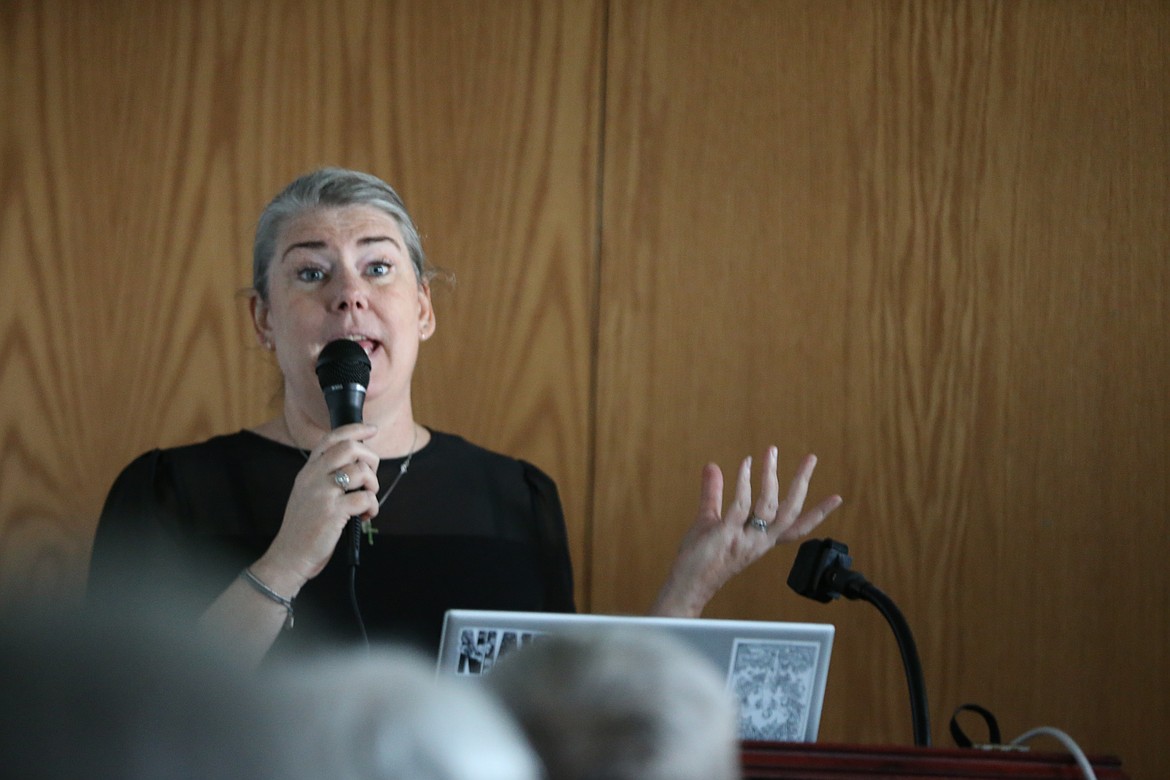
Meagan Mize discusses her familial ties to New England witch trials during her "Early American Witches" presentation at the Kootenai County Genealogical Society's Thursday meeting at the Hayden Library.
DEVIN WEEKS/Press
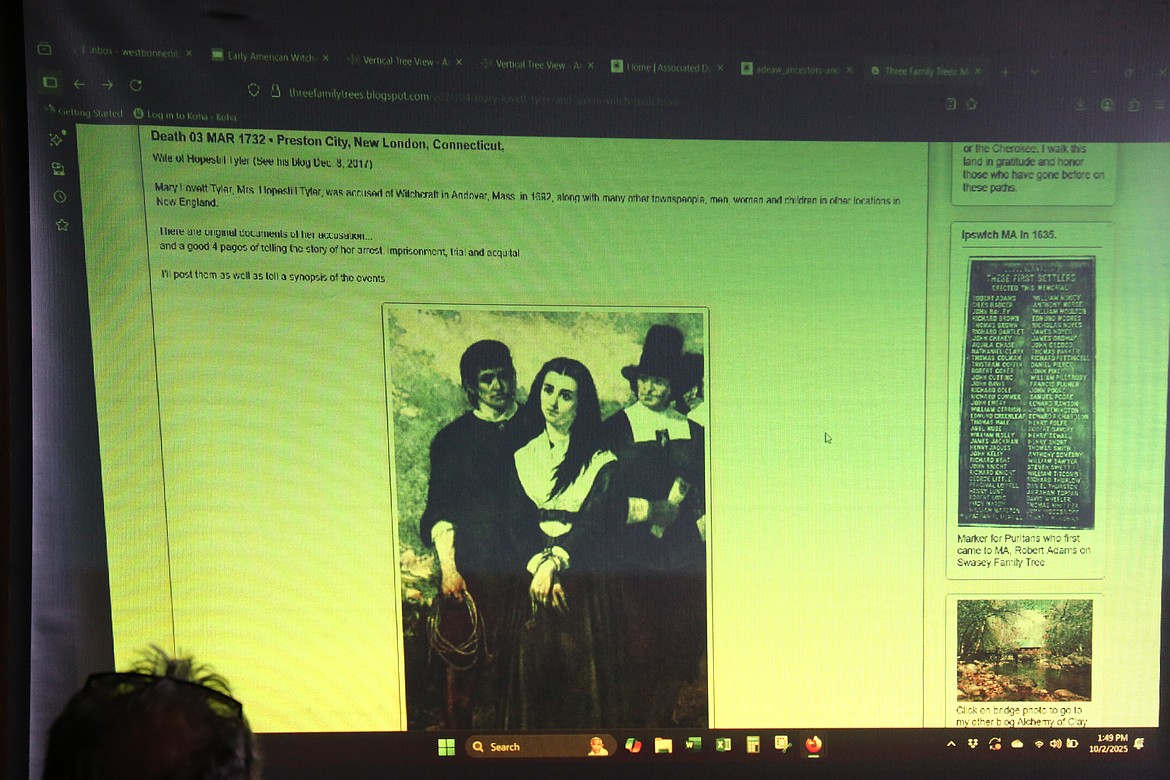
A slide depicting a witch persecution is shown Thursday during a presentation on early American witches.
Devin Weeks is a third-generation North Idaho resident. She holds an associate degree in journalism from North Idaho College and a bachelor's in communication arts from Lewis-Clark State College Coeur d'Alene. Devin embarked on her journalism career at the Coeur d'Alene Press in 2013. She worked weekends for several years, covering a wide variety of events and issues throughout Kootenai County. Devin now mainly covers education, entertainment, human interest stories and serves as the editor of North Idaho Live Well magazine. She enjoys delivering daily chuckles through the Ghastly Groaner and loves highlighting local people in the Fast Five segment that runs in CoeurVoice. Devin lives in Post Falls with her husband and their two eccentric and very needy cats. | October 3, 2025 1:07 AM
HAYDEN — Imagined sorcery, finger pointing, innocent lives ruined and lost.
The hysteria of sorcery and alleged witches wrought havoc and misery throughout communities in early America. Most infamous are the witch trials that took place in Salem, Mass., between 1692 and 1693. While more people were executed for witchcraft during this period, nearby Connecticut suffered an era of trials and persecution from 1647 to 1697.
“I know we live in some crazy times today, but I think if I lived back then I would have really tried to have leave Connecticut and Massachusetts," Meagan Mize said Thursday, speaking to members of the Kootenai County Genealogical Society. "This was a really good way to get rid of somebody when you didn’t like them."
The persecution of witchcraft has existed since before the birth of Jesus Christ, Mize said.
"It's actually documented in Hebrew scripture, Exodus, Leviticus, Deuteronomy," she said. "From 200 A.D. there is a lot of recorded history of witch persecution around the world in one form or another."
Massachusetts enacted the death penalty for witchcraft in 1641. The following year, it was enacted in Connecticut. These were the main colonies that experienced the most frenzied witch hysteria.
The last person in the world who was accused of witchcraft was executed in Saudi Arabia in 2011, Mize said.
As a genealogist, Mize peered into her own past to see if her family had any ties to this turbulent time in history. She shared those ties during her presentation, "Early American Witches," at the Hayden Library.
Mize's 10th great-grandfather, Christopher, was involved in the witch trials of Connecticut not once but twice.
In 1654 Christopher produced an affidavit about visiting his wife in prison. She was soon after executed by hanging. He later served on a grand jury investigating witchcraft.
“I wasn’t as thrilled to find this information, but we can’t rewrite history or our ancestors’ stories," Mize said. “When I started to dig into this, I didn’t really expect to see the other side of things. I was looking for a witch, not an accuser, a jury member, not someone who had written affidavits."
One of the reasons these trials kept happening was because whenever someone was accused, they would be pressured to confess, either their own guilt or the guilt of another.
"The other thing that was really curious in all of this is a lot of money was exchanging hands," she said. "If you had money and could pay off these people, you were getting out of jail."
It was also a challenging time to be alive, especially in a fledgling country. People's lives were tough, Mize said.
“They were in constant battle with our indigenous, plague, death, fire, winter," she said. "All of these things led to some crazy behavior, and I guess if you can’t blame life on it, you’ve got to blame the witches.”
Mize and Kootenai County Genealogical Society President Susan Snodderley are members of the Associated Daughters of Early American Witches, an organization that comprises female direct descendants of colonial witchcraft trial victims. Snodderley said she has previously given a presentation on witches of early America, which always makes for a fascinating topic.
"A lot of it came about because of ignorance," Snodderley said. "Maybe it's a good lesson for us as society nowadays."
A whispered rumor can destroy a person's reputation, she said, "and maybe that's what we need to take from the Salem witch trials."
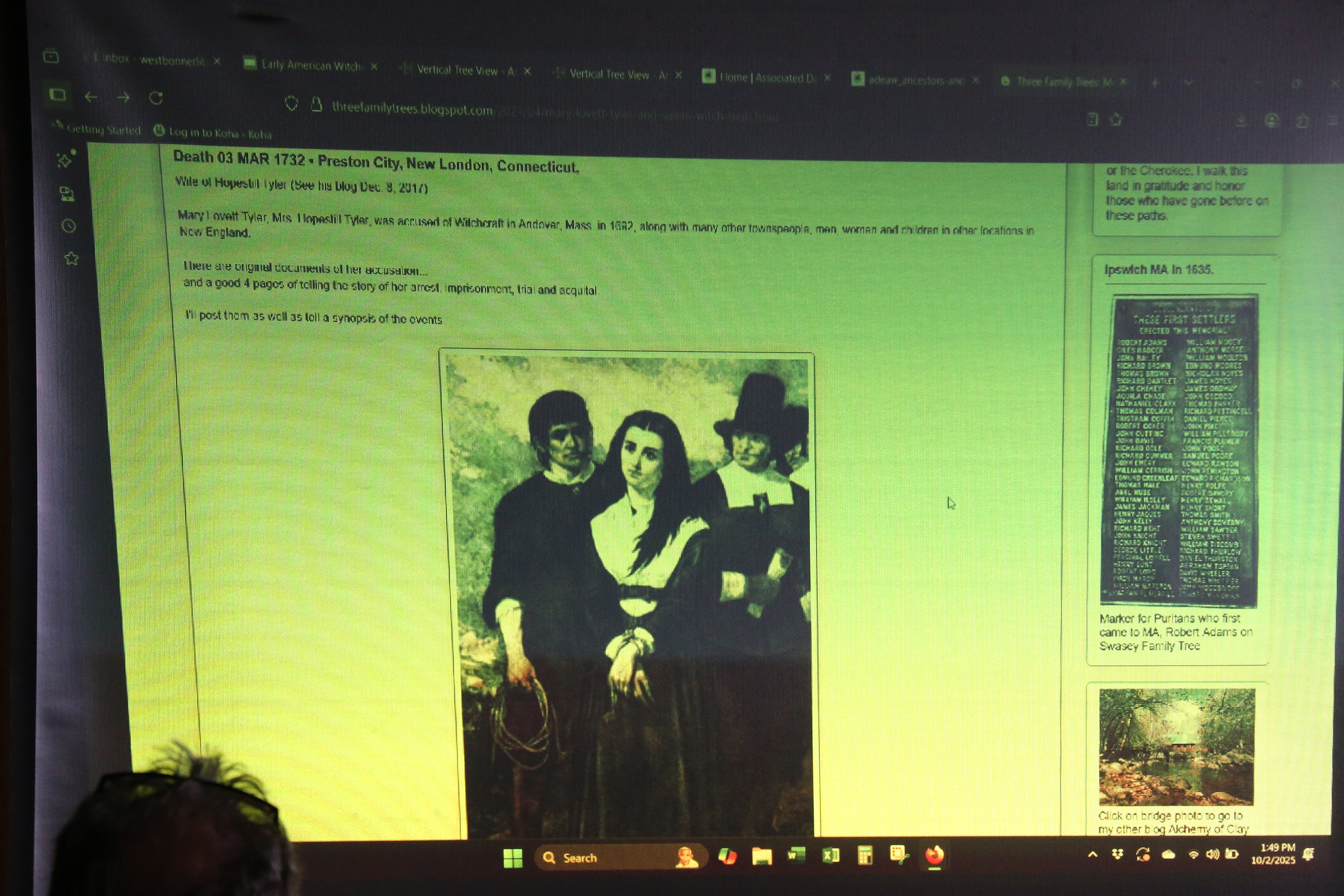 A slide depicting a witch persecution is shown Thursday during a presentation on early American witches.
ARTICLES BY DEVIN WEEKS

Treaty Rock teacher to retire after 21 years
Treaty Rock teacher to retire after 21 years
In Mary Pattis' third-grade class at Treaty Rock Elementary School, students have been learning about the science and architecture of different bridges.

This hometown reporter is moving on
This hometown reporter is moving on
It's never easy to say goodbye. Especially twice.

Superintendent reflects on 32-year education career; open house Friday
Superintendent reflects on 32-year education career; open house Friday
Post Falls Superintendent Dena Naccarato said it feels pretty strange to be closing the education chapter of her life after going to school for the last 50 years.