
Agriculture and national security sciences lead Montana State’s annual research expenditures
REAGAN COTTON MSU News Service | Daily Inter-Lake | UPDATED 5 months AGO
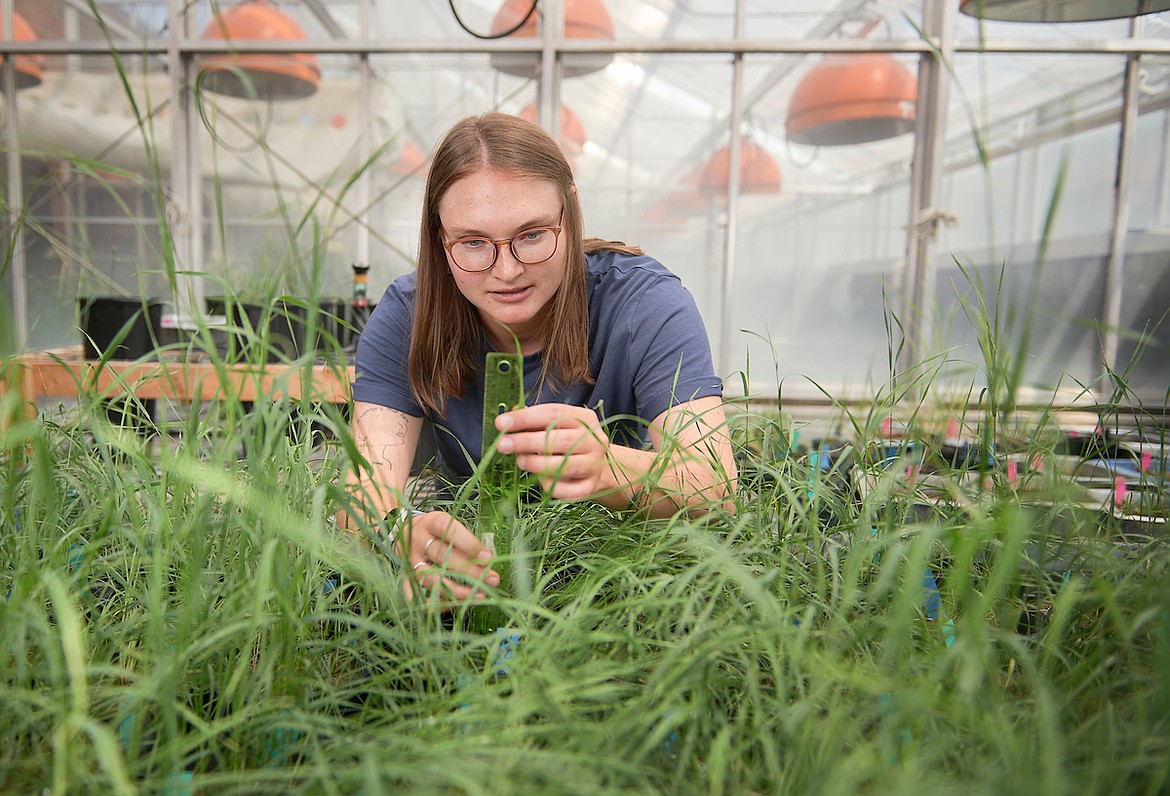
Caption: Montana State University College of Agriculture doctoral student Erin Teichroew inspects Crested Wheat Grass. (MSU photo by Colter Peterson)
BOZEMAN – For the fourth consecutive year, research expenditures at Montana State University have topped $200 million, chiefly in the form of grants that have supported applications ranging from agriculture and cybersecurity to health and rural education.
MSU’s annual research expenditures totaled $288.7 million during the 2024-25 fiscal year, according to the university’s annual report to the National Science Foundation. MSU is the first and only institution in the state to surpass $200 million in research expenditures, and its research enterprise is larger than all other public and private universities in the state combined.
“While we are extremely proud to have set another record in research expenditures, the heart of university research is its positive impact on our state and its people,” said Alison Harmon, MSU’s vice president for research and economic development. “The opportunities provided to students and faculty through research, as well as the economic, societal and health benefits that these projects have for our communities, are the crux of our land-grant mission, and seeing those benefits in action is the highest reward.”
This year’s record expenditures represent an increase of roughly 12% over the previous year’s total of $257.9 million.
During the 2024-25 year, MSU faculty and researchers submitted 731 funding proposals. In that time, 525 new awards were funded totaling $128.2 million. Of the new total expenditures, $14.5 million supported research by 654 graduate students and 803 undergraduate students, many of the latter through the Undergraduate Scholars Program.
“Our faculty and researchers are extraordinarily dedicated and talented individuals whose efforts have real, direct impact on lives and communities in Montana,” said MSU President Brock Tessman. “Additionally, seeing the research done by our students under their leadership and knowing that our graduates are prepared to continue that impact is so gratifying. The ripple effects from research that starts at Montana State extend far beyond our campus.”
Roughly 92% of MSU’s research expenditures came via competitively awarded funds through federal agencies, including the departments of Defense, Health and Human Services, Agriculture, the National Science Foundation and NASA. The remaining 8% of funding came from private sources and from the state.
The College of Agriculture led the university with $54.1 million in research spending, followed by the College of Letters and Science with $40.6 million and Norm Asbjornson College of Engineering with $24.5 million.
MSU MilTech, now part of the newly launched Institute for National Security Research and Education, led university non-college programs in expenditures with a record $64.7 million. It was followed by the MSU TechLink Center with $11.1 million, Montana INBRE – the IDeA Network of Biomedical Research Excellence – with $4.4 million, and the Western Transportation Institute with $3.5 million.
MSU is one of only 104 institutions in the U.S. to both receive an R1 designation for its “very high research spending and doctorate production” and be classified for community engagement by the Carnegie Classification of Institutions of Higher Education. MSU has also been named among the top 3.7% universities in the world based on education, research and employability by the Center for World University Rankings. It was the highest-ranked university in Montana.
Research done at MSU during the 2025 fiscal year and ongoing projects include:
Pat Secor of the Department of Microbiology and Cell Biology received a $2.8 million grant to advance research on Lyme disease. Lyme disease can be transmitted by blacklegged ticks, the first of which was identified in Montana earlier this year.
Assistant professor of civil engineering Siwei He received funding from EPSCoR, the Established Program to Stimulate Competitive Research, to conduct research focused on improving flood forecasting.
A $3 million NSF grant is facilitating a program the Department of Education to support dozens of science, technology, engineering and math teachers in rural and underserved areas of Montana as they work toward graduate degrees in science education or deepen their expertise as teachers.
With a grant from the Merck Foundation, MSU’s nursing college helped bring oncology services to Barrett Hospital and HealthCare in Dillon. With a new infusion center that opened in October, scores of rural patients can receive care close to home instead of traveling over two hours to a hospital in Bozeman.
Cara Palmer in the Department of Psychology led a study to determine whether common sleep habits of children contribute to later psychiatric disorders, such as substance abuse and depression.
A team in the Department of Plant Sciences and Plant Pathology led by Michelle Flenniken studied the impact of viral infection on honeybees with the aim of mitigating population losses and providing new knowledge for the beekeepers who manage Montana’s more than 250,000 honeybee colonies.
Giorgio Morales, a doctoral student in the Gianforte School of Computing, explored the use of artificial intelligence to synthesize on-farm data and help farmers maximize crop yields by dialing in knowledge on everything from soil nutrients to humidity.
MSU’s nursing college is working with local partners to increase the state’s number of sexual assault nurse examiners, who provide comprehensive physical exams to victims of sexual assault and connect victims to advocates, survivor services and other follow-up care. The program is on track to meet its goal of training 40 of these responders in its first year.
In an inter-college collaboration, Anna Schweiger in the College of Agriculture and Danielle Ulrich in the College of Letters and Science used NSF funding to study carbohydrates stored in whitebark pine trees, a critical native species to Montana’s subalpine ecosystems, and how those carbohydrates affect the trees’ abilities to withstand and recover from drought.
The Buffalo Nations Food System Initiative received funding to provide education and conduct research in support of Indigenous food sovereignty focused on the people of the Northern Great Plains and Rocky Mountains. The project aims to revitalize cultural knowledge, expand food system research and increase engagement.
Supported by a $1 million award from the W.M. Keck Foundation, Dana Rashid continued work researching the link between inflammation and skeletal development, which could offer insights into how anti-inflammatory drugs impact patients' bone structures.
MSU Extension, with funding from the Montana Department of Public Health and Human Services, expanded its support programs for unpaid family caregivers across Montana.
Graduate students in the Department of Land Resources and Environmental Sciences published new findings on the management of wheat stem sawflies. One of the state’s most prevalent agricultural pests, sawflies caused roughly $66 million worth of crop losses in Montana in 2024.
More information about research funding and programs at MSU can be found at montana.edu/research/.