
Local leaders celebrate hydrogen initiative, but federal cuts mark a setback
MONTE TURNER | Hagadone News Network | UPDATED 5 months, 3 weeks AGO
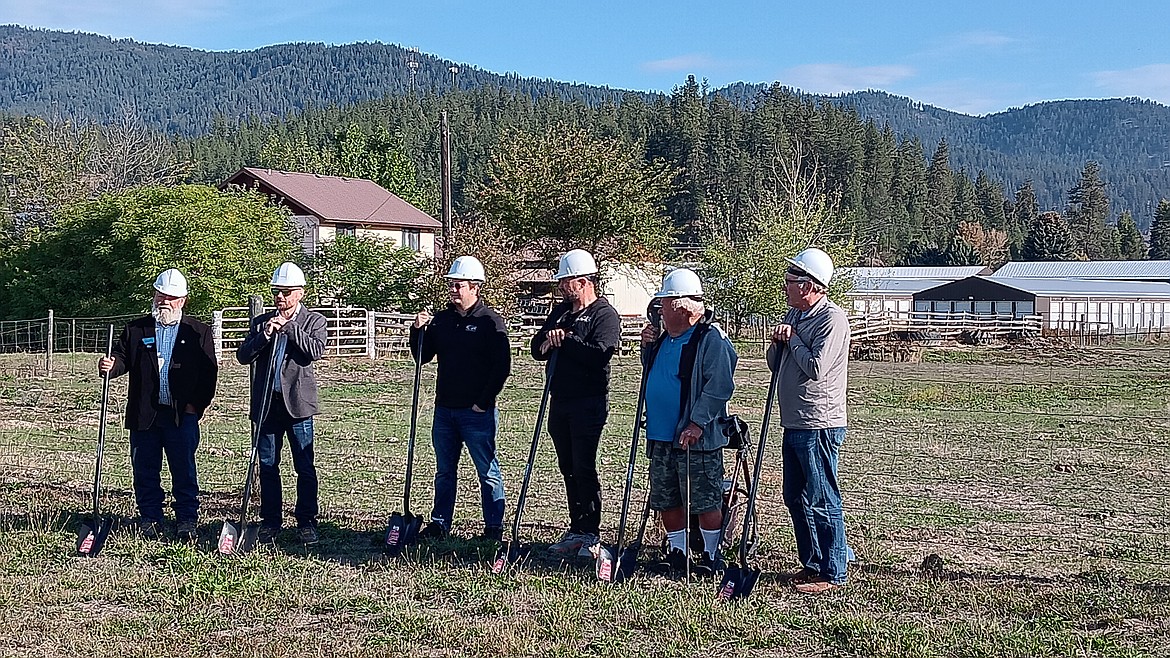
From left, Sen. Denley Loge, SRSH2 Board Member; Brian Solen, VP of business development of Ameresco; James Vogel, VP of sales for Carbon Recall; Joel Robinson, president of Carbon Recall; John Cheesman, SRSH2 board member; Ken Jasper, business owner in St. Regis. Carbon Recall in Kalispell is the solar company that will install the solar panels which will be on the storage building roofs in the background. (Monte Turner/Mineral Independent)
Once known for its lumber mill and scenic mountain views, St. Regis is now making headlines as the home of Montana’s first solar-to-hydrogen production facility, a major leap forward in clean energy and local economic development.
Community members, state leaders and energy innovators gathered Sept. 29 to celebrate the grand opening of the St. Regis Solar Hydrogen Project, a bold new initiative that’s bringing renewable energy and jobs to the town of roughly 500 residents.
"This is a big deal for Montana," said James Fehr, deputy director of the Montana Department of Environmental Quality. “What’s starting here will help shape policy and energy development for the whole state.”
The project is part of a massive $1 billion investment by the U.S. Department of Energy, which selected the Pacific Northwest Hydrogen Hub (PNWH2) including Montana, Washington and Oregon as one of seven clean hydrogen centers across the country.
However, on Oct. 2, the Trump administration said it will cut funding for about $8 billion in clean energy projects amid debates over the federal government shutdown. The Energy Department said in a statement that 223 projects were terminated after a review determined they did not adequately advance the nation’s energy needs or were not economically viable, according to the Associated Press.
"Nearly $8 billion in Green New Scam funding to fuel the Left's climate agenda is being cancelled," Russell Vought, director of the federal Office of Management and Budget, posted on X on Wednesday, according to Axios.
In a statement, PNWH2 expressed disappointed in the cuts, but said it will continue with its mission.
"Regardless of the political fighting in Washington, D.C., hydrogen remains a viable product for energy dominance and represents a market worth hundreds of billions of dollars that generates millions of jobs," the statement read.
"While we are disappointed in the Department of Energy’s decision to cut funding for the Pacific Northwest Hydrogen Hub, there is still immense opportunity for our region to finish what we started — establishing a national benchmark for hydrogen production that brings economic opportunities to communities across the region. PNWH2 will continue to support our project and industry partners that have laid the foundation for a thriving hydrogen ecosystem throughout the Pacific Northwest. The future of hydrogen is still being written by states, communities, and industries across the country. With or without federal support, this industry will continue to drive the innovation and infrastructure needed to fortify America’s energy economy."
Pacific Northwest Hydrogen Association is appealing the decision to end the grant.
At its core, the facility uses solar energy to produce hydrogen fuel, a clean alternative to gasoline and diesel, through a process that releases no carbon emissions. That hydrogen can then power trucks, tractors, trains, and even planes.
“This is about energy, yes, but it’s really about community,” said George Bailey, managing partner and CEO of the St. Regis Solar Hydrogen project (SRSH2). “If we can build a cutting-edge project like this in St. Regis, we can do it in Ekalaka, Harlowton and other small towns that need jobs.”
The facility is more than just a production site. It includes the new “Just in Time” training center, located at the St. Regis Community Center, where locals can gain skills to join the growing clean energy workforce.
For many in the community, this project is more than a win; it’s a turning point.
In 2021, the closure of the Tricon Lumber Mill by Idaho Forest Group dealt a heavy blow to the local economy, eliminating nearly 100 jobs and cutting tax revenue by over $100,000.
“I lost my job when the mill shut down,” said Duane Simons, a Mineral County commissioner who spoke at the event. “That was a huge hit to our county. Every single job we can bring back now is a big deal. Ten jobs is a really big deal. One hundred jobs? That’s fantastic.”
Bailey noted that the solar project is expected to offer good-paying positions, similar to or even better than those lost when the mill closed.
“We’re talking about jobs in the $50,000 to $60,000 range, and possibly higher,” he said.
Located along I-90, St. Regis is strategically positioned to serve as a hydrogen refueling point for trucking companies traveling between Spokane, Missoula, and Glacier National Park.
"St. Regis is the eastbound entry point to Montana," said State Senator Denley Loge. “This project could turn our town into a hub for clean fuel distribution.”
The hydrogen produced in St. Regis will help reduce emissions in industries that are typically hard to clean up, such as heavy-duty transportation and aviation. By using solar power and clean water to make the fuel, the project avoids the environmental downsides of traditional energy sources.
The ultimate goal, says SRSH2, is to ensure that the transition to clean energy brings prosperity, not just for corporations, but for communities like St. Regis.
“We’re building something here that’s about more than technology,” said Bailey. “It’s about improving lives, creating opportunity, and showing that small towns can lead the way into the future.”
ARTICLES BY MONTE TURNER
St. Regis mill expanding operations, adding employees
Driving along Montana 135 just outside St. Regis, it’s hard to miss the towering stacks of bundled posts and poles, and the large building at Big Sky Forest Products.
Superior students send postcards from the British Isles
Every two years, Superior teacher Jeff Schultz organizes an unforgettable European tour for students and locals touring different countries.

Legion begins refurbishing highway fatality markers
Ray Welch American Legion Post 13 in St. Regis is responsible for maintaining fatality markers along Interstate 90 from Lookout Pass to mile marker 77, just east of Alberton, as well as along Montana 135 from St. Regis to the Sanders County line.