
Resolution in the works for Lookout Pass boundary dispute
MONTE TURNER | Hagadone News Network | UPDATED 5 months, 3 weeks AGO
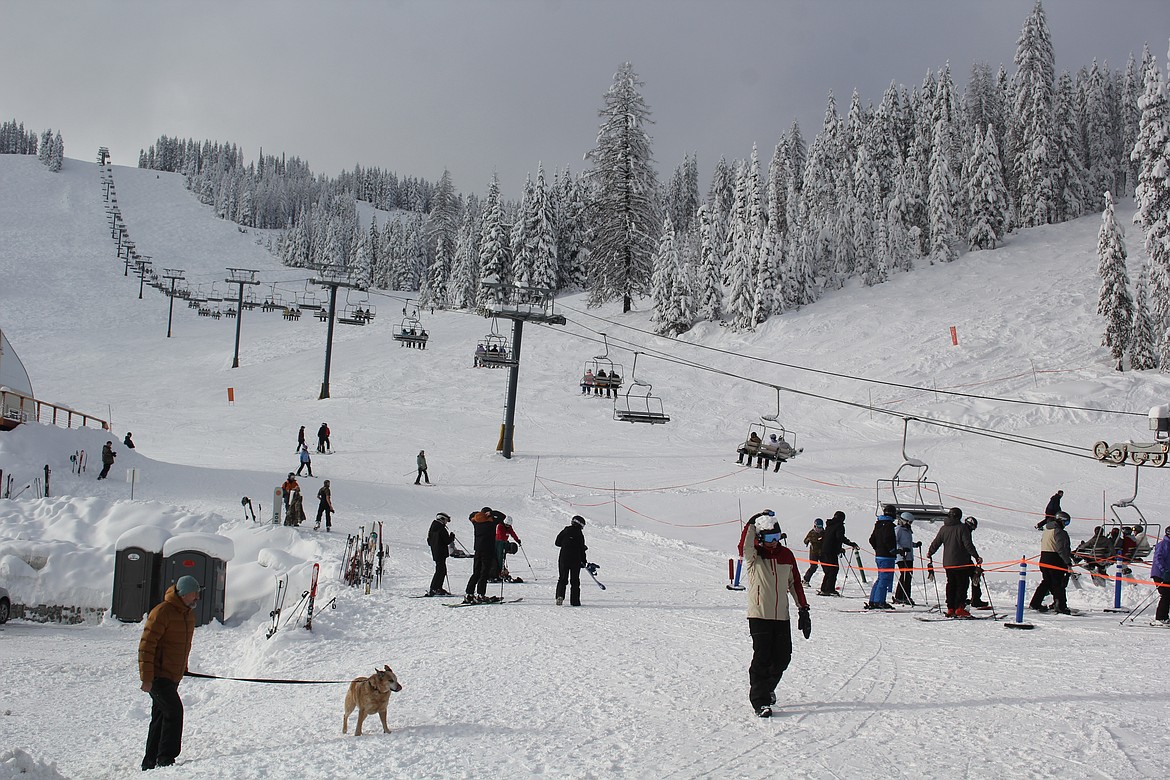
Lookout Pass Ski Aera had plenty of snow on New Year's Eve with the Peak 1 quad chair lift packed, but with short lines. The ski area has a 50-inch settled base at the summit. (Monte Turner/Mineral Independent)
A century-old boundary confusion on the Montana-Idaho state line is finally being addressed after simmering for decades thanks to the persistence of a local lawmaker.
In October 2021, Sen. Denley Loge organized a critical field trip to the disputed area near Lookout Pass, drawing together key officials from local, state, and federal levels, including Carolyn Upton, Regional Forester for the Lolo National Forest, Carole Johnson, Superior Forest Ranger, all three Mineral County Commissioners, and representatives from the Montana Department of Revenue and Sen. Steve Daines’ office.
The goal: See the land in question firsthand and discuss the discrepancy that has long baffled planners and frustrated local leaders.
“This has been simmering for years,” said Loge. “But no one knew what the next step was or wanted to take it.”
Despite the cloudy weather that day, Loge pointed out where the original 1905 Government Land Office boundary was believed to be, and the single remaining survey marker still standing in the Bitterroot Mountains. Others had disappeared during mountain development, especially with the construction of I-90, which may have inadvertently shifted the perceived watershed divide, the natural feature used to define the original state line.
“The boundary (between Idaho and Montana) was a natural drainage at the summit, but when excavation work was completed, a man-made drainage was created about 800 feet into Montana,” Loge explained. “Shoshone County (Idaho) is treating that as the state line.”
This shift, while it may sound minor, has large implications.
That 800 feet of discrepancy potentially affects between 13 to 40 acres of land. Crucially, it includes operational structures of the Lookout Pass Ski Area, including the lodge, rental shop, and the restaurant, facilities that have been paying property taxes to Idaho, not Montana.
“It may not seem like much, but it’s a big chunk of taxable property that should be contributing to Mineral County’s revenue,” Loge added.
Since the field trip 4-years ago, the issue saw no movement until late last month. The Bureau of Land Management (BLM), at the request of the Montana Department of Revenue and the U.S. Forest Service, began surveying federal lands near the disputed state line.
According to Brittany Jones, chief of communications for BLM’s Montana/Dakotas/Wyoming division, “This survey won’t change the state line, it’s just meant to confirm exactly where it is.”
Jones noted that there appear to be two recognized lines: the 1904-1905 line based on the original watershed divide, and a more recent, irregular boundary used by Shoshone County for tax assessment purposes. The latter encompasses parts of the ski area now in question. Only the BLM is authorized to conduct the official survey and set monuments to clarify the legal boundary.
The implications for Mineral County could be significant.
While back taxes are unlikely to be recouped, a corrected boundary could bring in a new, ongoing source of tax revenue for Montana, a boon for a rural county that could use every dollar. But despite the renewed action, delays are looming.
“With the government shutdown, I don’t know when it will get done,” Loge said. “They’re trying to get both states’ attorneys general involved, and the shutdown is throwing a wrench into everything. The results probably won’t be submitted until 2026 at the earliest.”
Still, for the first time in decades, the gears of government are turning on this issue, thanks in no small part to one man who spotted the irregularity on a map back in the 1990s and never stopped pushing.
“I was helping to build the road and, as a geography major with experience in cartography, I saw the wiggle in the line,” Loge recalled. “Nobody else caught it or believed it could happen. But it did. And it’s time to make it right.”
ARTICLES BY MONTE TURNER
St. Regis mill expanding operations, adding employees
Driving along Montana 135 just outside St. Regis, it’s hard to miss the towering stacks of bundled posts and poles, and the large building at Big Sky Forest Products.

Superior students send postcards from the British Isles
Every two years, Superior teacher Jeff Schultz organizes an unforgettable European tour for students and locals touring different countries.

Legion begins refurbishing highway fatality markers
Ray Welch American Legion Post 13 in St. Regis is responsible for maintaining fatality markers along Interstate 90 from Lookout Pass to mile marker 77, just east of Alberton, as well as along Montana 135 from St. Regis to the Sanders County line.