
MLSD’s Lewis addresses levy promises, elementary start time
NANCE BESTON | Hagadone News Network | UPDATED 5 months, 3 weeks AGO
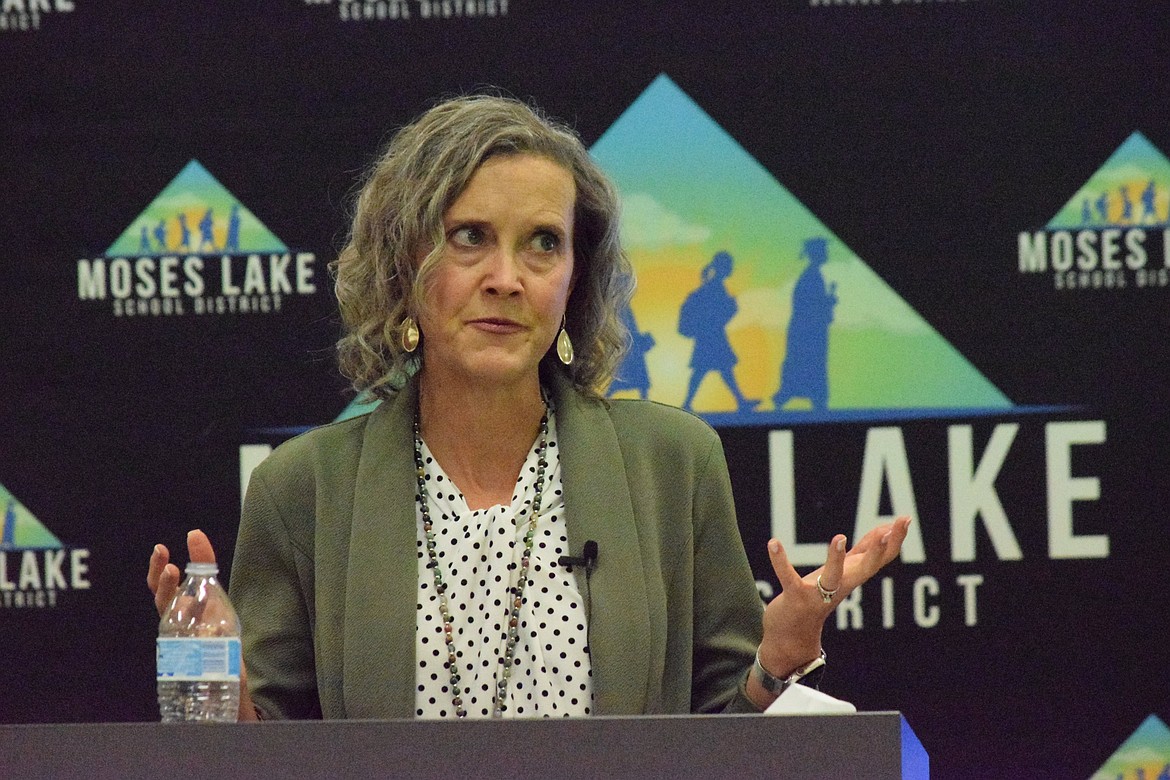
Moses Lake School District Superintendent Carol Lewis addresses levy promises, reduced elementary start time for the final time at the Oct. 16 regular school board meeting.
NANCE BESTON/COLUMBIA BASIN HERALD
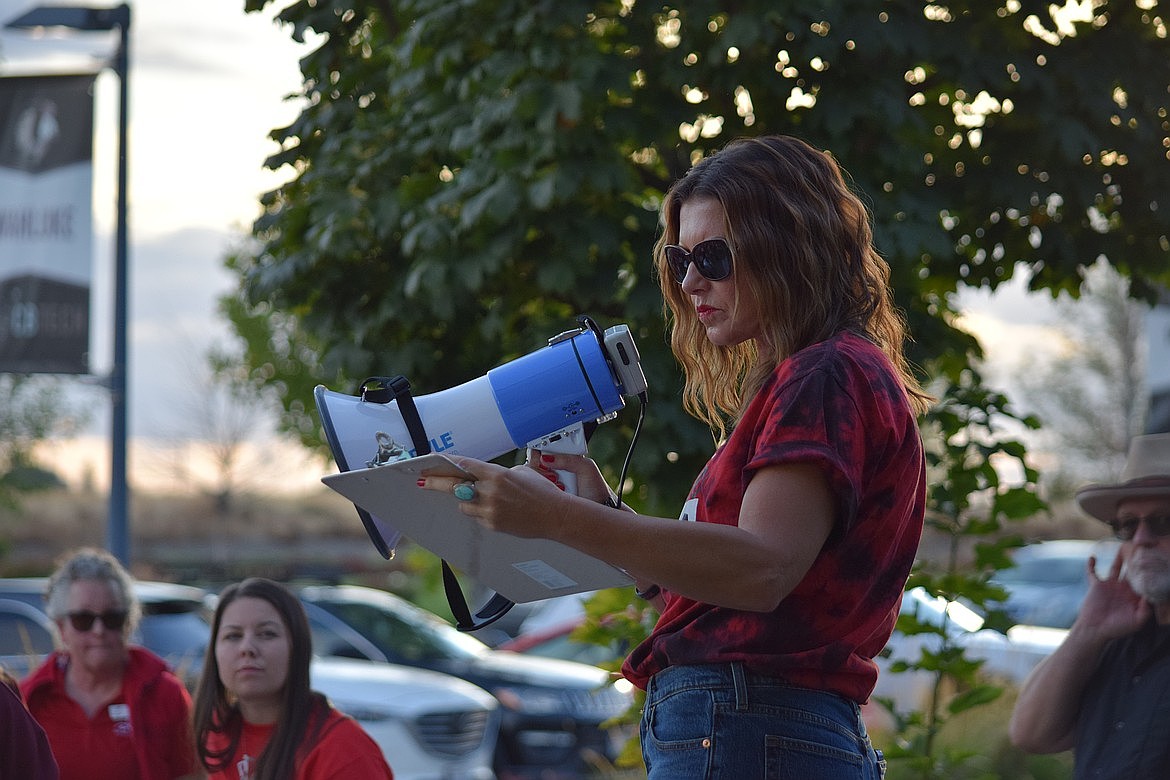
Moses Lake Educators Association Heather Whittall addresses the crowd before walking out to Yonezawa Boulevard and looping up to the Moses Lake School District transportation building earlier this month. MLEA is currently in negotiations with MLSD for a new contract.
MOSES LAKE — Tensions continue between the Moses Lake School District and the Moses Lake Educators Association as discussions continue over a modified elementary school schedule and the restoration of educational programs critical to student learning.
“Tonight, I want to take a moment — one final time — to talk about something that’s been at the heart of nearly every conversation we’ve had since May of 2024: keeping our promises,” Superintendent Carol Lewis said during the Oct. 16 regular school board meeting, her full statement is included below.
Lewis explained the district is unable to reinstate the elementary start time without using funds from the general fund, which, according to the district’s policy 602,2 cannot be done.
The policy, passed in 2011, states the district will “present a general fund budget that includes a goal of at least 12.5% of the (current year’s/prior year’s) expenditures towards a minimum fund balance.”
MLSD passed a $144.6 million budget at an August regular board meeting, which is considered fiscally sound, according to RCW 28A.505.110. The RCW states a district must pass a budget where expenses cannot exceed the revenues plus the mandatory reserve fund balance. If the district is unable to do so, the district may ask for an extension.
As of Oct. 17, contract negotiations are still happening with MLEA and MLSD. There is one contract proposal on the table that would reinstate elementary start times, which is still awaiting a response from MLEA. The other proposal made by MLSD was discontinued, at the request of MLEA, according to the district’s public contract information.
At the forefront of this issue is MLEA President Heather Whittall, who has been vocal about the need for the district to restore the elementary school schedule to its previous length.
Since the district reduced the elementary schedule by 30 minutes during the 2024-2025 school year to cope with financial shortfalls — resulting in reductions in music, physical education and library programming — educators and community members have expressed growing concern over the impact on younger students.
“We want the district and the school board to restore the elementary schedule and finalize our negotiations for the collective bargaining agreement,” Whittall said.
She emphasized that the community has rallied behind the necessity for educational equity, especially for the most vulnerable learners.
The MLEA is advocating for a full-time schedule that includes access to vital programs, arguing that the shortened school day has compounded issues affecting students' access to a well-rounded education. Whittall also highlighted the district’s healthy financial reserves, urging administrators to prioritize student needs over fiscal conservatism.
Conversely, Lewis defended the district’s actions regarding scheduling, citing ongoing financial constraints and the need for long-term stability. She talked about how the community lost trust in the district after the district passed a bond to build a new high school in 2017. Instead, Vanguard Academy was built, a project-based learning model.
“Ironically, many of those same people are now asking the district to take actions that would undoubtedly be seen as another bait and switch. How quickly some forget. I cannot, and will not, allow negative history to repeat itself under my leadership,” Lewis said. “Levy promises were developed in collaboration with staff, community members, and representation from our labor unions… Can any of us imagine the loss of trust those who voted yes would feel if we didn’t keep our promises?”
During her statement, Lewis reaffirmed her commitment to a balanced budget that prioritizes the educational future of students while acknowledging previous promises made during the recent levy campaign.
“Running a school district is complicated,” Lewis said. “Every day, we face conflicting pressures.”
She illustrated her commitment to maintaining fiscal responsibility as essential for ensuring quality education in the long run, emphasizing that she would not jeopardize student futures for short-term gains.
Lewis addressed specific community concerns by detailing the rationale behind the shortened schedule.
“The loss of a levy always impacts a school district for two years … we always knew the 2024-2025 and the current 2025-2026 school year would be impacted by the levy failure.”
The superintendent highlighted that while programs were reduced due to financial constraints, staff had been assured that adjustments would be made to gradually restore programs as finances stabilize.
The ongoing dispute centers not only on the length of the school day but also on the overarching sentiment of trust between the district's administration and the community.
Many community members and educators remain concerned that the financial strategy employed by the district could compromise educational quality.
Whittall pointed to the emotional toll on teachers, stating, “We were asked to shoulder the burden of financial cuts while maintaining high-quality student instruction and care for our youngest learners.”
Despite the clashes over the scheduling, Lewis's plan includes a phased approach aimed at restoring school programming incrementally as funds are available.
Lewis confirmed that the expected changes within the 2026-2027 academic year would significantly improve the situation, providing more time for subjects like music and PE.
“Even when some may not see it, we have each and every employee’s long-term best interest in mind,” Lewis said. “Shortsighted thinking focused on immediate gratification is in direct conflict with a steady, long range plan that will continue to build the trust, resilience, and stability necessary to ensure the students of Moses Lake have access to a quality education, delivered by educators who have the support they need to be effective in their jobs five, 10, 20 and 50 years into the future, long after most of us in this room are no longer part of the Moses Lake School District.”
Superintendent Carol Lewis’s statement:
“Tonight, I want to take a moment — one final time — to talk about something that’s been at the heart of nearly every conversation we’ve had since May of 2024: keeping our promises.
I may not have lived in Moses Lake my whole life, but it has quickly become my home. When people ask me where I’m from, I don’t talk about the place I grew up, I proudly say I’m from an amazing town in the middle of Washington called Moses Lake. A place I’m proud to call home. It’s a community I’m committed to, through thick and thin. A year ago, when I was asked if I would leave if the levy failed, my answer was no. When colleagues from around the state ask me why I don’t look for an easier job that pays more money, I give them two reasons:
First, over 8000 kids in Moses Lake seek and deserve a quality public school experience, now and for years to come.
And simply, Moses Lake is worth fighting for.
This is the last time I will use this platform to address our school district’s decisions about how to spend this year’s partial levy collection, or our commitment to maintain the board’s minimum required fund balance. Those who continue to publicly debate these topics will only erode the fragile trust that grew in our community over the last several months.
A year ago, our town was divided about whether or not to support Moses Lake School District. I spoke with countless staff and community members who made abundantly clear reasons for mistrust stemmed largely from what many viewed as a “bait and switch” after voters approved a bond to build a new high school in 2017. Ironically, many of those same people are now asking the District to take actions that would undoubtedly be seen as another bait and switch. How quickly some forget. I cannot, and will not, allow negative history to repeat itself under my leadership.
Levy promises were developed in collaboration with staff, community members, and representation from our labor unions. Every person who stood on a freezing street corner last winter waving signs in support of our kids, and every person who graciously voted yes did so knowing exactly what was going to happen this year and next year if the levy passed. Can any of us imagine the loss of trust those who voted yes would feel if we didn’t keep our promises:
- The promise to increase paraeducator support for student safety and learning
- The promise to give our kids access to Boys and Girls Clubs
- The promise to provide our students access to athletics and activities
- The promise to hire more elementary music teachers so our elementary students could have music all year
- The promise to hire more elementary PE teachers so we can increase PE time for all students
- The promise to increase our custodial and maintenance services so our students have access to cleaner, safer schools
- The promise to provide adequate funding for basic supplies and materials needed for teaching and learning
- The promise to begin offering our secondary students the courses needed to fulfill their personalized graduation pathways
- The promise to provide for safety by maintaining resource officers, security personnel, and health room staff
- The promise to begin restoring lost instructional technology
- And finally the promise to build a balanced, “Money In, Money Out” budget.
What would our students, staff, and community be saying right now if we hadn’t done those things?
Running a school district is complicated. Every day, we face conflicting pressures — people want us to hire this, replace that, spend here, or cut there. But our responsibility is to keep the longevity and stability of this district at the forefront. It is my job to carefully consider our financial situation and make decisions that secure the future — for our students, for our families, and for our staff. Even when some may not see it, we have each and every employee’s long-term best interest in mind.
Shortsighted thinking focused on immediate gratification is in direct conflict with a steady, long range plan that will continue to build the trust, resilience, and stability necessary to ensure the students of Moses Lake have access to a quality education, delivered by educators who have the support they need to be effective in their jobs five, ten, twenty, and fifty years into the future, long after most of us in this room are no longer part of the Moses Lake School District.
In recent years, we have seen many examples across our state of school districts developing shortsighted spending plans that sent them into devastating financial positions. Several of those districts have remained in financial crisis for many years, including entering into binding conditions with the state. Moses Lake’s conservative financial plan that began in the spring of 2024, and our willingness to remain committed to that plan, have turned us in the right direction, and rather than struggling for years, we plan to be in a healthy, stable financial position by the 2026-2027 school year.
In the coming weeks, we can expect outside voices to come into Moses Lake and try to tell us our spending priorities are out of order and not focused on kids. Those voices are not part of our community, and they won’t care about what happens to Moses Lake and our kids in the long run.
In fact, their intent will be to create division and confusion. These are the same voices that have pressured school district leaders across our state to make quick decisions that resulted in overcommitted long-range spending plans.
I’m proud that Moses Lake is no longer on the list of districts in severe financial trouble, and I intend to keep it that way. Every time I mention money, it’s with the image of Moses Lake’s kids in my sights.
I am well aware that kids only get one shot at each grade level. It’s true that they’re only in kindergarten once, but that’s true for every grade level. The district’s priorities cannot be so shortsighted that we would jeopardize their future for short term gains.
Right now, we need to be asking ourselves how we will protect opportunities for our current kindergartners when they start third grade in 2028, sixth grade in 2031, go to high school in 2034, and graduate in 2038.
The fact that we temporarily shortened our elementary day to get through a two year financial crisis was never ideal, and was never intended to be a long term plan. The intent is, and has always been, to restore elementary start times to 9:00 in the fall of 2026.
In spite of rumors you may be hearing, there was never a promise made to restore the elementary start time this school year. Beginning now, you will see and hear us focus on what truly matters: what students are learning, how we are keeping everyone safe, and how our staff continues to make learning possible every single day. We will show, through our actions, that we honor the promises made during the levy season, just eight short months ago.
Finally, I know some will pick phrases out of what I’ve just said, looking to invent ways to tell you I’m not being honest, or to take advantage by misrepresenting my statements. I will not respond to those kinds of accusations, not because I can’t, but because continued public conflict will only lead to division in our community. As an advocate for all students, and a careful steward of your taxpayer dollars, I stand behind my commitment to the students and staff of Moses Lake School District, and I intend to keep the district’s promises to the greater community.
I will always be open to dialogue with students, staff and community members, even when conversations are difficult.
Please reach out to me if you have questions, ideas, or constructive criticism.
There’s no game to be won, and there will be no glory in keeping score or having the last word. The youth of our community are counting on all of us to continue coming together, and they’re watching how we behave.
It’s time for Moses Lake to turn the page and that’s exactly what we’re going to do — starting tonight.”
 Moses Lake Educators Association Heather Whittall addresses the crowd before walking out to Yonezawa Boulevard and looping up to the Moses Lake School District transportation building earlier this month. MLEA is currently in negotiations with MLSD for a new contract.
ARTICLES BY NANCE BESTON

1 arrested after Highway 17 stop; detectives recover fentanyl, firearms
MOSES LAKE — The Moses Lake Street Crimes Unit conducted a traffic stop on Highway 17 near Randolph Road and executed a search warrant Friday morning as part of an ongoing narcotics investigation.

4th-year drought declaration in WA, subtle effects in the Columbia Basin
EPHRATA — Washington’s fourth straight year of drought is expected to hit some regions hard, but in Grant and Adams counties, the impacts will look different – quieter, less visible and centered underground. Statewide, the Department of Ecology issued an emergency drought declaration after a warm winter left Washington with about half its usual snowpack, raising concerns about low summer streamflows, stressed fish populations and heightened wildfire risk. Seven of the past 10 years have included drought somewhere in the state. “If you look at our mountains, the challenge we are facing is clear,” Gov. Bob Ferguson said during a press conference Wednesday. “We’re taking emergency action to protect fish, farmers and communities across Washington.”

Sleep Diagnostic Center to close after doctor’s sentencing
MOSES LAKE — The Central Washington Sleep Diagnostic Center announced it will be closing its doors effective April 30. This includes locations in Moses Lake, Spokane Valley, Brewster and Wenatchee. The announcement follows the March 25 guilty plea from Dr. Eric Edward Haeger, 57, in United States District Court to adulterating and misbranding medical devices with the intent to defraud or mislead, according to a statement from the U.S. Attorney’s Office. “The adulterations by Dr Haeger show a dangerous disregard for the safety of his patients,” Washington Attorney General Nick Brown said in a statement. “This is a win for patient safety, for protecting public dollars from fraud, and for ensuring citizens of Washington get necessary healthcare. This case exemplifies the great work our team is doing in collaboration with our federal partners to fight fraud and protect Washingtonians.”