
Fire season officially ends in Washington
NANCE BESTON | Hagadone News Network | UPDATED 5 months, 2 weeks AGO
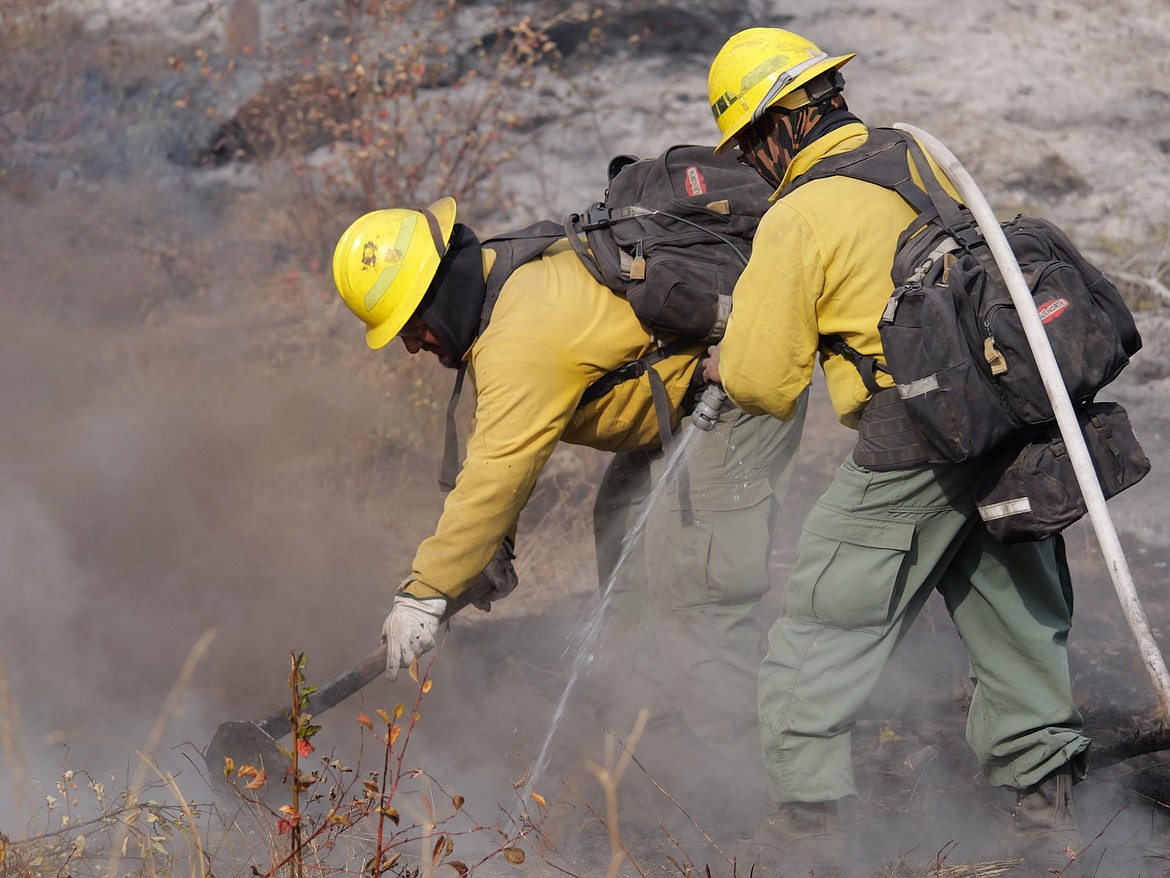
Two firefighters work on mopping and gridding the Lower Sugarloaf Fire at the beginning of October. The fire is mostly contained and scorched nearly 43,300 acres.
COURTESY PHOTO/INCIWEB/ANDY LYON
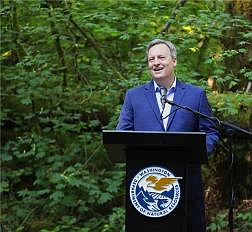
Public Lands Commissioner David Upthegrove said he would like to give special thanks to the firefighters who helped throughout the 2025 fire season.
OLYMPIA – The Washington Fire season has officially come to a close as of Monday, according to Department of Natural Resources Communications Manager Ryan Rodruck.
“After all of the rain that came through this weekend, we are going to consider a season-ending precipitation event,” Rodruck said. “If that's not good enough, it's going to rain in Central and Eastern Washington again next weekend. The chance of a large, costly fire developing on the landscape at this point in the year is extremely unlikely.”
Rodruck said the fuels are not dry enough after the rain.
“That atmospheric rain that made it over the mountains definitely did the trick to end the fire season here in Central and Eastern Washington,” he said.
He explained that there may be a one-off wildfire start, but they will be extremely small starts in areas that didn’t get the precipitation over the weekend. He explained that the end of October has become a pretty normal time for the fire season to conclude.
“It's getting later and later in the year. This is becoming more and more typical where you're in that October time frame. It used to be that once we got clear of Labor Day, I would kind of breathe a sigh of relief, like, ‘Okay, we made it through.’ Because Labor Day typically falls around that time frame, when the weather patterns change. That's really not the case anymore. And we've been seeing seasons that are moving further into that October time frame.”
Fire season
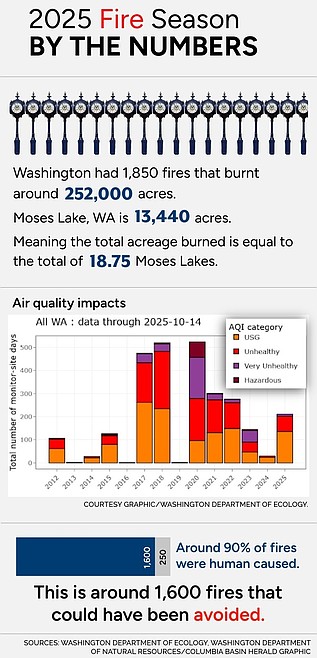
Commissioner of Public Lands Dave Upthegrove said this year there were around 1,850 fires that burnt nearly 252,000 acres in a statement Monday morning.
“How many of these fires could have been prevented? About 90% of these in Washington State are human-caused. That means we had over 1600 fires that could have been avoided through human activity.” Upthegrove said. “The decisions we make as residents of this state can help reduce the risk of fire.”
Upthegrove said another takeaway he had during his first fire season is that fires are becoming a statewide issue, not just an Eastern Washington problem.
“About 40% of the fires that started this season were in Western Washington, and the Bear Gulch fire was the largest fire in Western Washington that we've seen in a generation,” he said. “The impacts of these fires, the impacts of smoke on population centers and their contributions to asthma and public health concerns, are something that people throughout Washington need to care about.”
The two largest fires the state had this year were the Lower Sugarloaf at nearly 42,967 acres and the Labor Mountain at 42,980 acres. Both were located in central Washington.
Air quality
The 2025 fire season, combined with lightning-sparked fires, hot and dry weather and light winds, caused unhealthy air quality for days across Central and Eastern Washington, according to a statement from the Washington Department of Ecology.
According to DOE, the season started off pretty tame until mid-August, when the blazes started to impact air quality levels.
While no region was free from the smoke, Central Washington was hit the hardest, according to DOE. According to a graph the department released, there were around 70 days where air quality was unhealthy for sensitive groups. There were around 50 days when the air quality was unhealthy. There were only a handful of days when the air quality was very unhealthy.
The area had fires, including the Wildcat, Lower Sugarloaf and Labor Mountain fires, which all produced a lot of smoke.
Northeast Washington also saw impacts on air quality from the nearby fires. The region saw around 60 days of either unhealthy or unhealthy for sensitive groups.
However, Southeast Washington dodged most of the smoke, with only a handful of days of air quality that was unhealthy for sensitive groups. Western Washington followed a similar trend with less than 10 days of unhealthy air quality.
According to Airnow, Moses Lake, Ephrata, Quincy and Ritzville have good air quality planned for the rest of the week.
House Bill 1168
HB 1168, which passed the 2021-22 legislature unanimously, provided around $500 million over eight years in funding for initial attack, forest health and community resilience.
Initial attacks, as it sounds, are used to help prevent fires from growing larger. This includes funding for aircraft to help contain and suppress fires.
“We try to keep it as low as possible and that is money well spent because if the fire gets big, we pay for the cost of putting it out at the other end, so it is a pay me now or pay me later,” Rep. Larry Springer, D-Kirkland, said. “Pay me now is cheaper."
Forest health includes prescribed burns, repairing damage done from fires, and thinning forests. Community resilience helps at-risk communities avoid catastrophic damage from wildfires. Springer said this includes adding fire-resistant structures and working with homeowners to prepare for potential blazes.
Springer said previous to this year the state had kept up with the funding, receiving $115 million on the last two-year budget and $130 million in the one prior to that.
However, this year, with the budget shortfall, the funding was cut to $60 million for the next two years. The legislature covered the expense with around $40 million out of the General Fund and around $20 million out of the Climate Commitment Act, Springer said.
“I believe this will save the legislature and help them save money and help them with their budget problem,” Springer said.
Springer said the bill helps fund proactive measures to ensure blazes don’t spread as quickly or cause nearly as much damage.
“If we can prevent or reduce the size of one or two large fires, this will more than pay for itself, freeing up funding and capacity for other government priorities at the legislature,” Springer said. “This is a fiscally wise investment, and we're very hopeful that both the governor and the legislature will see that.”
He said he will be working alongside Upthegrove to restore the money to the cause during the next session.
“There's never enough money to fund everything we want, but putting out wildfires is a core basic function of government that saves lives and protects property and saves us money in the long run, although the General Fund has a large shortfall,” Springer said. “The Climate Commitment Act funding has some capacity.”
Next year
Rodruck said it is too early to predict how the fire season is going to look next year, with a lot of it depending on how much precipitation areas get over the winter.
“The long-term forecast for this winter is looking kind of below normal on the temperature range and above normal on the precipitation range. Above normal precipitation range is a good thing,” Rodruck said. “The more snowpacks that we see hanging up in those mountains, the more snow water equivalent that will generate. The more water there is, the longer it takes those fuels to dry out, so above normal precipitation is a good thing.”
Rodruck said three factors go into the predictions for the fire season, including fuels, weather throughout the fire season and precipitation prior to the season.
He said DNR is taking steps right now to eliminate some of the fuels using techniques such as prescribed burns.
Caution advised
Although the fire season has officially ended, blazes can still happen, Rodruck said.
“There are still burn rules in place, just because those burn restrictions and burn bans start to move away, there. There are still rules in place for burns over a certain size,” Rodruck said. “It's always best to just make sure you're checking with the appropriate agency whose jurisdiction you're in to make sure you're following the letter of the law.”
Rodruck said he recommends residents give local fire jurisdictions a call if they plan on burning anything larger than a backyard fire pit.
“Call and just give them a heads up and let them know you are going to be burning some stuff,” Rodruck said. “They may give you some tips or best practices depending on what jurisdiction you are in. Each landscape is different, and each situation is different.”
Acknowledgments
Upthegrove concluded his speech Monday morning, thanking the firefighters for their work.
“This fire season tested us, but it also reminded us of the courage that's within the firefighters,” Upthegrove said. “They ran towards danger in order to keep the rest of us safe and thank God they're home. On behalf of the people of the state of Washington, I want to thank each and every one of them for their strength, for their sacrifice and for their heart.”
Rodruck reiterated a similar sentiment.
“I always want to thank our firefighters. We did have a bunch of those large, costly fires in the landscape. We had a lot of tired faces out there, but they put in a lot of hard work and made sure that we were able to successfully suppress those fires,” Rodruck said.
Rodruck said he also wants to thank the public.
“This year, we had done a ton of messaging around fire prevention and keeping those sparks off the landscape,” Rodruck said. “Without the support of the public this year we could have potentially had a much more catastrophic fire season, but the public really came through for us this year.”
 Public Lands Commissioner David Upthegrove said he would like to give special thanks to the firefighters who helped throughout the 2025 fire season.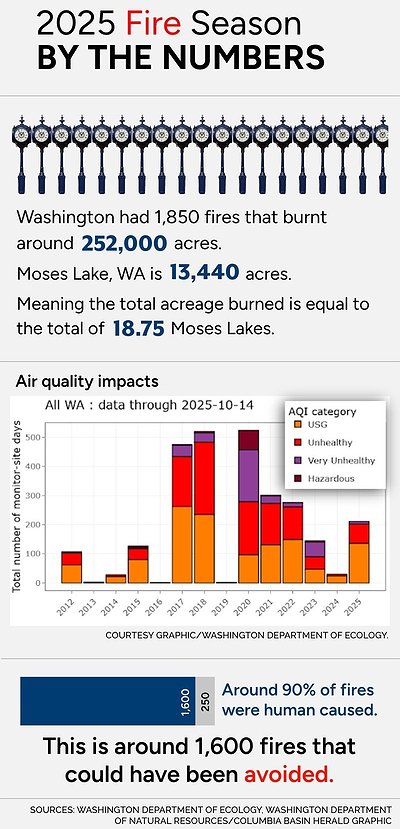
ARTICLES BY NANCE BESTON
1 arrested after Highway 17 stop; detectives recover fentanyl, firearms
MOSES LAKE — The Moses Lake Street Crimes Unit conducted a traffic stop on Highway 17 near Randolph Road and executed a search warrant Friday morning as part of an ongoing narcotics investigation.
4th-year drought declaration in WA, subtle effects in the Columbia Basin
EPHRATA — Washington’s fourth straight year of drought is expected to hit some regions hard, but in Grant and Adams counties, the impacts will look different – quieter, less visible and centered underground. Statewide, the Department of Ecology issued an emergency drought declaration after a warm winter left Washington with about half its usual snowpack, raising concerns about low summer streamflows, stressed fish populations and heightened wildfire risk. Seven of the past 10 years have included drought somewhere in the state. “If you look at our mountains, the challenge we are facing is clear,” Gov. Bob Ferguson said during a press conference Wednesday. “We’re taking emergency action to protect fish, farmers and communities across Washington.”
Sleep Diagnostic Center to close after doctor’s sentencing
MOSES LAKE — The Central Washington Sleep Diagnostic Center announced it will be closing its doors effective April 30. This includes locations in Moses Lake, Spokane Valley, Brewster and Wenatchee. The announcement follows the March 25 guilty plea from Dr. Eric Edward Haeger, 57, in United States District Court to adulterating and misbranding medical devices with the intent to defraud or mislead, according to a statement from the U.S. Attorney’s Office. “The adulterations by Dr Haeger show a dangerous disregard for the safety of his patients,” Washington Attorney General Nick Brown said in a statement. “This is a win for patient safety, for protecting public dollars from fraud, and for ensuring citizens of Washington get necessary healthcare. This case exemplifies the great work our team is doing in collaboration with our federal partners to fight fraud and protect Washingtonians.”