
School tuition bill could force rural districts to close
EMILY MESSER | Hagadone News Network | UPDATED 6 months AGO
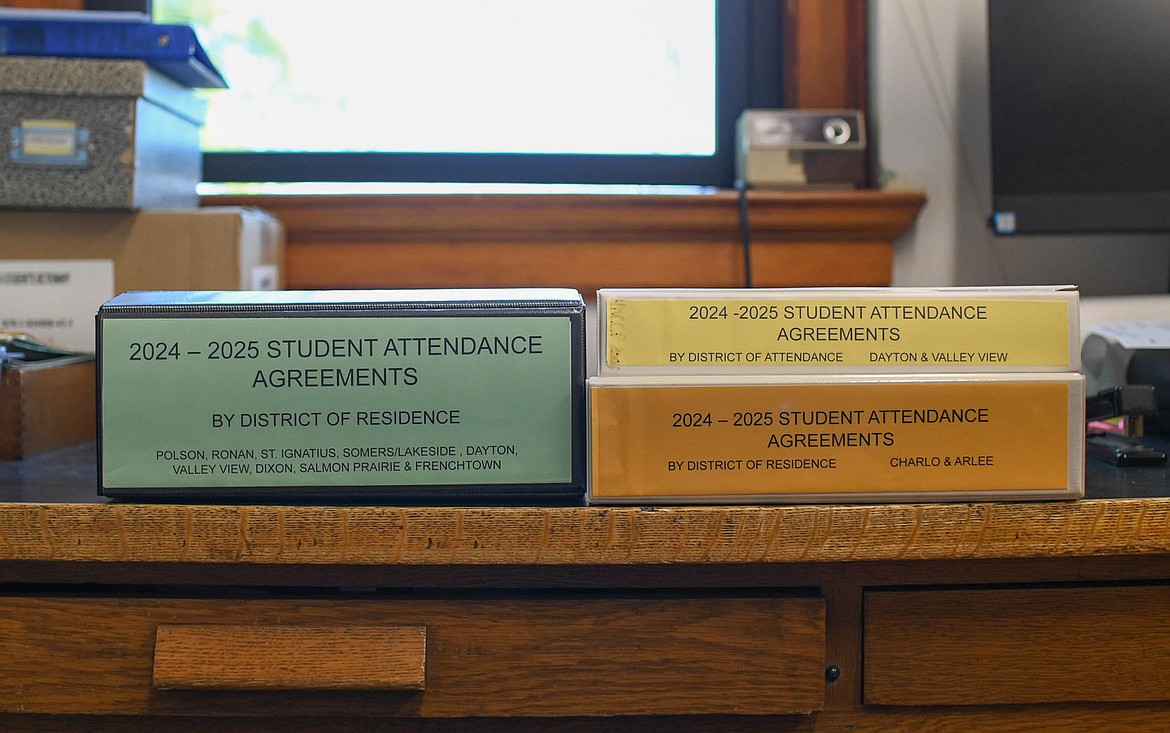
The binders in the Superintendent of Schools Office which hold the documents and applications for out-of-district students in Lake County. Carolyn Hall, the Superintendent has to document and keep track of piles of information for out-of-district students. (Emily Messer/Leader)
Emily Messer joined the Lake County Leader in July of 2025 after earning a B.A. degree in Journalism from the University of Montana. Emily grew up on a farm in the rolling hills of southeast Missouri and enjoys covering agriculture and conservation. She's lived in Montana since 2022 and honed her reporter craft with the UM J-School newspaper and internships with the RMEF Bugle Magazine and the Missoulian. At the Leader she covers the St. Ignatius Town Council, Polson City Commission and a variety of business, lifestyle and school news. Contact Emily Messer at [email protected] or 406.883.4343 | September 4, 2025 12:00 AM
The tuition bill (House Bill 203) enacted by the 2023 state legislature is taking full effect this year as K-12 schools are billed for last year's out-of-district student attendance.
For some it’s just a money swap between districts, for others it’s a greater effect on their bottom line but its biggest impact could play out for resident district taxpayers.
“It's a mobility tax on property owners. It is what it is and people should not be happy about this bill,” said Jason Sargent, superintendent of St. Ignatius Schools. “You can look at the numbers and see we're all trading money. But taxpayers pay the total amount for us to trade money. It really is ludicrous.”
House Bill 203 was introduced by Rep. David Bedey, R-Hamilton, with the intent to allow parents more school choice without burdening taxpayers with the cost of out-of-district attendance. This bill, known as the tuition bill, charges the tuition costs of out-of-district students to their home district.
The cost of tuition is configured by a complicated formula that takes into account students' attendance, the taxpayer contribution to the general fund levy and a dollar amount determined by the state legislature for the per-student funding amount. Each factor can change the per-student tuition cost because each school and grade level configures a different cost.
“I really don't think our legislators understood the full ramifications,” said Carolyn Hall, Lake County Superintendent of Schools.
Bedey explained in an interview that the premise of this bill, which he calls a “tax equity payment” was to fund public education for children living in the taxpayer's district who choose to go to school in a different district.
According to Bedey, the tuition bill does not increase the tax load for the district of residence because the payment or levy in this case would still exist if that student continued attending school in their home district.
With five K-12 districts and three rural K-6 in a county with historically fluid enrollments between districts, what’s really happening with the money?
Hall explained that the county has always been mobile, with students attending any district they please for various reasons. She said schools had the option to charge tuition to parents but agreed not to.
“We had agreed long ago between all of us, we aren't gonna do that,” Hall said. “We're just going to take care of kids.”  Carolyn Hall, the Superintendent of Schools for Lake County, gets ready for the school year to kick off. It’s a busy time of year for Hall with all the budget paperwork running through her office. (Emily Messer/Leader)
Hall, who also is the superintendent for the three rural districts, said for the last 20 years Dayton Elementary and Valley View Elementary have had an agreement with the Polson School District that their sixth through eighth graders will attend Polson with no cost of tuition. This is because the smaller elementary schools only operate as K-6.
“They had never been charged tuition and had an understanding between them,” Hall said. “So, the Legislature made it mandatory to charge them tuition, as well as any other students that come into the district.”
For just one example, according to the Invoice of Tuition for the 2024-25 school year 32 students attended Polson Elementary from their district-of-residence, Upper West Shore Elementary (Dayton). Tuition for one elementary student is about $1,700 but it quickly increases for middle schoolers at around $2,200. This leaves Dayton Elementary with a bill of more than $60,000 to Polson Elementary District.
But that tuition bill for one student, “is not what it takes to educate a child,” Hall said. According to Montana Office of Public Instruction, in 2023 the average per-pupil expenditure was estimated at $14,451.
The bills aren’t quite so daunting for the larger districts, with St. Ignatius K-12 owing Arlee Elementary around $13,000, Ronan owing Polson Elementary $36,000 and Polson High School and Elementary owing about $10,000 to Ronan. These numbers represent just four invoices out of a stack from around Lake County. Some bills are small with one student attending from one district for a couple hundred dollars, but some are large totals.
Hall explained that these bills account for each day a student is in class but some schools, like Dayton, only have 148 instructional days, whereas Polson has 170 days. So, this means Dayton is charged for more days for their resident students because of the other schools' number of instructional days.
The bill is calculated after the conclusion of a school year and billed the following school year. The district of residence then pays this amount from its general fund, tuition fund or other authorized pots of money.
Rural schools hit hardest
After the district of residence pays the bill, the general fund is replenished each year by state funding and local property taxes. But if the tuition becomes too much of a burden for the district, then the trustees can ask voters for an increased levy in the next election.
“The taxpayer can come back to their trustees and say, ‘look, it's costing us too much to educate the few children that we have in this district,’” Hall said.
On the other side, when a district receives tuition payments that income is applied to their taxpayer levies to lower the burden on taxpayers. But that doesn’t equation doesn’t balance out for the small schools.
For example, Hall said that the bill last year for Swan Lake-Salmon Elementary, “that little, tiny school of four,” is $72,000. She estimates that amount as half of the school's general fund. The tuition bills have a high impact across all the small schools.
“It would be a fourth of Dayton's, but a third of Salmon Prairie’s,” Hall estimates, and says it could force them to close. “It really numbers their days.”  Desks were moved outside of Valley View School Sunday before a crew moved them around the corner and into the new multi-purpose building. (Kristi Niemeyer/Leader)
“Shady way of eliminating small districts”
Sargent said there is really no purpose for this bill other than to do away with small districts.
“If you want to consolidate districts across the state of Montana, do it, but don't use taxpayers to make that happen,” Sargent said. “There're going to be districts that close down because of it. It's a pretty shady way of eliminating small districts and it's not fair to taxpayers.”
But for a district like Polson, where more students are coming in than leaving, it's a financial boon. This year, Polson will pay out almost $70,000 but receive just over $100,000 according to district superintendent Andy Fors.
“That’s probably a tougher conversation at the Dayton school, for sure,” said Devon Cox, a Polson board member trustee, as they passed the budget on Aug. 18.
For other schools in the valley, it's an administrative burden. Jim Baldwin, the superintendent of Charlo, said they have about $10,000 coming in and $10,000 going out.
“We created a lot of paperwork, a lot of heartache, a lot of administrative burden,” Hall said. “In reality, what will happen is that Swan Lake-Salmon School, possibly Dayton, depending on what happens with their ongoing enrollment, will be put out.”
As Hall pulls out her large binders of documents, she explains the paperwork behind it all. Each district has to have a contract on file for an out-of-district student and track their attendance because she has to check off the budget to make sure the tuition bill was invoiced correctly.
Along with this, there’s paperwork for the families to fill out, then it’s sent to the school board of attendance and the school board of residence. Following this, a family is sent a letter asking them to attend a board meeting at the district the student will attend and the school must document what happens at the meeting
“And the money does nothing,” Hall said as she finished her explanation.
On top of it being a huge administrative burden, Hall says it’s not necessary for most schools. Between Ronan and Polson districts, she said it’s just an exchange of similar amounts of money. Regarding St. Ignatius, Charlo, Ronan and Arlee, she said it’s a round robin between those districts with students fluidly moving to and from.
Is there a fix?
Rep. Linda Reksten, R-Polson, who heads the House Education Committee, explained in an interview that when the bill was presented the committee was in favor because of its perceived fairness to taxpayers. She said when people move to small rural districts and then send their children to larger school districts, the larger districts end up paying for it.
“However, when we looked at the whole situation this last session, we said, ‘wow, we have quite a few people complaining.’ It's not easy to pull up roots and move somewhere,” Reksten said. “Let's equalize it across the county.”
Reksten said during this last legislative session they also passed HB 156, which will change education funding laws for school districts by replacing local base levies to countywide levies. This house bill will take effect after July 1, 2026.
Sargent is less enthused about the second bill, designed to remedy problems with the first. “When you pass a bad bill and then create a new bill to cover it up, it's really bad business,” he said. “It stinks.”
Reksten explained that under the tuition bill trustees might need to ask for an additional levy to help fill the gap and said legislators realized schools might be closed due to this bill. However, “we really don’t think that’s the issue,” she said. Instead, fairness for taxpayers was the goal.
“That’s kind of the way legislation is, sometimes when you pass something, the unforeseen circumstances are such that, when you come back to the next session, you have to fix it,” Reksten said.
Since HB 156 doesn’t take effect until the next fiscal year, schools will have to deal with this tuition bill for the following two years because tuition is billed for the prior year’s student attendance.  Brycen Ek, the principal of Dayton, talks to his students during Bike Mechanics and Exploration and Safety class on Aug. 7. This was a summer class offered as a part of Dayton Discovery Days. (Emily Messer/Leader)
“(The tuition bill) will temporarily cause a little pain,” Reksten said. “(Tuition) really should be shared among the two districts and that's what we fixed.”
Rep. Bedey explained the tuition bill was necessary to be fair to taxpayers and he is not in favor of repealing that bill or 156, now that levies will be equalized across the county.
“I believe that parents should have a choice and I believe taxpayers need to be treated fairly,” Bedey said.
But the newly implemented law won’t remove the administrative burden of the tuition bill.
“We called it out two years ago. It was bad business. It turned out exactly as we thought,” Sargent, pointing out that he’s both an educator and a taxpayer. “Legislators that are working supposedly for the people and they're creating things like this, which is stepping backwards from what people really want.”
ARTICLES BY EMILY MESSER

Polson commissioners hear plan for reducing E. coli in Flathead Lake
Representatives from the Flathead Lakers and the Polson Bay Golf Course presented a plan to the Polson City Commission last Wednesday to reduce stormwater runoff, which had caused increased levels of E. coli in Flathead Lake near Boettcher Park.

City Commission finalizes Salt Cafe grant, hears from market vendors
The Polson City Commission council chambers were full of support Monday night for Andrew Perkins, owner of Salt Cafe, who has been awaiting funding from the Tax Increment Finance District grant he received nearly three years ago.

Foundation established for Polson Police
A non-profit called the Polson Police Foundation was launched at the end of 2025 to support the department by contributing to training, officer wellness, critical equipment and community initiatives.