Shoshone County adopts $16.6M budget
JOSH McDONALD | Hagadone News Network | UPDATED 3 months, 1 week AGO
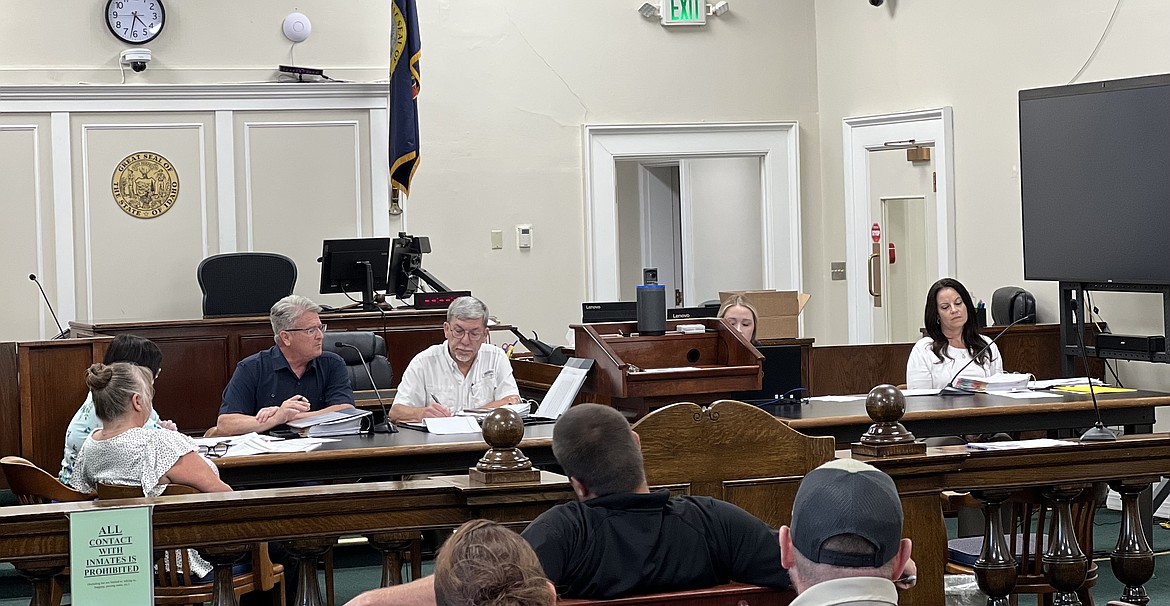
Shoshone County Commissioners (from left) Jeff Zimmerman, David Dose, and Melissa Cowles deliberate over the county's budget during a hearing last week in the county's district courtroom.
JOSH McDONALD
WALLACE – After multiple meetings last week, the Shoshone County Commissioners formally adopted the county’s 2025-26 budget, but not without making some tough decisions.
The approved budget totals $16,908,706, an increase of roughly $800,000 over last year’s budget.
County budget officials, including the commissioners and clerk, emphasized the need for fiscal responsibility amid rising costs and reductions in state funding.
While nearly every department made cuts to its proposed budget, none drew more scrutiny than the Shoshone County Sheriff’s Office (SCSO), a key sticking point that delayed the budget’s passage by nearly three days.
The SCSO was allocated $5,331,291, or 31% of the county’s total budget. That figure includes a $292,000 infusion from the Local Assistance and Tribal Consistency Fund (LATCF) grant, bringing the department to its final approved amount. Even with the grant, the SCSO’s budget is more than $500,000 less than last year’s.
Earlier this month, commissioners voted to allow the SCSO to pursue a two-year, $2 million override levy to recover some of the lost funding. If the levy fails in November, the department will have to return the $292,000 and make additional cuts to stay within budget.
“I am very grateful that the commissioners voted to allow the sheriff’s office to run an override levy and to allocate funding to support us until our citizens vote on the levy this November,” Sheriff Holly Lindsey said. “In addition, the additional funding they voted to allot us last week gives our office a fighting chance to continue promoting public safety and to provide the level of service our residents expect. It will keep us afloat until we get the results of the levy in November, preventing us from having to lay off several deputies.”
The SCSO is funded through the county’s justice fund, which also includes the safety building, jail, and public defense. Lindsey said the justice fund was never adequately established, leading to financial instability and limiting her office’s ability to meet community needs.
“We are a small community facing challenges typically seen in larger cities, and crime continues to increase in frequency, violence, and sophistication each year,” Lindsey said. “Our office has been fiscally responsible with taxpayer money, consistently coming in under budget. However, our overall budget has decreased each year, trimming expenses and revenues to the point that we can no longer operate at full capacity. As a result, this could lead to a reduction in the services we provide our community, and that's the last thing we want to do as a law enforcement agency.”
The Public Works budget also took a significant hit. Director Jessica Stutzke received $3,095,960, down from a previously proposed $4.2 million.
The cuts stemmed from the loss of Secure Rural Schools (SRS) funding and declining state revenues. Following guidance from the Idaho Association of Counties, the department also avoided relying on unstable state general funds.
As a result, nine full-time positions were eliminated, and services such as snowplowing, road striping, and equipment maintenance were scaled back. Stutzke plans to hire temporary, seasonal workers to help offset the impact.
For much of the past two decades, Shoshone County Public Works (SCPW) has not relied on county levies for funding. This year, however, it will receive a small amount for the first time since 2019.
Shoshone County Prosecutor Ben Allen saw a modest increase in his office’s budget compared to last year, though it was still about $40,000 less than what he proposed during an early August budget workshop.
Despite the shortfall, Allen praised the commissioners for navigating the process amid public criticism. Still, he warned that the county’s funding challenges are becoming harder to ignore.
“It is clear that our local constituents desire services within our valley,” Allen said. “They expect to call 9-1-1 and have an officer respond, they want to speak with their assessor about property valuations without having to take a ticket and sit in line for an hour, they desire to see the county proactively engaged in land use issues instead of sitting on the sidelines. However, these services all require funding and the state’s 3% cap on local tax greatly impedes the County’s ability to keep up with growing demands for service.”
Allen also criticized state officials for allowing rural counties to struggle while celebrating their own financial successes, including a recently announced $354 million surplus that Gov. Brad Little has pledged to redistribute as property tax relief.
“It is unfortunate to see such a funding shortage at the local level while our state touts ending FY25 with a $345 million dollar surplus, while simultaneously highlighting their ability to increase state employee pay,” Allen said. “The funding our county needs to provide the services our citizens deserve is sitting in the State coffers. We just need to make our demands heard for that money to make its way back into our local communities.”
ARTICLES BY JOSH MCDONALD

Weather woes continue to stall North Idaho ski season
Resorts hope for snow as Christmas approaches
Warm weather, strong winds and power outages have prevented area ski hills from fully operating on a consistent basis.
Weather woes continue to stall Silver Valley ski season