
EXPLAINER: Funding libraries in North Central Washington
NANCE BESTON | Hagadone News Network | UPDATED 1 year AGO

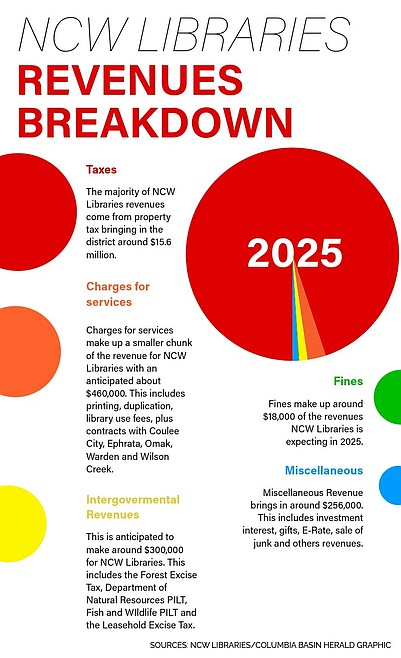
MOSES LAKE – The North Central Washington Libraries operate under a unique funding model reliant on local taxpayer dollars, primarily property tax revenue. NCW Libraries runs 30 branches in five counties.
Funding
According to Amanda Brack, the Communications and Community Engagement Manager for NCW Libraries, the primary source of funding for the libraries in the region comes directly from taxpayer contributions.
“About 95% of our total revenue comes from property taxes,” Brack said.
Brack said that the remaining 5% of the budget is sourced from intergovernmental revenues, such as the Forest Excise Tax, and other small amounts accrued from fines related to lost or damaged materials, and charges for printing services.
NCW Libraries is a junior taxing district of each county it serves, including Chelan, Douglas, Ferry, Grant and Okanogan counties. Residents of the unincorporated areas within the district pay for library services through a levy on residents' property taxes. Those who are in annexed or contracted areas also pay the levy tax.
“We don’t have overdue fees at the library system, so we don’t make money from that,” she said. “As long as you return something late, there’s no fee. But if it's lost or damaged, there’s a fee."
This diversified funding structure presents NCW Libraries with the challenge of allocating limited resources effectively amidst growing demands for services.
The library operates under a levy rate that is included in property taxes, a rate that currently stands at $0.26 per $1,000 of assessed property value.
By law, NCW Libraries may collect up to $0.50 per $1,000 of assessed property value. If future increases to this levy rate are necessary, the district would have to put the measure before voters in the district, Brack said.
Access
Each community within the library district has voted to incorporate itself into the library system, according to NCW Libraries documentation. After being incorporated into the library system, each city must make the decision to annex or contract the library services.
Annexation is brought up by a city's legislative body and put before voters. Any community annexed by the district had that annexation approved by the electorate. A community can only be de-annexed by a vote of the residents.
If a city is not annexed, it may still choose to contract with NCW Libraries for library services. Local public officials can choose to terminate the contract with NCW Libraries without putting it before voters.
All residents of unincorporated areas in the five counties the library district serves are eligible for NCW Library services.
Cities that are annexed or contracted and residents who live in unincorporated areas, pay the same levy rate as residents and receive the same library services, Brack said.
According to NCW Libraries’ documentation, Coulee City, Ephrata, Omak, Warden and Wilson Creek have contracts for library services. Quincy, Royal City, Soap Lake, George, Grand Coulee, Mattawa and Moses Lake are annexed into the library district.
Residents of incorporated cities or towns that are neither annexed nor contracted with NCW Libraries will not automatically receive library services. Instead, those residents have the option to purchase a library card for $10 a month or $120 a year, according to NCW Libraries. Fee cards do not provide access to the mail-order library or interlibrary loan services.
Resource allocation
Brack said NCW Libraries has a budget that is broken down into different departments, which is accessible to the public on the district’s website.
“It’s so important for us to be good stewards of our budget,” she said.
The budgeting season for NCW Libraries is not confined to a specific period; rather, it’s a continuous process in which administrators engage in discussions about future needs and potential expenditures, Brack said.
Executive Director of NCW Libraries Barbara Walters said the budgeting process is long and painstaking.
“Typically, about six months before the end of the fiscal year, staff are working on developing the budget,” she said.
Each department submits requests based on data from prior years and staffing and cost projections.
Walters said the district focuses on priority-based budgeting. This method considers community needs and usage data to determine how money and other resources are allocated.
“When we prepare the budget, it’s about putting our priorities in serving the communities we are in,” she said.
She explained that one way that NCW Libraries can function with a small budget is that the district can purchase online resources once for all 30 locations, which saves them a lot of money.
“What makes us so special is we can provide a lot of resources to our communities because we are a library district. Which means we are able to pay for services once, versus if they were a stand-alone library, those demand far more funds because they have to pay for each service for use at one facility,” Walters said. “We try to stretch each dollar we are bring in to maximize what we can offer.”
While the district applies a systematic approach, regulations restrict how money can be allocated and revenues raised.
"By state law, we can increase our levy rate only by 1% per year," Walters said.
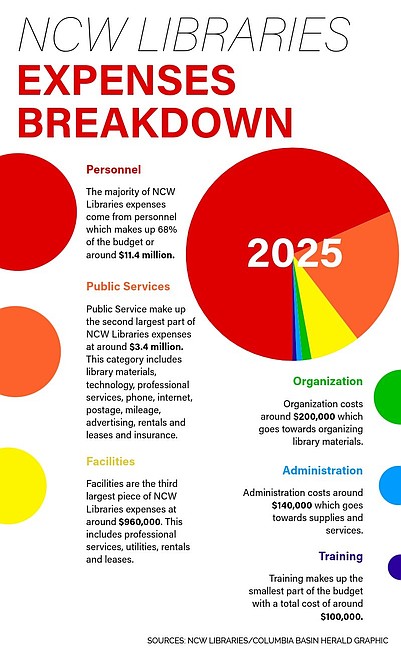
This limitation means that the budget must stretch further to maintain services amidst rising operational costs, she said, particularly with respect to personnel. Staffing accounts for approximately 68% of the total budget.
Partnerships
One of the unique features of NCW Libraries is its cooperative engagement with local municipal governments. The libraries mostly operate out of city-owned buildings and are governed by building maintenance and use agreements with these municipalities.
“We are able to match that partnership by providing everything inside it, staffing, services, resources,” Brack said.
Walters said the agreements focus on collaboration.
“It’s a testament to both the cities and the libraries’ commitment to providing those resources to residents,” Walters said.
However, the arrangement has been met with challenges in some municipalities, where there have been discussions about the renewal of agreements. Specifically, the Moses Lake City Council has been discussing the potential of updating the building agreement. Mattawa has also examined the future of its library.
“If cities decide not to renew their building maintenance agreements, we can't reimburse them for costs related to those facilities,” Walters said. “That’s all it means.”
Walters said each building owner in the district is reimbursed $4 for every square foot of the facility, which accounts for around $200,000 in the district's annual budget with all facilities combined.
“We don’t own 29 of our buildings and they're not all cities. We do have three private owners,” Walters said. “The building maintenance use agreement just outlines what our responsibility is – that's ... library services and staffing, materials, the online resources, all of that. And then the city is responsible for their own building.”
Walters described that model as “walls-in,” meaning that the district deals with what happens inside the building while the owner of the building manages the brick-and-mortar maintenance.
Walters said the libraries are proactive in community engagement, hosting discussions and assessments to solicit feedback and clarify misunderstandings related to funding or resources.
“It’s important for us to communicate and ensure that the community understands how our funding model operates,” Walters said.
ARTICLES BY NANCE BESTON

Kratom restrictions begin in Moses Lake today
MOSES LAKE — A new Moses Lake ordinance restricting access to kratom products for people under 21 takes effect today, adding age restrictions and new requirements for retailers who sell the products. The ordinance, approved by the Moses Lake City Council on July 28, prohibits the sale, distribution or advertising of kratom products to anyone younger than 21. The law applies to products containing kratom, kratom extracts, mitragynine, 7-hydroxymitragynine and synthetic kratom-derived compounds.

4th District candidates talk affordability, ag and healthcare
RICHLAND — Rising costs, agricultural challenges and concerns about the future of rural healthcare dominated discussion Tuesday during a candidate forum for 4th Congressional District candidates Amanda McKinney and John Duresky. The candidates presented competing visions for the future of Central Washington in the forum hosted by AARP Washington, Northwest Public Broadcasting and the League of Women Voters. Held at the Washington State University Tri-Cities campus, the hour-long debate focused on issues affecting residents throughout the district, including affordability, Social Security, healthcare access, tariffs and economic development. “The issues discussed today are not partisan issues. They're kitchen-table issues that affect people and families every day,” AARP Washington Advocacy Director Cathy MacCaul said.

Homesley, Falstad outline priorities for improving Auditor’s Office
EPHRATA — As Election Day approaches, voters are considering not only who should lead county government offices, but how those offices can better serve the public through transparency, accessibility and efficient service. For the final installment of the Columbia Basin Herald’s five-part candidate Q&A series, auditor candidates Shannon Falstad and Darci Homesley were asked: “Grant County residents expect government offices to be efficient, transparent and accessible. What's one area where the Auditor's Office is falling short today, and how would you address it differently than your opponent?” Falstad: I do not believe the Auditor’s Office is currently falling short in these areas. In fact, there are already several ways the office provides accessible service to the public. For elections, the public can observe the election process. For licensing, residents have access to two subagents-Winzler Licensing in Moses Lake and Petersen Licensing in Quincy-which provides additional convenience and accessibility. For recording, the office accepts electronic recording, and the public can access the index through Eagle Web. That said, there is always room for improvement and welcome feedback from residents and employees. Listening to the people we serve and being willing to make improvements when needed is an important part of keeping county government efficient and accessible.