
Save Our Schools town hall answers questions on House Bill 93
JACK FREEMAN | Hagadone News Network | UPDATED 6 months, 3 weeks AGO
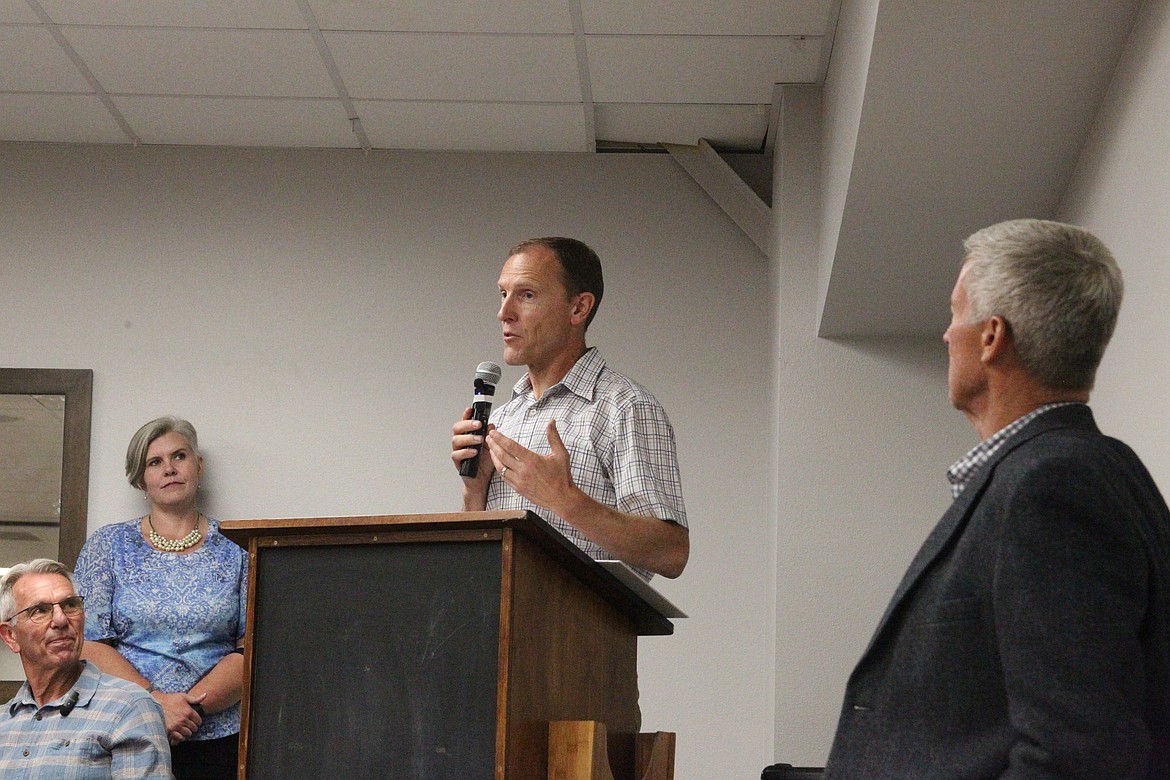
District 1 state senator Jim Woodward speaks at the Save Our Schools town hall.
Photo by JACK FREEMAN
PONDERAY — From rising school costs to potential drawbacks, a three-person panel consisting of educators and concerned citizens discussed House Bill 93 at a town hall Thursday evening.
The bill, passed last legislative session, directs $50 million in taxpayer funds to private school tuition through a tax credit of $5,000 per child and $7,500 per student with special needs. Save Our Schools, the organization who hosted the town hall, contends that the bill lacks oversight and accountability in how the money is spent.
The panel featured Jan Bayer, superintendent of Boundary County School District, who spoke about how the bill could affect her district. Marcy Curr, the town hall’s moderator, said that it’s her understanding that the district would lose $9,000 per year in funding for every student taken out of schools.
"I’m not opposed to parent choice,” Bayer said. “It’s just very difficult when we have to go out and beg the public for a supplemental levy and bond, that you can hardly pass, and we continue then to fight an uphill battle, and funds are diverted.”
The legislation faced heavy backlash and debate in the Idaho Legislature with detractors pointing to the similar programs in other states that have ballooned in scale and become a burden on the taxpayers. For example, Arizona’s voucher program is expected to cost the state around $1 billion next fiscal year, according to the Arizona Mirror.
Supporters of the legislation cite Idaho’s $50 million cap, which will prevent immediate out of control spending. However, Idaho Sen. Jim Woodward, R-Sagle, who voted against the bill last year, said at the town hall, he’s unsure how long that cap will stay in place.
"That’s the only tax credit I know of that has a cap on it,” the Idaho legislator said. “That cap will be challenged. If it’s not removed by the Legislature, that cap will be challenged in court I believe, so that cap will be removed.”
Woodward expressed his support for local public schools and noted the state has begun paying for school facilities as a step in the right direction. District 1 Rep. Mark Sauter, who also voted against HB 93, spoke and echoed many of the same sentiments as Woodward.
“I just didn’t think it was right that we would shift $50 million to something that’s estimated only 7-10% of our families may benefit from,” said Sauter, who serves in the Idaho House of Representatives. “Why are we just not shifting $50 million to everybody’s property tax? That would be a better way to shift it across the board... I thought we could use that money better.”
The panel was asked several questions from residents during the town hall, the first of which relating to the need for a strong public education system. One area resident asked if the panelists would be in support of a free market for education choices, which would allow parents to choose the best option for their student.
Education policy researcher and panelist Elizabeth Wargo said that not every parent has the time to search through a potential market. She pointed to Florida’s voucher system that has struggled to collect data because students are constantly moving schools.
"Anybody that’s ever had to switch a school for their kid knows it’s not an easy thing to do ... they’re doing it because it’s not working for them,” Wargo said. “More choice does not equal more quality.”
Another parent, who home schools his children, asked a question on why the school district’s costs are so high per student. He noted that the cost for a child in the district is more than double what he pays for his children to be home schooled at a local co-op.
Panelist Kim Keaton, former principal at Sandpoint Middle School, said that in his experience rural schools still carry big school costs which make funding complicated. Bayer agreed saying that the district’s costs have only risen and that they’ve had to turn to levies to continue funding their schools.
“We run five buildings, we bus over 750 miles a day, we have electricity, we have water, we have textbooks, we have desks. When the students don’t show up, those costs don’t go away,” Bayer said. "When there are changes in those state funds, it has shown to go back to local dollars with levies.”
Further discussion at the event related to how and what public schools in North Idaho are accommodating different student choices. Keaton said that the schools have made great leaps, citing Sandpoint High School’s new Carrer Technical Education building as a step forward.
If you’re interested in listening to the entirety of the Sandpoint town hall, it will be posted to local community radio station KRFY’s website in the coming days.
The event was a part of a series of town halls across North Idaho hosted by Save Our Schools. The series will continue Saturday with two events, the first in Priest River from 11 a.m. to 12:30 p.m. at West Bonner Library District and closing in the afternoon from 4 p.m. to 5:30 p.m. at Post Halls High School.
ARTICLES BY JACK FREEMAN

Outgoing POP executive director wins statewide award
That effort combined with the construction of nearly 20 miles of new trail and a new trail management plan has earned her the 2026 Professional Award for Parks, Trails, or Conservation from the Idaho Recreation and Parks Association.

APRIL NIBJ: Nonprofits help people follow their life’s compass
Kanning’s story isn’t unique, ask any worker at one of the 500 nonprofits in Bonner County are you’ll likely hear the same reason for working: it feels right.
Ponderay to begin Black Rock clean-up project
With the approval of a memorandum of agreement with Sandpoint on Wednesday evening, the city of Ponderay is now able to begin its Black Rock clean-up project next week.