
Hemorrhagic disease suspected in dozens of deer deaths
HAILEY SMALLEY | Hagadone News Network | UPDATED 6 months, 1 week AGO
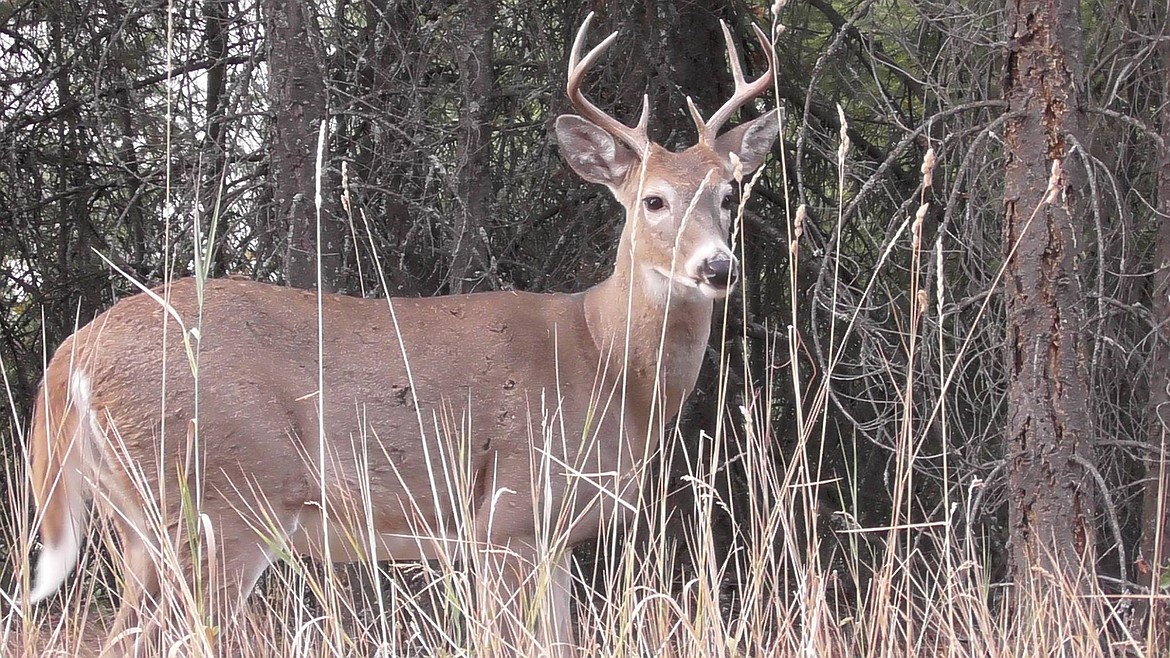
A white-tailed deer grazes off Blacktail Road on Wednesday. Deer are frequenting area roads and highways as fall arrives and the breeding season begins. (Scott Shindledecker/Daily Inter Lake)
State wildlife officials suspect hemorrhagic disease is behind a recent spate of white-tailed deer deaths near Eureka and Plains.
Montana Fish, Wildlife and Parks officials have received reports of about two dozen dead deer in the Eureka area and a dozen dead deer in the Plains area. While lab testing has yet to confirm a culprit, the timing points toward two well-known forms of viral hemorrhagic disease.
Both the epizootic hemorrhagic disease virus and the bluetongue virus are spread by small biting gnats that become especially active during the late summer and early fall. Most outbreaks of the diseases naturally subside once winter frosts set in and gnats become less abundant.
White-tailed deer are vulnerable to hemorrhagic disease, but mule deer, elk, pronghorn and bighorn sheep may also be affected. Hemorrhagic diseases are not transmittable to humans.
Infected animals suffer hemorrhages throughout the body, leading to rapid weight loss and dehydration. Other symptoms include swelling in the face and neck, excessive salivation, nasal discharge and fever. Death rates from hemorrhagic disease range from less than 25% to more than 90% of a population, depending on the size of the outbreak and the frequency at of the diseases in the area.
Hemorrhagic disease has been regularly observed in wild deer populations in western Montana since 2013. Some researchers believe a warming climate could expand the range of the gnats that carry hemorrhagic viruses, making outbreaks more common.
No treatments are currently available, though animals that survive the disease develop resistance to future outbreaks.
Montana Fish, Wildlife and Parks advised that meat from animals that appear healthy at the time of harvest is safe to eat when properly prepared. Hunters should avoid harvesting or consuming animals that appear sick.
Officials also noted that additional reporting of dead deer is unnecessary.
Reporter Hailey Smalley can be reached at 758-4433 or [email protected].
ARTICLES BY HAILEY SMALLEY
Winging it through winter: Rare Anna's hummingbird finds shelter in Bigfork backyard
The bird turned out to be an Anna’s hummingbird — a rare find in western Montana. The Montana Natural Heritage Program’s bird distribution database has logged only 158 sightings of Anna’s hummingbirds in the state, including 21 sightings in Flathead County.

Business groups sue to stop proposed ban on political spending in Montana
The Kalispell Chamber of Commerce is one of several organizations to file suit over a proposed ballot initiative to ban corporate spending in politics, arguing it infringes on the free speech rights of businesses.

Mexican man who led deputies on high-speed chase in Kalispell receives federal prison sentence
A Mexican national arrested after a high-speed chase through Kalispell in June 2025 received an 18-month sentence for illegal reentry in federal court last week.